

Your first Amazon scraper works. Design it to scrape product information, search results, prices, or retailer data and then write this data to your output of choice.
Then you scale it across more pages, marketplaces, and endpoints, and the problems start to arise: CAPTCHAs, incomplete responses, and data for a shopper somewhere else. These issues are handled by Amazon scraper APIs that manage access, retries, localization, and extraction through a single interface.
In this guide, we’ll explain how Amazon scraper APIs work, the main types available, and the best options for different workloads. We’ll also cover how to choose one and when building a custom scraper may still make sense.
Why is Amazon scraping hard?
Amazon pages can vary by marketplace, delivery location, session, and request type. A scraper will also need to deal with blocked requests, fluctuating responses, and page structure changes when scraping at scale.
- Anti-bot checks: Bot-management solutions (like AWS WAF) recognize automated traffic using a combination of signals such as browser fingerprinting, behavioral patterns, and request history. This can end up causing CAPTCHAs, throttling, or blocked responses.
- Endpoint coverage: Amazon data is extracted from product pages, search result pages, seller profiles, offers lists, reviews, category and variant rankings. Ensure that the API supports exactly the kind of page types your project will really require.
- Parsing changes: The layout of a web page and the place of fields on Amazon can change at any time, which will lead to broken selectors or incomplete record returns. That maintenance is lessened with structured APIs, which parse the response for you.
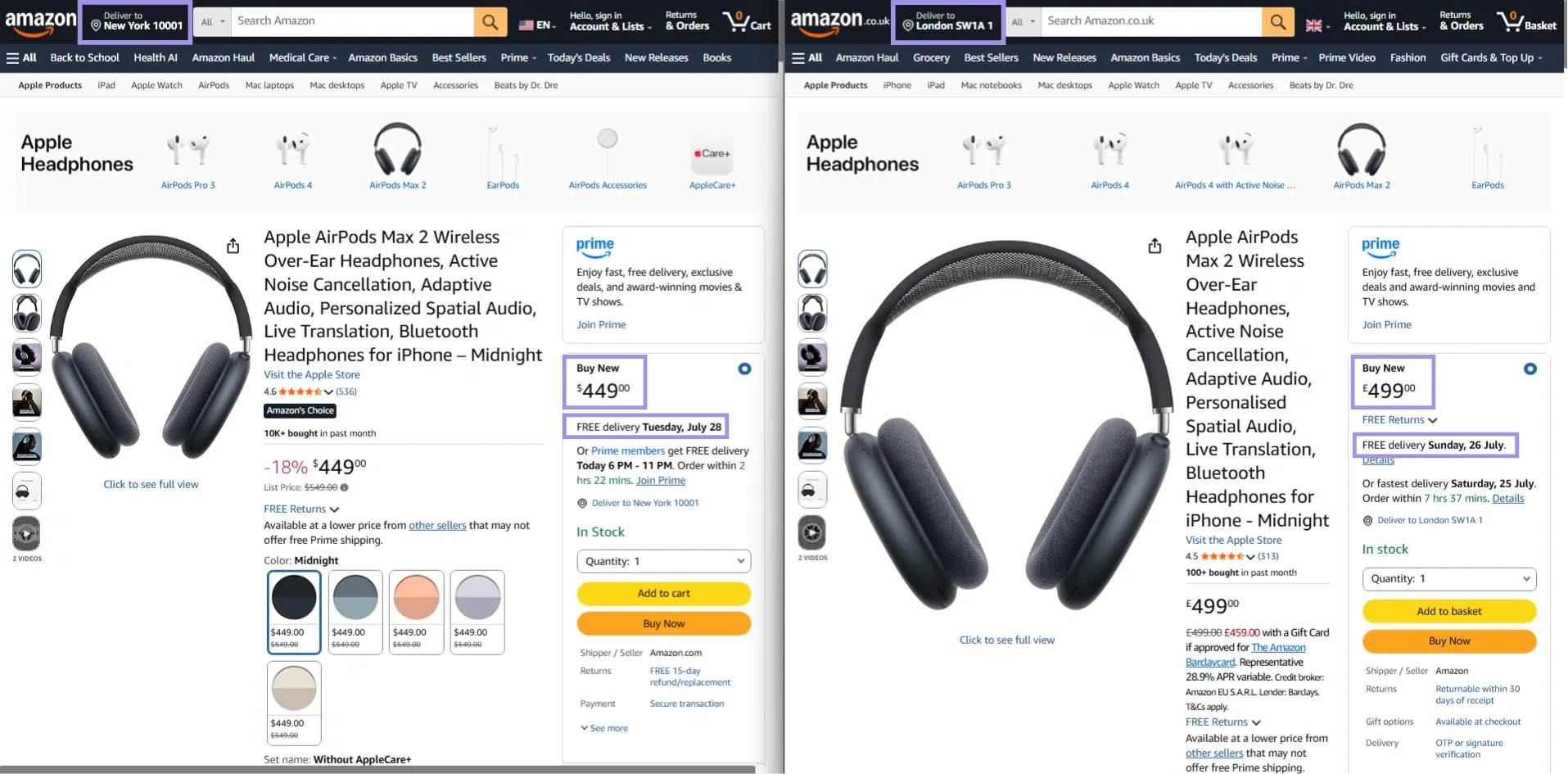
- Localized results: Price, seller, stock, and delivery estimate can all change based on marketplace and delivery location. General catalog collection may do fine with country targeting, but projects based on pricing and availability will likely require more precise control over locations.
- Review access: Dedicated review pages may require sign-in, leaving only a limited sample; the aggregate rating and star distribution remain visible on the public product page.
- Request costs: Rendering, premium routing, retries, and advanced parsing can increase the credits used per result, so the headline request allowance may not reflect the actual number of Amazon pages you can collect.
Types of Amazon scrapers
Amazon scrapers have six product categories, and choosing the right approach can matter as much as selecting the right provider. If you are weighing approaches rather than APIs alone, no-code Amazon scraper tools sit outside this comparison but solve some of the same problems.
- Dedicated Amazon APIs offer multiple pre-defined endpoints for products, search results, offers, sellers, reviews, rankings, and other Amazon page types. They return a JSON payload that is predictable and relatively easy to parse.
- General web scraping APIs accept Amazon URLs just like other targets. They control who can access and render the data, but may require users to specify extraction rules or construct an automated parser.
- Ready-made datasets offer a large number of pre-collected Amazon records. These formats are great for historical analysis, catalogue studies, and large exports where live collection is not needed.
- Custom scrapers with proxy infrastructure provide full control over requests, extraction, scheduling, and storage. They may reduce per-result costs at scale, but proxy performance and ongoing maintenance become your responsibility.
- Hybrid or mixed-method scrapers integrate managed services with pieces of your own stack. For instance, you could use an API for access and localisation while managing parsing, scheduling, or storage on your own. This gives you more control than a fully managed service but does not require you to build every layer from scratch.
- Amazon Selling Partner API (SP-API) is Amazon’s official API for sellers, vendors, and authorised applications. It grants access to account-level data like listings, inventory, orders, shipments, payments, and reports. But while this covers only data the seller or vendor can obtain with permission, it does not replace a scraper for public competitor listings, reviews, or results for specific shoppers. Sellers and vendors that only need to manage their own Amazon data may be able to use the Selling Partner API instead of an Amazon scraper.
Many managed APIs combine proxy routing, retries, rendering, and extraction within the same service. With custom scrapers, you have to provide and manage those layers on your own.
Best Amazon scraper APIs
We narrowed it down to five APIs, which we ranked according to their endpoint coverage, extraction options, localisation controls, pricing structures, and the workloads they suit.
Performance figures come from Proxyway’s 2026 benchmark, while feature and pricing details were checked against each provider’s official documentation. Results may vary by target page, marketplace, and configuration.
Pricing note: Most providers do not charge a fixed price for Amazon scraping. The headline numbers are nearly always for the basic command and not the true price you would pay once rendering, premium routing, or other capabilities are bundled.
| Provider | Type | Coverage | Performance | Pricing model | Best for |
|---|---|---|---|---|---|
| Oxylabs | Dedicated API | Product, search, pricing, sellers, best sellers, Q&A | 98.14% / 3.54s | Per successful result | Widest endpoint coverage |
| Decodo | Dedicated API | Product, search, offers, sellers, best sellers | 99.5% / 3.88s | Per request | Reliability on a budget |
| Zyte | General API + AI parser | Product pages and lists via extraction | 97.78% / 2.58s | Per response | Multi-site scraping |
| Bright Data | API + datasets | Products, pricing, reviews, sellers | Not benchmarked | Record-based | Enterprise datasets |
| ScrapingBee | Dedicated API | Search, product, pricing | 97.05% / 4.29s | Credits | Simple setup |
NetNut previously appeared in Proxyway’s comparison at 97.4%, but it is currently listed as unavailable.
Oxylabs: Best for Broad Amazon Endpoint Coverage
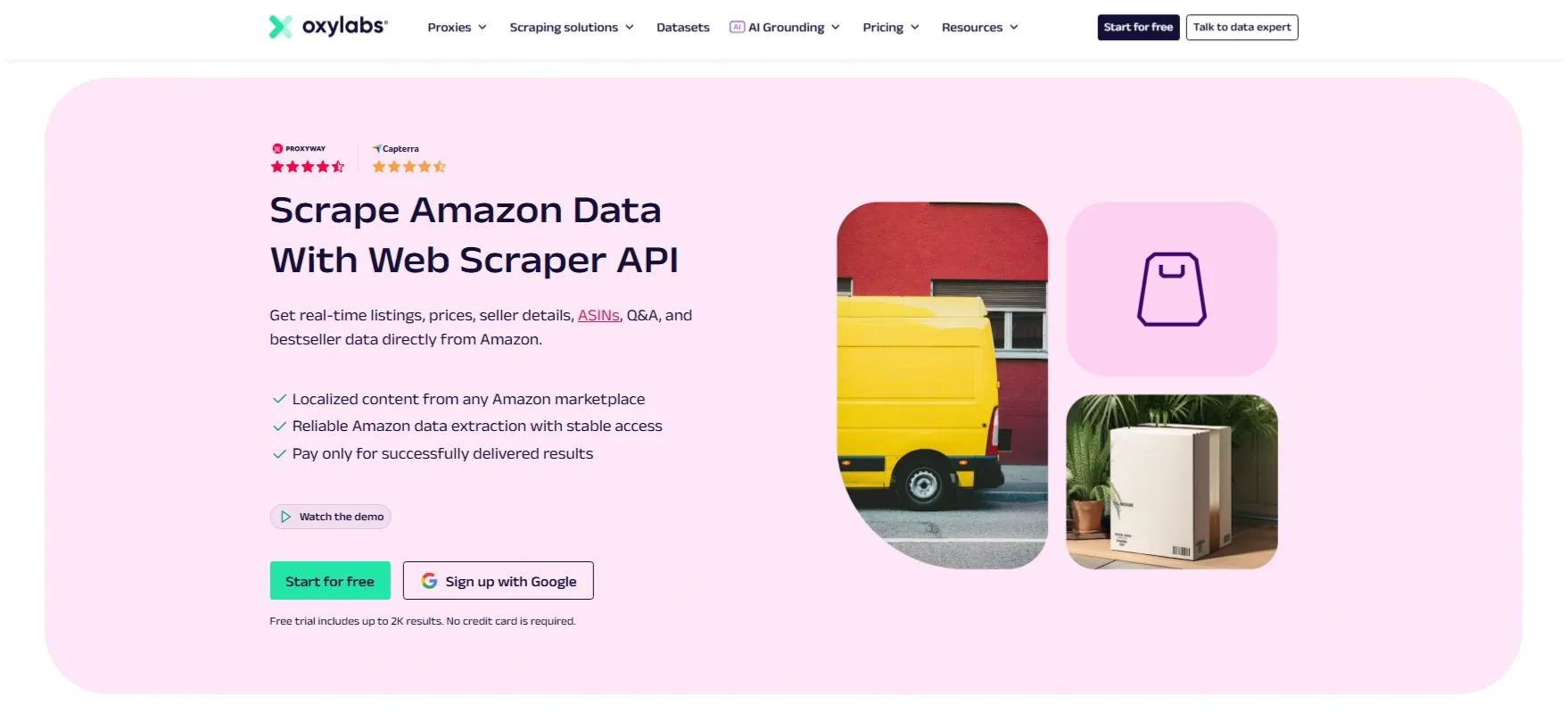
Oxylabs offers a dedicated Amazon source for products, search results, seller pages, pricing, best sellers, and Q&A. Among the alternatives that have been discussed here, this provides the most coverage of predefined endpoints.
You can return parsed JSON when you want ready-to-use fields or request raw HTML, Markdown, and screenshots when you need more control over the page output. It also supports parent ASINs and automatically chooses variants for listings composed of different size, color, or model combinations.
Features
- Specific sources for product, search, seller, pricing, best sellers, Q&A
- Parsed JSON, raw HTML, Markdown, and screenshot outputs
- Parent ASIN and automatic variation support
- ZIP-level targeting for delivery-area pricing and availability
- Billing based on successful results
Limitations
- No pay-as-you-go option
- Entry plans require a fixed monthly commitment
- May offer more endpoint depth than a small product-monitoring project needs
Base pricing: The $49 plan includes up to 98,000 Amazon results, while larger plans reduce the cost per 1,000 results.
Decodo: Best for Reliable Scraping at a Lower Cost
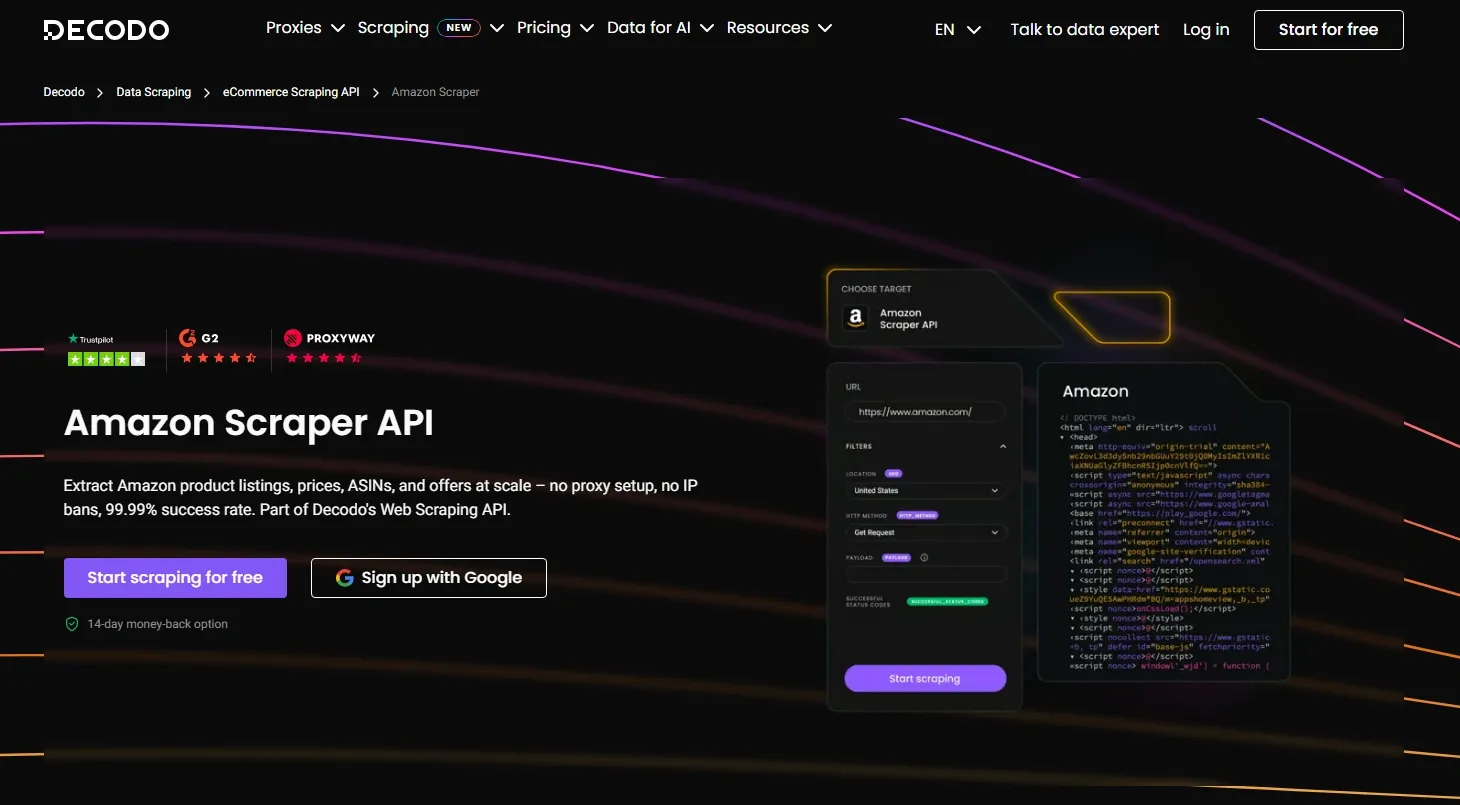
Decodo provides templates for Amazon product pages, search results, offers, seller pages, and best-seller listings. It provides structured output and can target marketplaces and delivery areas, completing all the page types required by many price-monitoring and catalogue projects.
Proxyway’s 2026 benchmark recorded a 99.5% success rate and a 3.88-second response time, giving Decodo the highest reported success rate among the APIs tested. It also divides its request tiers between basic requests, JavaScript rendering, and premium proxy routing so you can more easily see what features are driving costs.
Features
- Templates for products, search, offers, sellers, and best sellers
- 99.5% success rate in Proxyway’s 2026 benchmark
- ZIP-level targeting
- Separate pricing for standard, rendered, and premium-routed requests
- Free tier for testing a limited workload
Limitations
- No dedicated product-variations endpoint
- Not as extensive field coverage as the deepest enterprise-focused APIs
- Request costs increase with rendering and premium routing
Base pricing: Standard requests start at approximately $0.50 per 1,000, rising to around $1.50 when premium routing and rendering are combined.
Zyte: Best for Teams Scraping Amazon and Other Websites
Zyte is a general web scraping API, not an Amazon-specific endpoint library. You submit Amazon product, category, or listing URLs and use its automated extraction system to return structured data.
This is what makes Zyte a stronger fit for teams that are scraping Amazon with other sites and want one integration across their projects. Proxyway recorded a 2.58-second response time in its 2026 benchmark, the fastest among the tested APIs, and native Scrapy integration makes it easier to add to an existing Scrapy workflow.
Features
- Automated extraction from product, category, and listing URLs
- Fastest response time in Proxyway’s 2026 API benchmark
- Native Scrapy integration
- One API for Amazon and other websites
- Pricing based on difficulty level of request
Limitations
- No dedicated library of Amazon endpoints
- Lower Amazon field coverage compared to domain-specific APIs
- Location targeting stops at the country level rather than ZIP code
Base pricing: Prices are dependent on the level of difficulty with respect to requests, browser rendering, and complex targets.
Bright Data: Best for Deep Datasets and Enterprise Collection
Bright Data provides real-time Amazon scraping alongside ready-made datasets. Amazon products include product records, search results, sellers, reviews, and pricing; datasets contain record samples already collected in bulk.
The main distinction is depth. Bright Data can return detailed product records compared with simpler APIs, making it suitable for catalogue analysis, historical research, and enterprise projects that need many fields from each listing. The trade-off is that a more comprehensive extraction may take longer than creating a simpler product or running a search query.
Features
- Amazon APIs in production and previously collected datasets.
- Products, search results, sellers, reviews, and pricing coverage
- Extensive product-field extraction
- Pay-as-you-go and record-based billing options
- No charge for blocked requests
Limitations
- Deep extraction may have slower speeds than lighter APIs
- The volume of products and pricing options can be overwhelming for smaller teams
- Not ideal for tools that require immediate pricing responses
Base pricing: Pricing is record-based, with pay-as-you-go and promotional rates varying by dataset and collection method.
ScrapingBee: Best for Quick Setup and Smaller Projects
ScrapingBee offers a unique set of Amazon-dedicated endpoints for searching, products, and pricing. It features multi-seller offer support via its pricing endpoint, as well as ZIP-level targeting to localise prices, availability, and delivery estimates.
Its visual playground is the standout feature for beginners. You can build a request, test its parameters, and inspect the response before writing the integration. ScrapingBee does not charge a specific price for each Amazon result, but it uses credits, where rendering and premium routing can increase the cost of each query.
Features
- Dedicated search, product, and pricing endpoints
- Multiple seller offers through the pricing endpoint
- ZIP-level targeting
- Browser-based testing playground
- Free credits for initial testing
Limitations
- Slowest response time in Proxyway’s benchmark
- Unsuccessful requests can still use credits
- Credit multipliers can make the real request allowance harder to calculate
Base pricing: Plans range from $49 to $599 a month with between 250,000 and 8 million general credits.
How to choose an Amazon scraper API
Start with the kind of output your workflow needs. A structured JSON response saves development time, while raw HTML gives you more control over extraction.
For location-sensitive data, check whether the API supports ZIP or postcode targeting, or lets you pass the cookies needed to set a delivery location. Also confirm whether its structured output includes child variations under the parent product and automatically moves through multiple pages of search results or reviews. Otherwise, you may need to request each variation and page yourself.
Next, check how the service handles request billing. You should be able to pay per successful result, or on credit with increasing charges for rendering, premium routing, or other complex pages.
Check whether CAPTCHA handling and retries are covered by the normal request cost or use additional credits. You should also compare concurrency or rate limits and what happens when you exceed them, such as whether requests are queued, rejected, or need to be retried.
For larger workloads, check whether the provider offers asynchronous or batch endpoints that let you submit many ASINs without keeping every request active at once.
Check how compatible the API is with your stack. SDKs, batch requests, scheduling, and framework integrations can matter just as much as raw performance once the scraper is running in production.
Last but not least, test on a smaller scale using your own targets and page types. While benchmarks are a good way to cut down the list, checking against your own request will show if the API is reliable enough for production use and cheap enough for your workload.
Build your own Amazon scraper
When you have a long enough list of what you'd pay for, building is rational. Otherwise, you get unused endpoints, painful per-result pricing at your volume, or fields that managed APIs are unable to parse. The drawback is that when Amazon changes its markup, you have to own the parsers, retry logic, and every fix. For most teams, a managed API means less work.
A basic scraper can collect a few Amazon pages fairly quickly. The challenge begins once the scale of workload grows with more page types, locations, and repeat requests, because everything from access to parsing to retrying or consistency needs to work at scale. The Amazon product data scraping workflow shows what the initial build involves.
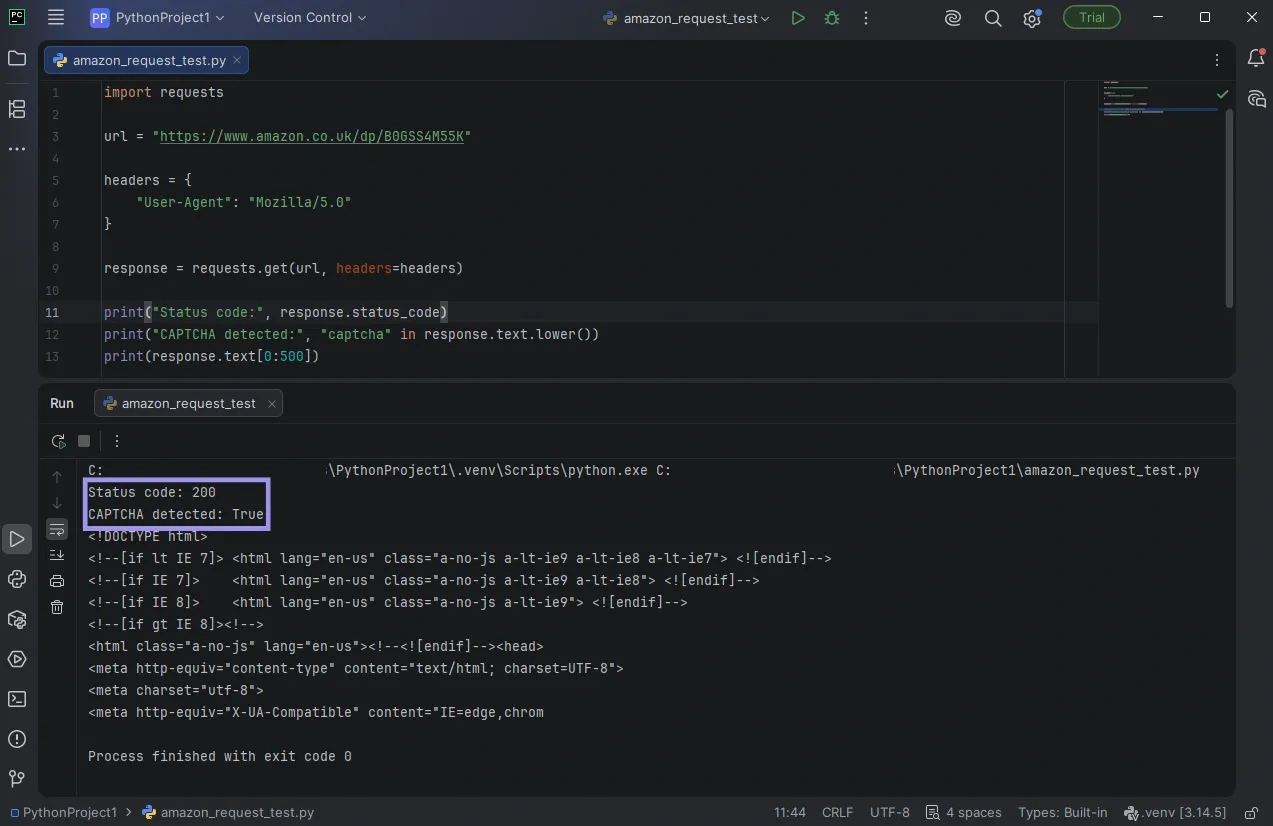
What actually breaks. Amazon observes request patterns per IP, and if it receives a large burst from an IP, it may throttle or block that IP. Even a robot-check page that only provides CAPTCHA HTML can still respond with HTTP 200; the parser will write empty fields, not an error. Similarly, TLS fingerprinting can distinguish automated clients whose connection patterns do not resemble a regular browser.
The proxy layer is one part of the setup: most managed APIs offer proxy routing, retries, and extraction together as part of their services, whereas for custom scrapers you have to handle these pieces yourself. A proxy pool helps balance requests across different exit IPs while allowing location targeting and session management. It depends on the page what type of proxy you need:
- Datacenter proxies are meant for low-stakes, high-volume jobs such as checking whether URLs of products stay alive, scraping public search results, or tracking category pages where speed and cost are more important than continual shopper connectivity.
- Residential proxies are the best choice for geo-sensitive requests like price, stock, seller-checking, and delivery estimate queries since they use consumer-network IPs that can support precise geo-targeting.
- ISP (static residential) proxies are a better fit when Amazon needs to see the same connection across repeated requests. Consider a price-monitoring workflow that returns to the same product and seller pages for a few minutes without switching IPs or resetting its session context.
- Mobile proxies can help with requests that need to resemble traffic from a smartphone on a carrier network. For example, they may be useful when checking how Amazon prices, availability, delivery options, or app-specific results appear to mobile users in a particular region. Mobile traffic is also quite a bit more expensive than other types of traffic, so it makes sense to keep it for pages or areas where residential proxies are not getting consistent results.
Since a slow proxy layer throttles throughput no matter how fast your code is, checking performance makes sense. Proxyway's 2026 market research measured 13 providers collectively on pool size, success rate, and response time.
In that research, Byteful recorded the fastest residential response time among the providers measured, at 0.41 seconds, and achieved an 81.23% success rate on tested targets, compared with a 74.43% median across Amazon, Google, and Instagram.
Configure rotation, routing, and validation
Start with rotation: use different IPs for independent requests, unrelated product or search pages. Use sticky session when there are multiple requests associated with the same workflow, since changing IP in the middle of a connection can break the consistency of the session.
Bandwidth also matters. Amazon pages may load images, scripts, and CDN assets that require residential routing at times. SmartPath will process requests in isolation and even relay valid traffic over datacenter IPs, allowing residential bandwidth to be preserved.
Before adding more scale, check that the exit IP corresponds with the desired region, returned prices match the defined marketplace or delivery area, and that the response contains real Amazon data and not a CAPTCHA page returning HTTP 200. The proxy tester can check the connection and exit location before you increase volume.
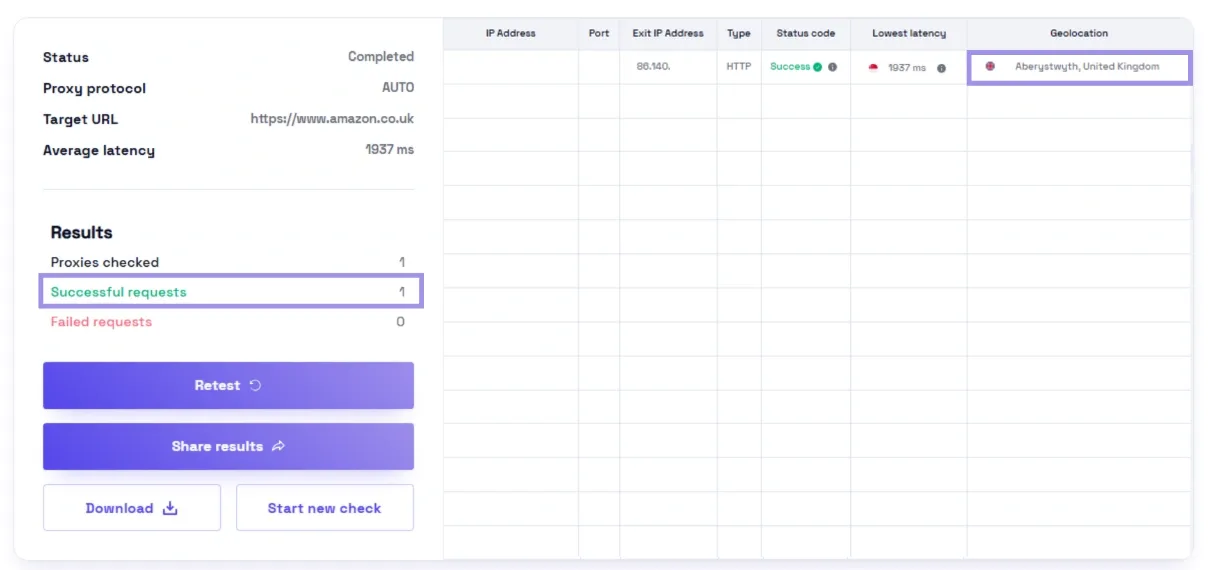
You can test the configuration with Byteful's free 1 GB residential data trial before scaling to larger workloads.
