

Are you finding it difficult to choose a proxy provider? With so many options and different features on offer, it is no easy task.
And as proxy providers and users ourselves, we fully understand both sides of that fence. Therefore, we have kept this comparison primarily based on reputed 3rd-party research (discussed later).
The criteria used in that study include pool size/coverage, unique IPs, response time, overall features, and performance against real-world targets, making the analysis rigorous and suitable as a benchmark.
Best proxy providers (2026) at a glance
Before you scroll down to the details, this table provides a bird's-eye view of all the important aspects across providers at once.
| Provider | Proxy Types | Geo Coverage | Base Pricing | Best for |
|---|---|---|---|---|
| Byteful | Residential, Mobile, ISP/Static Residential, Datacenter | Over 40M+ IPs covering 195+ countries, ZIP code-level targeting | $3.25/GB and $2.5/month (1 IP). Non-expiring bandwidth (residential and mobile). | High performance and bandwidth optimization with SmartPath AI routing |
| Oxylabs | Residential, Mobile, ISP, Datacenter | 175M+ IPs, global coverage | $11.80/month (20 GB) and $6.75/month (3 IPs) | Enterprise-scale data collection, high-volume workloads |
| Decodo | Residential, Mobile, ISP, Datacenter | 115M+ IPs across 195+ countries | $3/month (1GB) and $3.5/month (100 IPs). PAYG from $4/GB | General-purpose proxy users and AI/LLM workflows |
| Webshare | Rotating Residential, Static Residential, Datacenter | 80M+ IPs across 195 countries | $3.5/month (1GB) and $2.99/month (100 IPs). Free tier with 10 datacenter IPs | Budget-conscious users and beginners |
| ProxyEmpire | Residential, Mobile, Static Residential, Datacenter | 30M+ IPs across 170+ countries | $3.5/GB (PAYG) and $3.5/month (1 IP). Unlimited bandwidth from $200/day (100 Mbps) | Rollover bandwidth and granular geo-targeting |
| DataImpulse | Residential, Mobile, Datacenter | 90M+ residential IPs, global coverage | PAYG starting at $5 (10GB). Non-expiring bandwidth | Users needing consumption-based billing |
How to compare proxy providers?
Every landing page tells a convincing story about that (proxy) brand, each highlighting its own strengths. And we don’t denounce that strategy either, since customer acquisition (and retention) is the second most complicated thing after product development itself.
However, we have tried to keep this one clean of any marketing claims from any of the listed brands (including our own).
Instead, the following sections are mostly based on Proxyway's Proxy Market Research 2026. We were among the 13 participants who granted Proxyway access to our systems, allowing the study to take shape.
Proxyway’s research is based on critical metrics, such as pool size, download speed, IP quality, session persistence, and overall infrastructure performance against US-based servers of real-life targets, including Amazon, Google, and Instagram.
In their three weeks of testing, they sent a total of 5,200 requests (1 request per second) in three batches, conducted speed tests (for at least 10 IPs per brand), did 10k (for US) and 20k (global) IP quality checks, tested hundreds of sticky sessions for persistence, and more.
Ultimately, we see the study as a useful baseline for anyone shopping for proxy providers. However, we have also taken limited input from other sources, including the vendor's website and user feedback on G2 and Trustpilot.
Best proxy providers in 2026
Byteful: Ethically Sourced Residential With Smart Cost Routing
Byteful (formerly Ping Proxies) was probably the youngest of the lot and secured the Proxyway’s Newcomer of the Year 2026 award.
We were praised for our SmartPath AI, which auto-routes non-sensitive requests over datacenter IPs to save residential data. In our own tests conducted on 10,000 randomly selected pages, we found SmartPath to save up to 40% of bandwidth, with savings climbing to 60% (for requests to Reddit) without any reduction in connection success rate.
Key Findings
- The fastest residential proxies response time (0.41s) and the fastest mobile proxies response time (0.48s) globally.
- The best connection success rate of 81.23% (residential proxies) against real-world targets (Amazon, Google and Instagram).
- A global residential infrastructure success rate of 99.69%, higher than the 99.28% median.
- Even the 5% slowest requests (P95) responded within a second.
- Automatically sends non-essential requests over datacenter IPs to save residential bandwidth.
Pros
- Best-in-class dashboard (with ACL rules, live network activity, Zipcode-level geo-targeting)
- Strict KYC policy to avoid malicious use
- SmartPath AI-based routing at no extra cost
- 1GB free residential data trial
Cons
- Modest pool size compared to the competitors
- Lacks 24/7 human support
Base pricing: Monthly subscription starting at $2.5/IP. Non-expiring traffic from $3.25/GB.
G2/Trustpilot User Feedback Summary: Generally reported for a high-quality product experience and reliable customer support with quick response times. Some users also found the service expensive.
Oxylabs: Enterprise-Scale Data Collection
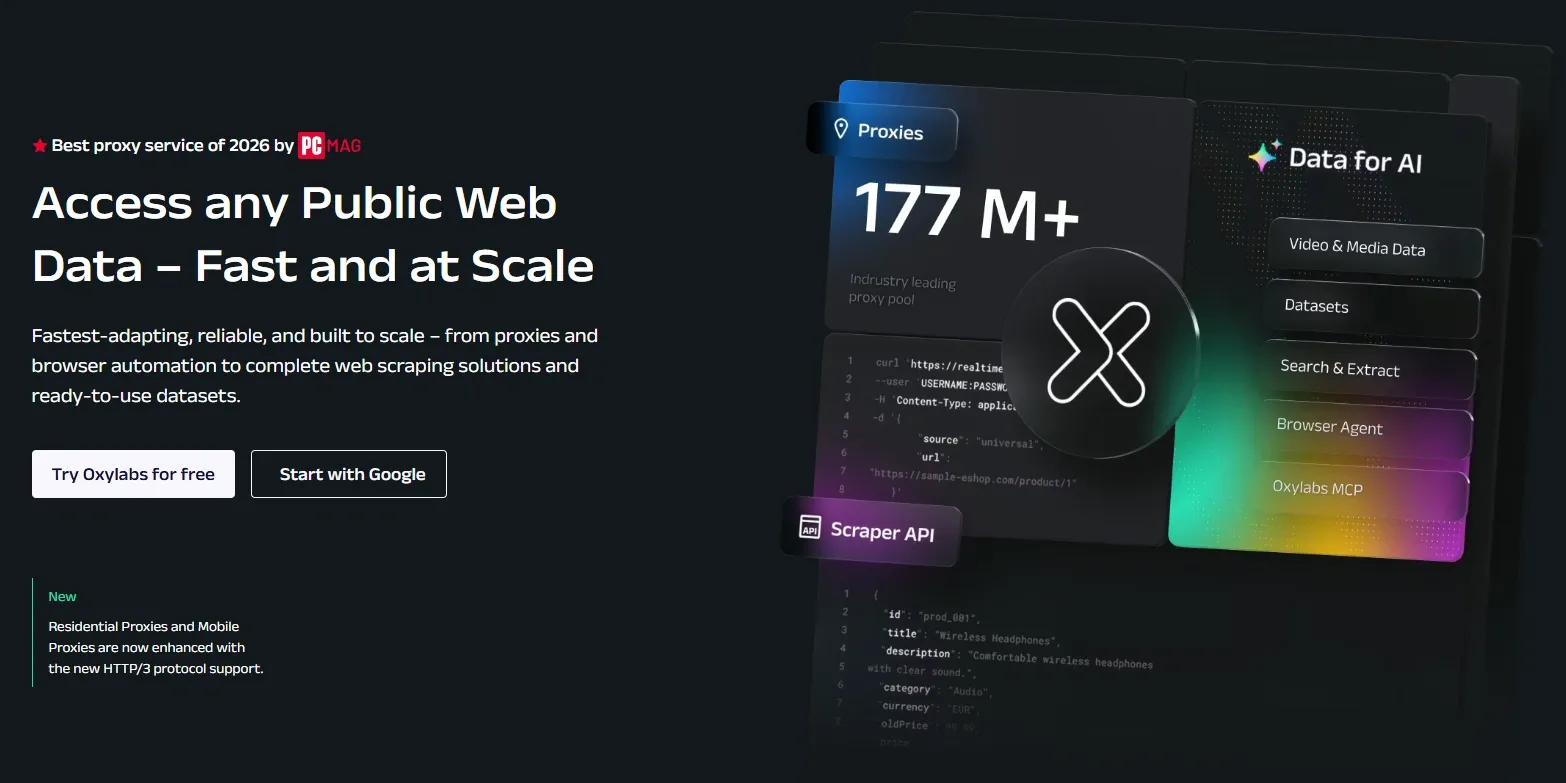
Oxlylabs is considered the market leader in the enterprise segment, along with Bright Data (non-participant). It had the biggest residential IP pool (exceeding 175 million) and the most unique IPs (3.6 million) among all participants at the time of Proxyway’s study.
In line with its size, Oxylabs bagged Proxyway’s Most Scalable Provider of 2026 award.
Key Findings
- The best infrastructure success rate of 99.93% and 99.84% for residential and mobile proxies, respectively
- Second-best infrastructure success rate and response time for datacenter proxies
- Over 95% mobile requests came from unique IPs in a global pool
- Comprehensive filters, including for OS and IPv4/IPv6
Pros
- Best infrastructure success rate and unique IP count
- One of the largest IP pools in the industry
- In-house scraping tools, such as a headless browser
Cons
- Sub-par average success rate (33.6%) against Google on mobile proxies
- Small datacenter proxy pool, considering the company size
Base pricing: Starts from $11.80/month (20 GB) and $6.75/month (3 IPs)
G2/Trustpilot User Feedback Summary: Praised for reliable performance, stable connections, and helpful customer service. Some users reported a high cost for base plans.
Decodo: All-Rounder Across All Proxy Types
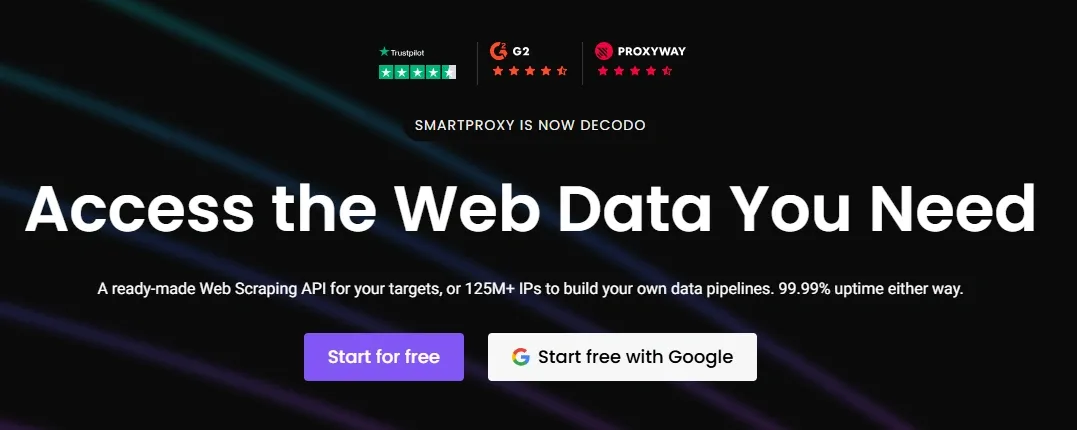
Decodo, dubbed the best all-rounder of 2026 by Proxyway, rebranded from Smartproxy in 2025. It boasts a decently sized pool of 115 million IPs across 195+ countries, with ASN-level targeting.
In addition to other features (discussed later), Decodo has been advertising a lot about LLM compatibility recently. Its AI-ready toolkit consists of natural language parsing, MCP-compatible clients-to-API connectors, scraping APIs, and its own n8n node.
Key Findings
- Second-best request success rates for residential (99.92%) and mobile proxy (99.75%) networks.
- Third-best residential success rate (80.14%) and the fastest mobile proxies response time (2.71s) against real-world targets
- Second best residential (0.53s) and mobile (0.74s) response times
- Third-best infrastructure success rate (99.94%) for datacenter proxies
Pros
- Great all-around option for regular users and enterprise
- Subscription and PAYG pricing
- LLM-readiness
Cons
- Subpar download speeds of US datacenter IPs (as tested by Proxyway)
- Low datacenter success rates (48.29%) against Amazon and Google
Base pricing: Starts at $3/month (1GB) and $3.5/month (100 IPs). PAYG at $4/GB
G2/Trustpilot User Feedback Summary: Majorly reported for intuitive interface and great performance through all proxy types. Issues with ID verification, constant timeouts, and unclear responses from sales teams were also mentioned, however.
Webshare: A Free Tier and Self-Serve Datacenter
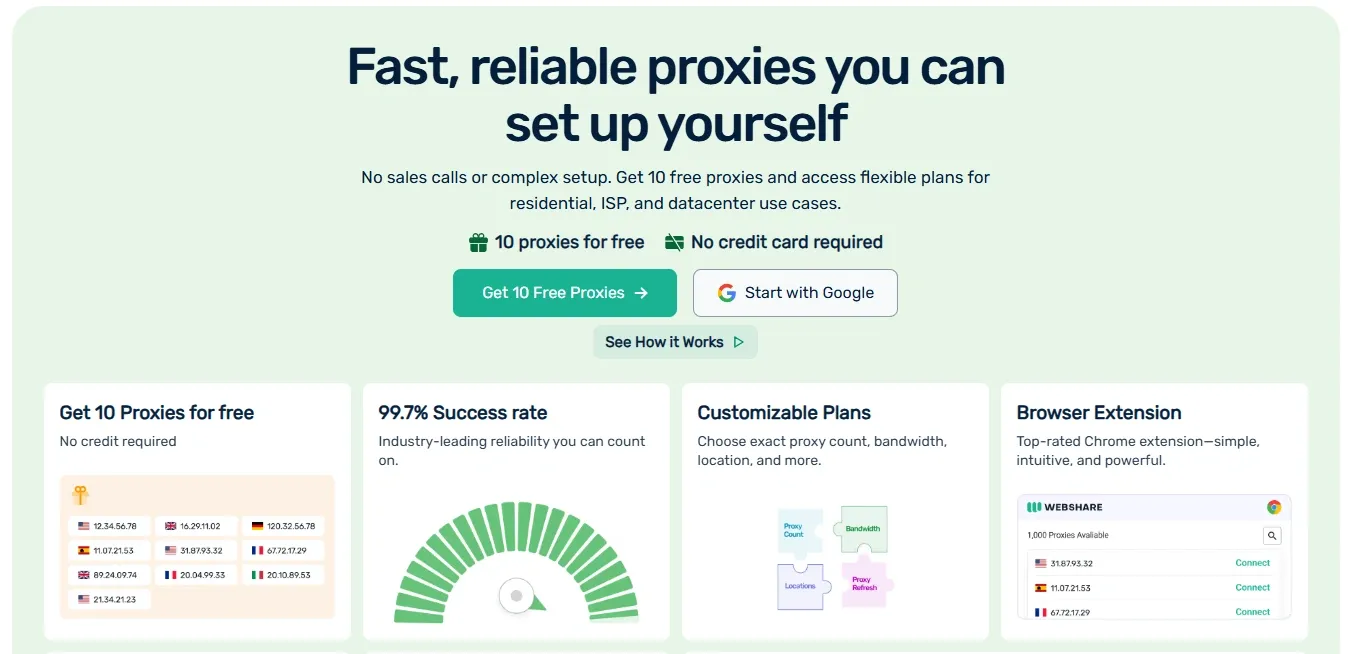
Webshare stands out for its free tier (datacenter IPs) and is one of the most beginner-friendly providers, offering proxy servers, static residential proxies, and rotating residential proxies.
The pricing is also budget-friendly. However, the Proxyway report clearly shows that anyone’s best bet with Webshare is its datacenter proxies, as Webshare’s residential performance is modest compared to the industry elite.
Key Findings
- Decent mid-tier performance with 99.28% residential infrastructure success rate and 0.86s response time
- An average residential success rate of 74.03% and a 3.27s response time against real-world targets
- Fourth-largest datacenter success rate of 99.93%
- The best datacenter success rate (79.84%) against Amazon and Google
Pros
- Budget-friendly pricing
- Forever free 10 datacenter IPs
- Excellent datacenter performance
Cons
- No mobile proxies
- Mediocre residential performance
Base pricing: Starting at $3.5/month (1GB) and $2.99/month (100 IPs).
G2/Trustpilot User Feedback Summary: Praised for good customer service and overall satisfactory performance. A few users also pointed out slow speeds and limited geographical coverage.
Note: Webshare has been part of Oxylabs since 2022.
ProxyEmpire: Check Active IPs Upfront
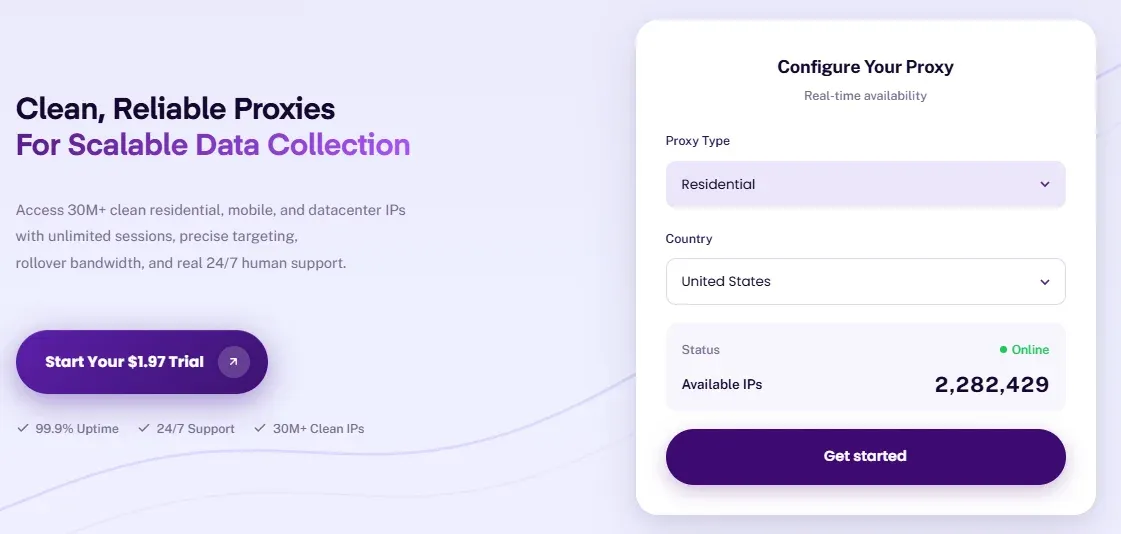
ProxyEmpire's differentiator is its bandwidth rollover and that it enables its prospects to verify active IPs per country on its home page before buying anything. Overall, it has over 30 million proxy IPs and sells major proxy types, including residential, static residential, datacenter, and mobile.
You also get deep geo-targeting support and flexible IP rotation policies, making ProxyEmpire worth your attention.
Key Findings
- Country, region, city, ZIP, ISP, ASN, and OS fingerprint targeting
- Per-request and time-based (up to 2 hours) IP rotation
- Unlimited concurrent sessions
- HTTP(S), HTTP/2, and SOCKS5 support
- Username-password authentication
- Team access, granular access controls, and 2FA
- (Optional) API-led proxy management
- Android app and Chrome browser extension
- 24/7 chat support
Pros
- Bandwidth rollover
- Pay-as-you-go residential plans
- Unlimited-bandwidth residential plans
Cons
- Lacks UDP support
- No IP whitelisting
Base pricing: Starts at $3.5/GB (PAYG) and $3.5/month (1 IP). Unlimited bandwidth $200/day (100 Mbps).
G2/Trustpilot User Feedback Summary: Users have reported prompt customer service and decent performance. However, some Trustpilot reviews complained about DNS and IP geolocation mismatch.
Dataimpulse: Flexible IP Options and Budget-Friendly

DataImpulse is an interesting addition to this mix, thanks to its multi-tiered residential proxies and PAYG pricing. Also, this is one of the only ones on this list with non-expiring, bandwidth-based datacenter plans rather than per-IP subscriptions, as seen with other providers.
All this and more helped DataImpulse win the Best Flexible Provider 2026 award from Proxyway.
Key Findings
- Third-highest residential (99.82%) and datacenter (62.36%) infrastructure success rates
- Fastest residential proxies against real-world targets with a 2.58s response time
- Highest average success rate (85.31%) for mobile proxies against Amazon, Google, and Instagram.
- 90 million residential pool, with a +500% YoY change.
Pros
- In-house bandwidth sharing app for sourcing IPs
- User-friendly data usage policies
- Decent mid-tier performance for the price
Cons
- Premium residential proxies are expensive
- Proxyway-reported performance of standard residential proxies is mediocre
Base pricing: Starting at $5 PAYG (10 GB).
G2/Trustpilot User Feedback Summary: Multiple users reported affordable pricing and reliable performance. However, some Trustpilot reviews mentioned higher detection rates and unaccounted-for data usage.
Which proxy is best for your use case?
The following sections will help beginners make the right call in choosing the correct proxy type against their specific task at hand.
Residential Proxies: These IPs are owned by real-world users, and they share their bandwidth willingly (at least in ethically sourced proxies like ours) in exchange for financial rewards.
The primary perk of using a residential proxy is greater anonymity and geographical coverage, which makes it a perfect match for stealth and geo-sensitive tasks. Therefore, you can use them for things such as social media data collection, search engine scraping, or anywhere else where you’ve faced blocks with datacenter IPs.
If you’re interested, you can try them with Byteful's free 1GB residential proxy trial.
ISP/Static Residential Proxies: This offers a middle ground between datacenter and residential proxies. While they are owned by ISPs, static residential proxies provide datacenter-like performance.
Since they offer static IPs linked to residential ASNs, they are better suited to sensitive targets than datacenter IPs. Likewise, they don’t rotate IPs like residential proxies do, which helps them bypass security systems that spot proxies by IP rotation.
You can try them for tasks such as ad verification and social media management, and broadly, wherever session continuity is a critical parameter.
Mobile Proxies: These are a subset of residential proxies and are owned by users of cellular devices, such as smartphones and tablets. And since a mobile IP address is shared by many users, blocking it becomes increasingly difficult and impractical.
This makes mobile proxies harder to detect and gives you the best chance of bypassing modern-day web defences. On top of that, mobile proxies also provide you with ASN-specific coverage and excellent stealth.
Use them for highly sensitive targets, including social apps, e-commerce, and any mobile-first platforms.
Datacenter Proxies: These offer best-of-the-lot speeds due to their datacenter origin and are optimally suited against low-risk bulk work. They are often sourced and sold in great numbers.
But use them against any sophisticated target, and you will get blocked in no time. The reason is that datacenters publish their IP addresses openly, such as this AWS IP address range. To make it worse, there are aggregators of such IPs, such as MaxMind and IP2Location, which developers can simply subscribe to and plug into to block these proxies at scale.
We would recommend deploying datacenter proxies against public databases or internet testing.
How much do proxies cost?
Proxies are billed based on their types. For instance, datacenter and static residential proxies are generally purchased per IP address, with no stated bandwidth cap. On the other hand, residential and mobile proxies are charged per GB of data they consume in connections and connection failures.
Ultimately, it’s not much of an issue for IP-based billing (datacenter and ISP proxies) unless you’re hitting fair usage limits, which again vary among providers.
For residential and mobile proxies, determining the cost depends on accurately estimating how much bandwidth a specific task will consume. And this is way more complex than it sounds.
For one, you need to find the data consumption per request and response, then multiply it by the total number of requests you're going to send.
You can start with a tool such as this web page size checker. This will provide the sizes of the raw HTML and the entire webpage (including images, videos, and JavaScript).
For a simple page, the difference between these two formats can be huge (30-50x). For instance, Forbes' homepage was just 130.05 KB for the HTML, but it came out weighing 6.38MB for its entire page.
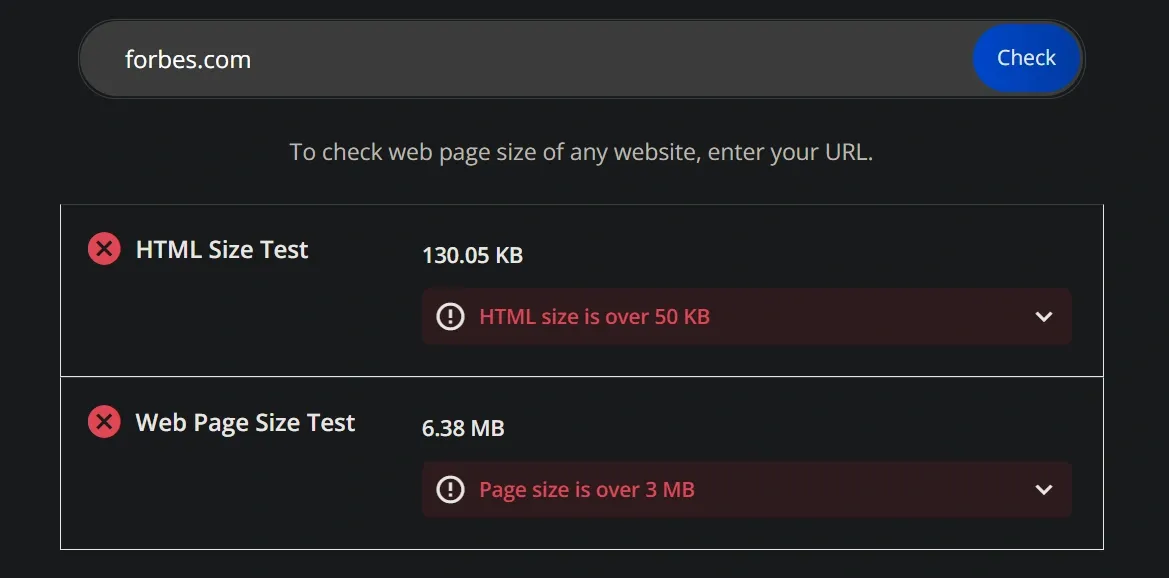
Therefore, the total bandwidth cost depends on which format you’re scraping in. In addition, for scraper APIs, the bandwidth costs of fetching raw HTML can exceed the actual data size because the proxy provider might be handling JavaScript rendering on their end to make the request more natural.
Furthermore, connection failures also consume some data (before getting blocked), which varies per request.
Finally, there is no accurate method to predict proxy costs other than running the actual workflow against that specific target. This will give you a good range to estimate actual proxy spend. Therefore, we recommend small-scale testing using trial data, such as our free 1GB residential bandwidth, to get a realistic cost-versus-task picture.
How to avoid bad proxy providers?
False advertising, subpar performance, poor customer support, and misleading claims are way too common in the proxy industry for anyone to admit. And there is no clear answer to how to avoid a bad proxy provider other than experiencing it yourself.
That said, the following sections will give you a solid head start in sifting away the bag guys upfront.
Ethical IP sourcing
There are multiple specific ways to source (residential) IPs, including publicly disclosed partner programs, provider-led self-sourcing, and malicious methods that trick unaware users into giving up their bandwidth. Proxy users must ask the provider and search the provider's website for clear information about their proxy sourcing framework.
We recommend that users take ethical sourcing as the absolute baseline and reject a provider with no clear and published answer to how they obtain proxies for their pools.
KYC and compliance
KYC, though it seems inconvenient from a user standpoint, actually does good for the genuine customer base. This limits malicious use and, in turn, helps keep the IP pools cleaner than they would be in an entirely non-KYC environment. Major industry players, including us, KYC our users to maintain high performance and compliance standards.
Another important point is to confirm if the proxy provider complies with security frameworks, such as ISO 27001 and SOC 2. This helps the user know whether the provider adheres to international data-handling standards and whether the data is protected from unauthorized access.
Pool size and quality claims
Instead of taking the raw pool-size claims at face value, we suggest determining how many of those IPs are unique. But since it’s difficult for regular users to research these numbers, 3rd-party studies such as Proxyway’s market research come in handy.
Also, it’s always good to run a few of those IPs against IP reputation checkers. The IP reputation checker we just linked also tells of the IP type. You should check it with a small sample, as some providers also publish misleading claims about the IP category.
Trials/Refunds
A first-hand trial tells way more than you trying to consume every bit of information about a specific provider on a 3rd-party platform. This makes free trials, like our free 1GB residential data, priceless to evaluate your options.
And while a completely free tier might sound great initially, the experience is generally poor because of the low-quality IPs supplied to entirely free users.
In the absence of a free trial/tier, the next best approach is to check if there is a good refund policy. One should also check UGC platforms such as G2 and Trustpilot to see whether the provider actually honours refund requests.