

Choosing the best proxy server for your specific game isn’t straightforward, since you need to figure out a proxy that provides lower latency, geo-targeting, and, above all, excellent uptime.
We have cherry-picked only a few proxy providers that could meet the technical criteria for gaming and have a strong overall reputation.
Best proxy servers for gaming: at a glance
Compare the best gaming proxy servers based on their SOCKS5 UDP support (explained later), trial availability, entry-level pricing, and more.
| Provider | SOCKS5 + UDP | Residential sticky sessions | Trial | Entry price |
|---|---|---|---|---|
| Byteful | ISP & DC | Up to 24h | 1 GB free residential data | From $2.50/IP/mo |
| IPRoyal | ISP & DC | Up to 7 days | 24-hour ISP plan | From $1.57/IP/mo |
| NodeMaven | ISP only | Up to 24h | $3.50 (residential and mobile IPs) | From $4.99/IP/mo |
| Decodo | ISP & DC | Up to 24h | 3-day, 100 MB | From $3/IP |
| Oxylabs | ISP & DC | Up to 24h | 7 days (registered companies) | From $6.75/mo |
Best proxy servers for gaming in 2026
Proxy providers can offer dozens of features unrelated to a gamer. Therefore, we were careful enough to present only the aspects that matter the most. In a nutshell, Byteful is great for overall performance, IP Royal for their 24-hour plans, and Nodemaven for their upfront IP reputation checks. Later sections discuss each provider in detail.
Byteful: Best for low latency gaming
Byteful is known for its slick performance and intuitive interface in the entire proxy industry. Proxyway recently recognized Byteful in its 2026 research covering 13 popular proxy providers, where Byteful outperformed industry giants, including Oxylabs and Decodo, on multiple fronts. Byteful topped the charts for residential (0.41s) and mobile (0.48s) proxy network response times, real-world success rates (81.23%), and latency consistency (P95 < 1 second).
Key features
- Full SOCKS5 UDP support for ISP and datacenter proxies
- Country, region, city, ZIP code, and ASN-level geotargeting
- 99.991% Historical uptime and 24/7/365 monitoring
- Dedicated IPs (ISP and datacenter both)
- Residential proxies sticky sessions (up to 24 hours)
- Premium carriers including AT&T, Comcast, Deutsche Telekom, Spectrum, and Virgin Media
- Username/password and IP-based authentication
- Unlimited concurrent sessions
- Residential IPs covering 195+ countries
- 1 GB free residential data trial
Limitations
- Datacenter geographic coverage is modest comparatively
Base pricing:
- Residential proxies: $3.25/GB
- Mobile proxies: $4.25/GB
- Static residential proxies: $3.5/IP/month
- Datacenter proxies: $2.5/IP/month
G2/Trustpilot user sentiment: High performance and quality customer support. Can feel expensive.
Note: By default, Byteful accepts proxy connections only to domain names. Game clients often connect to servers by IP, so those connections can fail. Enable remote DNS on SOCKS5, or contact our support team to unlock direct IP access after KYC verification.
IPRoyal: Best for good ISP coverage

IPRoyal is another one fit to function as a gaming proxy because of its SOCKS5 UDP support for its static residential and datacenter products. Furthermore, it provides decent geo-targeting, 24/7 customer service, and a good 195+ country footprint to help any gamer connect from their desired location.
Key features
- 500K+ unique ISP IPs in 31+ countries
- Dedicated ISP and datacenter IPs
- No limit on concurrent sessions
- Username/password or IP whitelisting
- Country, state, and city-level geo-targeting
- Residential rotating and sticky sessions (up to 7 days)
- 24-hour ISP plans
Limitations
- Expensive residential plans
Base pricing:
- Residential proxies: $7/GB
- Dedicated mobile proxies: $10.11/day
- Rotating mobile proxies: $6.80/GB (2 GB plan)
- Datacenter proxies: $1.57/IP/month
- ISP proxies: $1.80/IP/day
G2/Trustpilot user sentiment: Easy to set up and onboard. Limited geo-location support.
NodeMaven: Best for upfront IP reputation checks
NodeMaven is a mid-weight proxy provider, presenting its ISP proxies to gamers. This particular proxy type features UDP support, which is critical for live multiplayer games, such as fast shooters. As of this writing, NodeMaven ISP proxies are available in 9 countries.
Key features
- Dedicated IPs with country-level geo-targeting (ISP proxies)
- Same ISP IPs across renewals
- 30million+ residential IPs across 190+ countries
- Sticky sessions (up to 24 hours)
- Unlimited concurrent sessions
- Real-time IP reputation check
Limitations
- Absence of long-term ISP plans and no datacenter proxies
Base pricing:
- ISP proxies: $4.99/IP/month
- Residential proxies: $8.5/month (2GB plan)
- Mobile proxies: $8.5/month (2GB plan)
G2/Trustpilot user sentiment: Good quality residential proxies and customer service. ISP IPs can be unreliable.
Oxylabs: Best for enterprise gaming studios
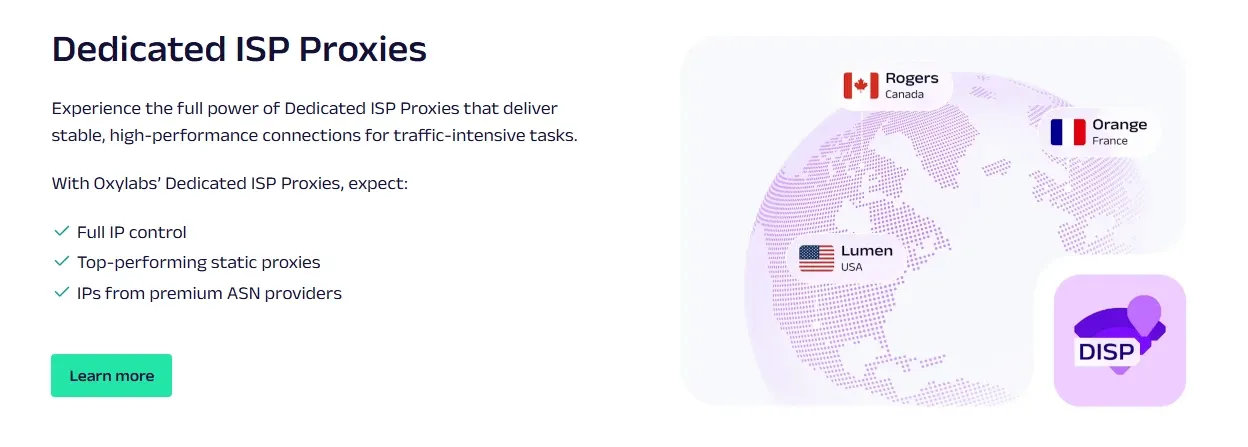
Oxylabs mainly caters to enterprise customers and is one of the biggest players in the entire industry. Similar to others on this list, Oxylabs has also listed SOCKS5 UDP support for its ISP and datacenter proxies. As of this writing, its proxy network includes 25 ISP locations and datacenter proxies across 44 countries, making it one of the largest on this gaming proxy list.
Key features
- SOCKS5 UDP support on ISP and datacenter proxies
- ISP ASNs include AT&T, Comcast, BT Group, Lumen, etc.
- Unlimited duration ISP sessions
- Fair usage cap of 50GB/month/IP (ISP proxies)
- Username-password or IP whitelisting
- Multi-tiered (shared and dedicated) datacenter proxies
- Up to 24 hours sticky sessions (residential proxies)
- 24/7 Live chat
Limitations
- A few gaming targets, such as PlayStation and Steam, are restricted on ISP and dedicated datacenter proxies
Base pricing:
- ISP proxies: $16/month (10 IPs)
- Datacenter proxies: $6.75/month (3 IPs, dedicated), $12/month (10 IPs), $11.80/month (20 GB)
- Residential proxies: $30/month (5GB)
- Mobile proxies: $30/month (4GB)
G2/Trustpilot user sentiment: Helpful customer support and good geo-targeting success rate. Expensive base plans.
Decodo: Best for flexible subscriptions
Decodo has a good spectrum of gaming proxies, which includes its ISP, datacenter, and residential proxies, with varying ownership (dedicated and shared) and payment types (per-GB and per-IP). The catch is, however, SOCKS5 UDP is limited to ISP and datacenter proxies purchased with per-IP and per-GB plans.
Key features
- ASNs include Verizon, Orange, AT&T, Tele2, etc.
- Username/password authentication or IP whitelisting
- Flexible pricing structure (per GB, per IP, or dedicated IP)
- Residential proxies in 195+ locations
- Up to 24 hours sticky residential sessions
- Country, state, city, ZIP, and ASN-level geotargeting (residential IPs)
- 3-Day free 100MB trial
- 24/7 support
Limitations
- Comparatively short sticky session duration (residential proxies)
Base pricing:
- Static residential proxies: $9.99/month (3 IPs, dedicated), $3/GB, or $4.7/month (10 IPs)
- Datacenter proxies: $5.55/month (3 IPs, dedicated), $6/month (10GB), or $3.5/month (100 IPs)
- Residential proxies: $11.25/month (3GB)
- Mobile proxies: $7.5/month (2GB)
G2/Trustpilot user sentiment: Reliable service and great customer support. Expensive entry-level plans.
What can and can't a proxy do for gaming?
Using a proxy is not a surefire solution in some gaming cases. While you can mask your IP and access location-restricted content, it can affect the overall gameplay either way, as explained subsequently.
Can a proxy reduce ping?
Ping is sometimes used interchangeably with latency, with the latter being a more appropriate term. Think of latency as distance in the digital networking realm.
Without a proxy server, your internet service provider connects directly to the game server. Ideally, this should be the minimum latency path, but only if your internet service provider uses an optimal route. However, when that doesn’t hold true, a proxy can indeed reduce latency. Therefore, start by picking proxy servers closest to the gaming server’s geographical location.
Also, a proxy that's unoptimized or farther from your game server can increase latency. However, it’s very complicated and nearly impossible to test and get the exact latency numbers (you to gaming server via proxy and back), even if you have trials for all proxy servers. Ultimately, the best practical way around this is to subscribe to trials or entry-level plans and test the games themselves.
Proxy vs VPN vs GPN
Proxy, VPN, and GPN are three different technologies. Among them, GPN services are designed for reducing gaming lag by routing gaming traffic through optimized paths.
Proxies, on the other hand, can help you bypass location-restricted content. They still might win over GPNs if you’re not playing live games or a specific title isn’t GPN-supported yet. But VPNs, because of their design, are the least gaming-appropriate option of the three. The following table compares them head-to-head.
| Technology | Main purpose | Changes public IP | Designed for gaming? | Traffic coverage |
|---|---|---|---|---|
| Proxy | IP masking, geo-spoofing | Yes | No | Configuration-based, application traffic to whole device |
| VPN | Privacy and encrypted tunneling | Yes | No | Configuration-based, but generally the entire device |
| GPN | Optimize game traffic routing | Not necessarily | Yes | Game data |
Gaming proxy requirements
A few networking things need clarification if you want to tell apart a good gaming proxy provider from another. Among them, the important things are SOCKS UDP support and residential sticky sessions.
SOCKS5 and UDP support
Most multiplayer games prefer UDP (User Datagram Protocol) over TCP (Transmission Control Protocol) for transmitting game data for various technical reasons, including good responsiveness and overall efficiency. And since HTTP(S) proxies and older SOCKS versions are conventionally designed around TCP, the present best case is opting for a proxy provider with SOCKS5 UDP support.
Even single-player games can route some data over UDP, making a SOCKS5 UDP proxy a better fit overall. That’s why we have featured only those providers in the above sections that could qualify for this particular criterion.
Static or sticky IPs
Static sessions are generally preferred for gameplay, since IP changes mid-session can trigger inconsistencies and potential blocks. This requirement makes static residential (ISP) proxies the best candidate, followed by datacenter proxies as the low-budget alternatives.
Residential or mobile proxy IPs, in contrast, don’t provide the stability needed for gaming since they are indirectly controlled by real user devices. These users can go offline at will, which can be troublesome for your gameplay. However, we still recommend residential proxies with sticky sessions (same IP for a set duration) for unlocking location-based offers since their geographic coverage is usually superior.