


Aggressive anti-bot systems, repeated CAPTCHAs, and instant IP bans are what send most people looking for residential proxies in the first place. Though a tad bit pricier, residential IPs route requests through real consumer connections, making them the safest bet against sophisticated anti-bot defenses.
That said, finding the best residential proxies is not straightforward. You need to be really careful, as there are many aspects and even more proxy providers to consider. Keeping that in mind, we have designed this well-researched compilation that highlights residential-related offerings from industry leaders, which will surely help you make the right pick.
Best residential proxy providers in 2026 at a glance
| Feature | Byteful | Decodo | NodeMaven | Bright Data | ProxyEmpire | Oxylabs | SOAX | DataImpulse | IPRoyal |
|---|---|---|---|---|---|---|---|---|---|
| Base price | $3.25/GB (PAYG) | $11.25/month (3 GB), $4/GB (PAYG) | $8.5/month (2 GB), $10 (2GB, PAYG) | $4/GB PAYG, $499/month (141 GB) | $3.50/GB (PAYG), $200/day (unlimited data) | $30/month (5 GB) | $25 top-up, credits validity 60 days (from $2/GB) | $5 (Regular, 5 GB, PAYG), $5 (Premium, 1 GB, PAYG) | $7.35/GB (PAYG) |
| Never-expiring bandwidth | Yes | No | No | No | Yes | No | No | Yes | Yes |
| Geo-targeting | Country, State, City, ZIP, ASN | Country, State, City, ZIP, ASN | Country, City, ISP, ZIP | Country, City, ZIP, Carrier, ASN | Country, region, city, ZIP, ISP, ASN, and OS fingerprint targeting | Country, State, City, ZIP, Coordinates, ASN | Region, City, ASN | Country, State, City, ZIP, ASN | Country, State, City |
| Sticky sessions | Up to 24 hrs | Yes | Up to 24 hours | Yes | Yes | Configurable | Custom | Up to 120 mins | Up to 7 days |
| Free trial | 1 GB | 100 MB / 3 days | 750 MB for $3.50 | N/A | Paid trial ($1.97) | On request | Sandbox credits | N/A | N/A |
| Highlight Feature(s) | Fastest network, never-expiring data, and Smartpath AI | AI workflows and LLM tooling | IP quality filtering and precise geo-targeting | Largest IP pool and enterprise-friendliness | Unlimited-bandwidth residential plan | Enterprise tooling and managed scraping | Lowest entry cost and QUIC support | Best value-for-money and never-expiring data | Beginner-friendly onboarding |
| Best suited for | Long-running scraping projects | AI-powered scraping workflows | Reliable scraping and automation with quality-filtered IPs | Enterprise-scale scraping | High-volume residential scraping | Large enterprise data collection | Budget-conscious teams | Cost-sensitive projects | First-time proxy users |
What makes residential proxies special?
Residential proxies use IP addresses assigned by ISPs to residential devices/users. So, when you subscribe to them, target security systems see data coming from genuine residential IPs. This in turn reduces scraping bottlenecks, such as CAPTCHAs and bans, compared to what one would face with datacenter proxies.
However, the catch is, IP reputation and higher trust can’t do it alone. Modern web defences also analyze browser fingerprints, request volume and behaviour, TLS fingerprints, click/scroll patterns, and more. There simply can’t be an exhaustive list to cover. Still, residential proxies provide the highest probability of success, provided you take care of other detection vectors. And when coupled with a robust IP rotation strategy or sticky sessions, they are about as good as you can get.
Best Residential Proxies Provider 2026
The following sections list top-shelf residential proxy providers with their features, residential base pricing, and user sentiment (G2 and Trustpilot).
Byteful
Byteful (ex-Ping Proxies) offers a 35+ million IP pool across 195+ locations. But we won’t dwell too much on pool size, since network quality is a bigger factor that dictates how useful and performant a proxy provider actually is.
That was clearly reflected in Proxyway’s 2026 market research study. Among the industry’s top names, Byteful stood at the top for the fastest residential proxy network globally with a 0.41s response time.
Not only this, but our residential proxies also outranked everyone with an 81.23% success rate against real-world targets, including Amazon, Google, and Instagram. Even our slowest 5% of requests (P95) completed under a second.
Features
- Pay-per-GB model with never-expiring bandwidth
- Unlimited concurrent sessions
- Up to 40% bandwidth saving with Smartpath AI
- Country, state, city, ZIP code, and ASN-level geo-targeting
- Per-request rotation and up to 24 hours sticky sessions
- Username-password and IP whitelisting
- HTTP, HTTPS, and SOCKS5 support
- Access control rules and live network activity
- Ethical IP sourcing and user KYC policy
- 1GB free residential data trial
- API access
Residential Base Plan: $3.25/GB (1GB, non-expiring)
G2/Trustpilot Sentiment: Commended for overall performance, especially connection speed and stability. Users also reported respectful and quick customer support. However, some customers pointed out limited coverage and higher prices.
Decodo
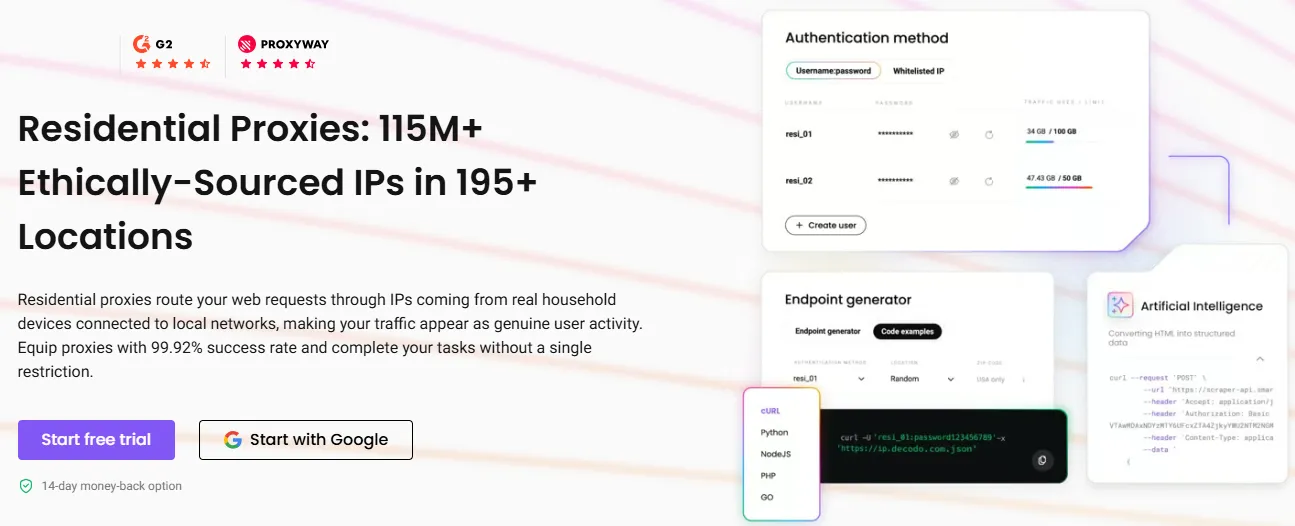
Decodo is an all-rounder proxy provider with an 115 million+ IP footprint in 195+ locations. It also participated in Proxyway’s 2026 proxy study and did decently well across all proxy types, including residential proxies.
However, it’s a particularly good bet if you’re eyeing LLM compatibility, with its AI parser, MCP server, Markdown output, and n8n integration. It helps with HTML-to-JSON conversions, connecting Decodo with AI agents, and using its n8n node to build AI workflows.
Features
- PAYG and monthly subscription residential plans
- Geotargeting by country, state, city, ASN, and ZIP code
- Per-request rotation and sticky sessions
- HTTP(S) and SOCKS5 support
- Username-password and IP whitelisting
- Live usage, spending analytics, and team collaboration
- Extension for Firefox and Chrome
- 3-day 100MB trial
- Web scraping API
Residential Base Plan: $11.25/month (3GB @ $3.75/GB) and PAYG at $4/GB
G2/Trustpilot Sentiment: Praised for excellent customer service with quick response times and ease of setup. Performance feedback, though great overall, indicated frequent timeouts and slow speeds.
NodeMaven
NodeMaven is a residential proxy provider offering 30M+ residential IPs across 190+ countries and 1,400+ locations, with precise country, city, ISP, and ZIP-level targeting. Its network is heavily invested in providing cleaner IPs and therefore offers IP-quality filtering. Users can also choose between rotating IPs and sticky sessions, making the network suitable for large-scale scraping, price monitoring, SEO, and automation.
Beyond proxies, NodeMaven offers a range of free tools for developers and data teams, including IP lookup, proxy testing, WebRTC leak testing, proxy checkers, and other tools for analyzing IP and network performance.
Features
- 30M+ residential IPs
- 190+ countries and 1,400+ locations
- Country, city, ISP, and ZIP-level targeting
- Cleaner IPs with IP quality filter
- High average success rate
- Rotating and sticky residential sessions
- HTTP(S) and SOCKS5
- Unlimited concurrent sessions
- Cashback on used traffic
- Traffic rollover
Residential Base Plan: From $8.5/month (2GB @ 4.25/GB) for residential proxies. A 750 MB trial is available for $3.50.
G2/Trustpilot Sentiment: Users reported high-quality IPs, reliable performance, good customer support, and easy setup. However, a few reviews were critical of the comparatively high pricing for smaller projects.
Bright Data
You won’t find a proxy provider bigger than Bright Data if pool size is your only standard. It has a 400 million-plus advertised proxy pool covering 195 countries. Bright Data sells residential, static-residential, and datacenter proxies. Although it also used to feature mobile proxies, it’s been discontinued for new users as of April 2026.
Interestingly, Bright Data opted out of Proxyway’s 2026 research study, continuing its absence since 2025. We have also observed Bright Data has been leaning towards hands-off structured data delivery of late. However, it continues to sell proxies and other scraping APIs in the user and enterprise segments.
Features
- Country, city, ZIP, carrier, and ASN-level geo-targeting
- HTTP, HTTPS, and SOCKS5 protocol support
- Per-request automatic rotation and sticky sessions
- Authentication via username-password and IP whitelisting
- Real-time usage and traffic monitoring
- Browser extension (Chrome) and multiple integrations
- 99.99% Uptime SLA
- API access
Residential Base Plan: $499/month (141GB @ $3.50/GB) and PAYG at $4/GB
G2/Trustpilot Sentiment: Upvoted for the ability to handle complex workflows and helpful customer support. Some users, however, mentioned inconsistent communication regarding service terms and pricing.
ProxyEmpire
ProxyEmpire offers over 30 million residential IPs across 170+ locations, giving it a worldwide footprint. It offers two tiers of residential proxies: rotating and unlimited residential. The former is a common offering among all major proxy providers; however, ProxyEmpire’s unlimited GB plan really helps it stand out. Likewise, ProxyEmpire offers multi-tiered mobile proxies, which include dedicated and rotating IPs.
Another good thing about ProxyEmpire is that you can check available IPs per country without signing up. This indicates the depth of the pool, and with geo-targeting support, your chances of getting IPs from specific locations after you sign up.
Features
- New IP per request, sticky sessions, or timed rotation
- Unlimited bandwidth residential proxies in 41+ countries
- Country, region, city, ZIP, ISP, ASN, and OS fingerprint targeting
- No limit on concurrent sessions for approved workflows
- Unused bandwidth rollover
- Username/password authentication
- Team accounts with granular access controls and 2FA
- Optional API-based proxy management
- Android app and Chrome browser extension
- Paid trial worth $1.97
- 24/7 live chat support
Residential Base Plan: $3.50/GB (PAYG) and $200/day (unlimited bandwidth at 100 Mbps)
G2/Trustpilot Sentiment: Generally praised for responsive customer support and solid performance, although some reviewers reported issues with DNS resolution and IP geolocation mismatches.
Oxylabs
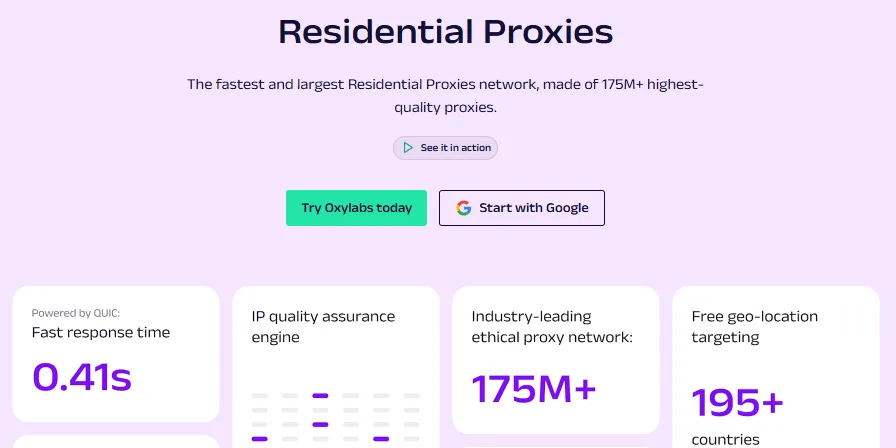
Oxylabs is an enterprise-grade proxy provider, which often ranks for its pool size and performance. It advertises a 175 million+ residential pool covering over 195 countries. Besides this sizeable IP footprint, you get to choose from a host of tools for managing scraping and automation, including scraping and search APIs, a headless browser, and AI-studio.
Oxylabs also provides bespoke data collection services, which work entirely as a done-for-you scheme with the company handling data collection to delivery as per your custom requirements. Think of it as a fully managed scraping service, with an option to choose from the pre-fetched, ready-to-use datasets as well.
Features
- Country, state, city, ZIP, coordinates, and ASN-level IP filters
- Advanced residential filtering by operating system and IP version (v4 or v6)
- IP rotation per request, at session timeout, or after 60 seconds of inactivity
- HTTP(S), HTTP/3 and SOCKS5 support
- Automatic scaling based on request volume
- Username-password and IP-whitelisting authentication
- Unlimited concurrent sessions
- Browser extension for Chrome
- On-request free trial
Residential Base Plan: $30/month (5GB @ $6/GB)
G2/Trustpilot Sentiment: User reviews report good performance (speed and stability) along with helpful customer service. On the downside, a few of them complained about a lack of billing transparency and facing frequent CAPTCHAs with their proxies.
SOAX
SOAX is a mid-weight proxy provider that enables access to 155+ million residential IPs covering 195 global locations with free geo-targeting. At the time of this writing, SOAX was predominantly into residential and mobile proxies, whereas datacenter and ISP proxies were limited to certain regions.
Besides proxies, SOAX facilitates managed data extraction, a worthy offering for lean teams managing data-hungry pipelines.
Features
- Per-request IP rotation and custom sticky sessions
- Region, city, and ASN-level IP filtering
- Programmatic error-handling for web browsing
- Unlimited concurrent sessions
- HTTP(S), SOCKS5, and QUIC support
- Username-password and IP allowlist
- API-led proxy management
Residential Base Plan: SOAX charges the same for residential and mobile proxies. The least you can start with is its Sandbox plan, which requires a $25 minimum top-up for 25 credits expiring in 60 days. Afterwards, IPs are charged by country, and the cheapest plan is for Tier 3 countries, billed at $20 (~20 credits) for 10GB.
G2/Trustpilot Sentiment: G2 feedback is very positive, citing good customer support and fast speeds. A few Trustpilot reviews, on the other hand, complain of IP instability and slow speeds.
DataImpluse
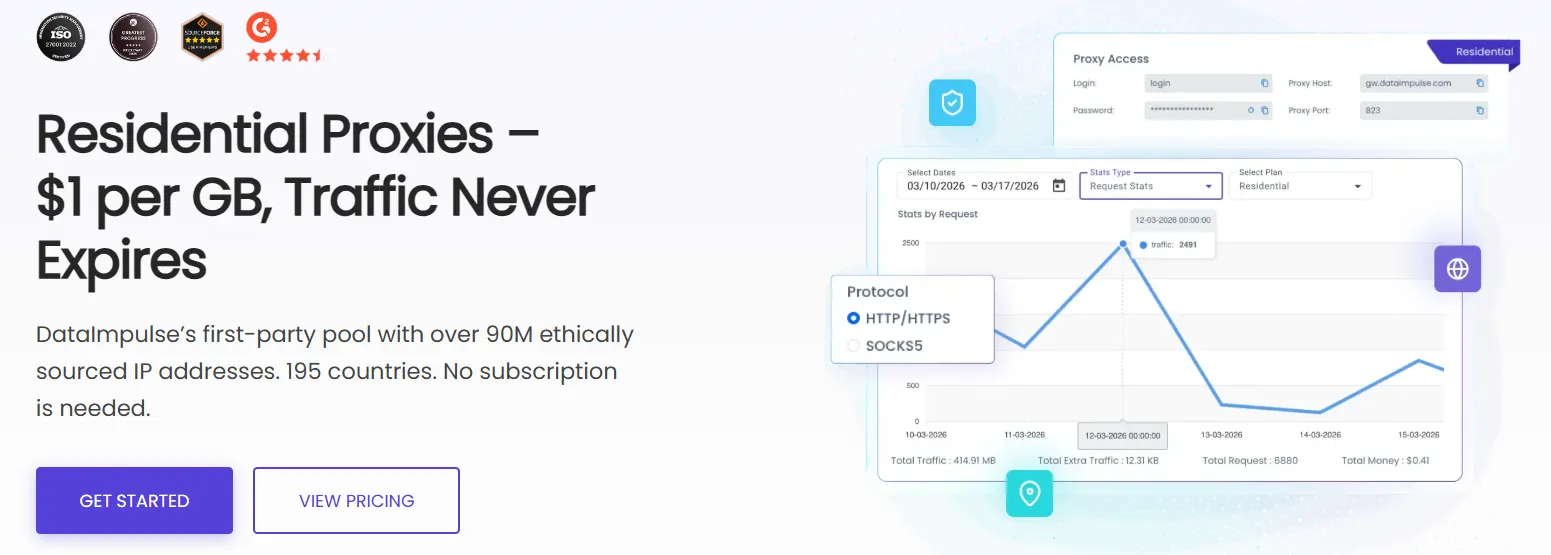
DataImpulse is one of the most value-for-money proxy providers around. However, one must be wary that this provider offers multi-tiered residential plans, regular and premium. The latter, which performed well in the recent Proxyway market research, is comparatively expensive and currently priced at 5x its regular residential rate.
Still, we would like to applaud DataImpulse for its flexible pricing and a decent list of 3rd-party integrations. Besides, the 90+ million IPs across 195 countries represent good residential coverage, in our opinion.
Features
- HTTP, HTTPS, and SOCKS5 support
- Geotargeting by state, city, ZIP code, and ASN
- Per-request IP rotation and up to 120 minutes sticky sessions
- IP whitelisting and username-password authentication
- Never expiring data (both tiers)
- 2000 Concurrent connections (high limit on-request)
- API access
Residential Base Plan: $5 for 5 GB of regular residential proxies, and $5 for 1 GB of premium residential proxies.
G2/Trustpilot Sentiment: Great G2 feedback about pricing, performance, and ease of setup. In contrast, some Trustpilot reviews complain of increased detection and unhelpful customer support.
IPRoyal
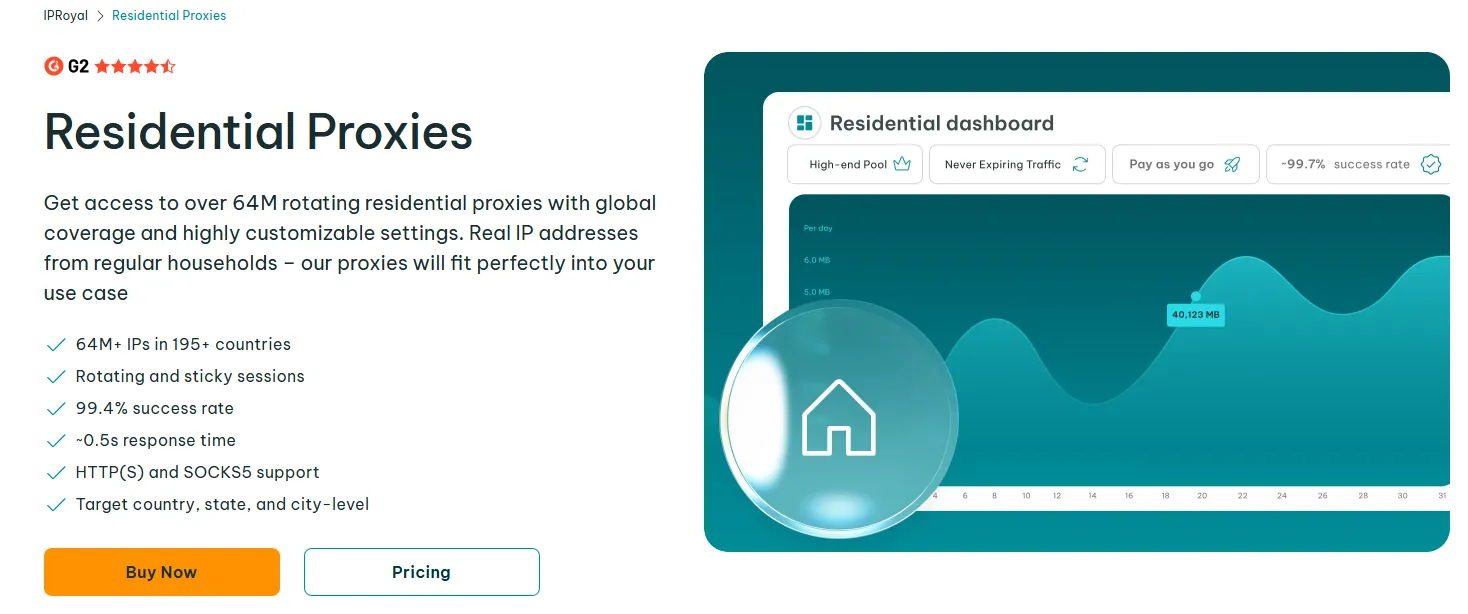
IPRoyal offers a very user-friendly onboarding experience where you enter the target domains and answer a few questions to receive proxy-type recommendations and plans. This makes it a great option if you aren’t sure about proxy types and their applications.
That's not it, IPRoyal supports integration with 650+ business tools and is a good pick for team collaboration, thanks to its granular access control and two-factor authentication. Besides, its residential pool has over 64 million IPs spread across 195+ countries, giving it a global footprint.
Features
- Country, state, and city-level geo-targeting
- Per-request and interval-based automatic rotation
- Up to 7-day sticky sessions
- (Optional) Manual rotation (dashboard and API)
- HTTP(S) and SOCKS5 protocol support
- Subscription and PAYG pricing models
- IP whitelisting and username/password authentication
- Unlimited concurrent sessions
- Chrome and Firefox extension
Residential Base Plan: Starting from $7.35/GB (PAYG)
G2/Trustpilot Sentiment: Strong user feedback about good performance, ease of setup, and intuitive dashboard. Negative reviews talk about poor customer support and blocks.
How to Test Before You Buy
Testing a residential proxy provider involves verifying their IP pool reputation by running a 50-100-IP sample against IP reputation databases and target testing. We have explained both of these checks in the following sections.
However, you’ll need sample IPs. So, check if your provider offers a residential trial, such as Byteful’s free 1GB residential data. If unavailable, try subscribing to the base residential tier before moving on to the tests.
Verify IP reputation
A good IP reputation pool will help you get through web defenses more easily than others. And though there are many tools for testing a single IP’s reputation and blacklist mentions (such as from APIvoid and Cisco Talos), the one from WhoisFreaks lets you validate 100 IPs at once for free.
To demonstrate, we have fetched five free proxies and ran them through WhoisFreaks.
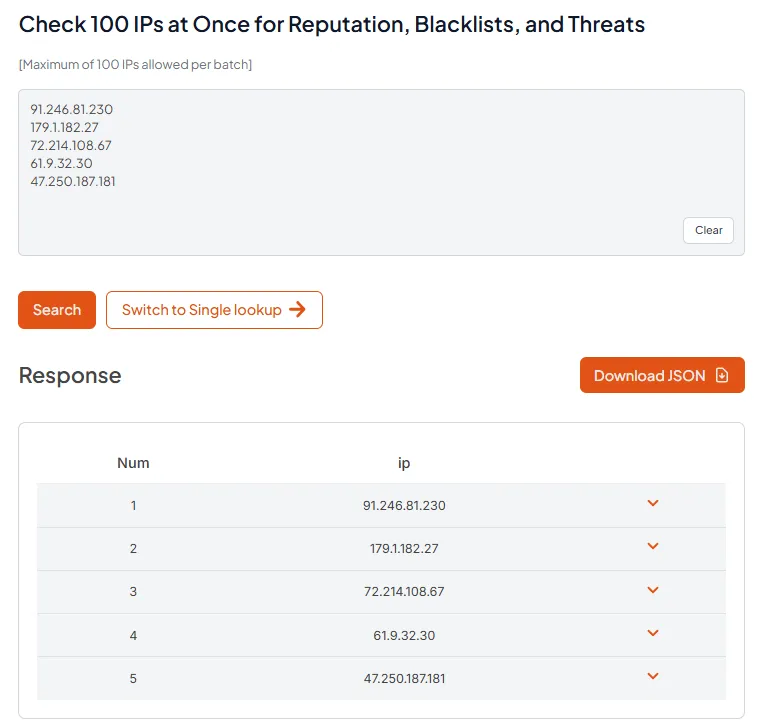
Furthermore, you can download the JSON file, parse it, and check if the IP details hold against the claims.
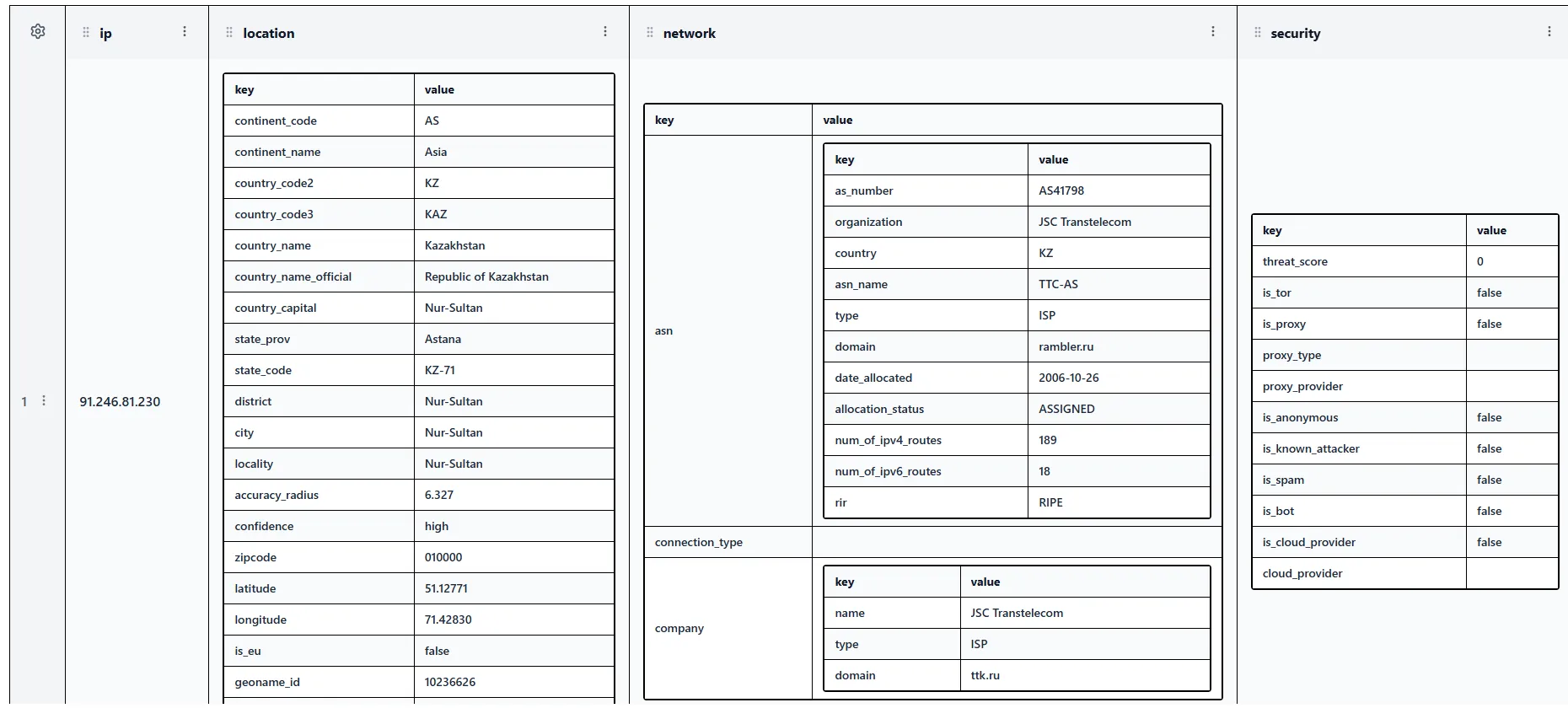
More than anything, this is to verify the geolocation and ASN details. However, this also provides a threat score, along with a few additional security-related details per IP (such as whether the IP is a proxy and its type).
For blacklist checking in particular, batchblacklist is a good one to verify a list of IPs against five well-known blacklist databases, such as Barracuda and SpamCop. However, we would like to acknowledge APIvoid, which runs an IP address against 75+ blacklists in one go (bulk check support is available via its API).
Overall, the objective is to determine whether residential IPs are not loaded with multiple blacklist mentions, as it’s a well-known practice among security platforms to filter incoming requests against such lists.
Test on your target
Most of the proxy providers, including us, advertise a success rate. But honestly, this is only half the story, which may not be that relevant for a specific project.
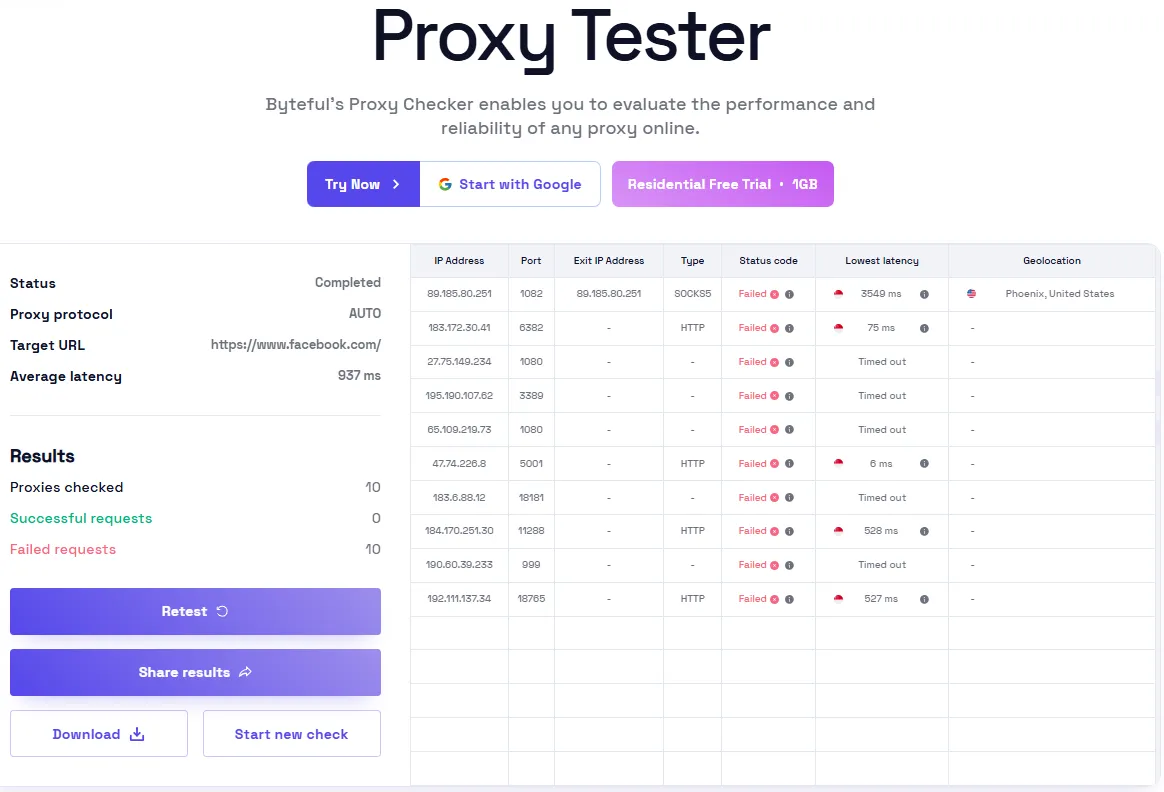
What's important, however, is testing a list of sample IPs against your actual target. And Byteful’s free Proxy Tester comes in really handy with that part. But it’s not just access, our proxy tester also informs you about the latency, proxy type, and geolocation.
We have run a check on Facebook using 10 free IPs to show what you would face if you were not using a premium proxy provider on sophisticated web platforms. You can see all ten failed or timed out in the following screengrab.
We also ran the same test, but this time using our own residential IPs. Here are the results:
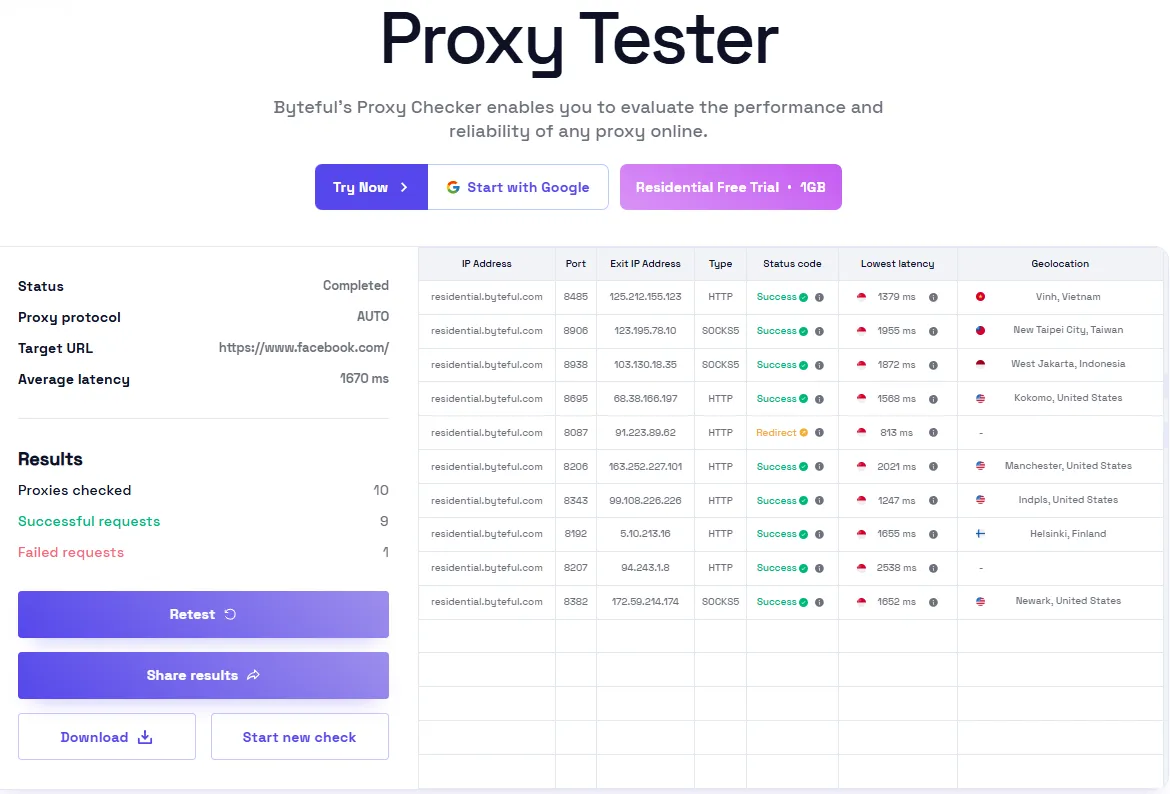
This was just a small test to demonstrate that premium residential IPs perform comparatively better than free options out there. That said, in practice, we recommend running multiple tests on the same IP set multiple times a day to obtain conclusive evidence of proxy quality.
(Effective) Cost per Project
Simply comparing the listed selling price per GB against your estimated bandwidth consumption can often lead you to underestimate the impact of unused data and the resulting financial leakage. This can be substantial, depending on the project scale and if the provider doesn’t roll over unused data to the next billing cycle.
Let’s understand this with a simple example. Assume you need 50 GB of aggregate residential data for a web scraping project and buy 10 GB per month but consume only 70% (i.e., 30% wastage) of the purchased data each month.
| Expiring bandwidth | Non-expiring bandwidth | |
|---|---|---|
| Purchased each month | 10 GB | 10 GB |
| Actually used each month (at 70% utilization) | 7 GB | 7 GB |
| Unused data | 3 GB expires each month | Everything carries over |
| Data purchased for 50GB usage | ~71.4 GB | 50 GB |
| Bandwidth wasted | ~21.4 GB | 0 GB |
| Cost incurred per GB | 1.43 × Price/GB | Price/GB |
| Total cost for 50 GB project | 71.4 × Price/GB | 50 × Price/GB |
| Project cost @ $3/GB | $214.20 | $150 |
| % Difference | 43% higher | NA |
Therefore, subscribing to a fixed-bandwidth plan is never a good idea for long-term projects unless you have something very specific in mind. That’s exactly the point that led us to offer never-expiring bandwidth to help you keep costs in check.