

Data scraping and data mining are often confused because they are closely related and part of the same data pipeline. This explainer covers what each does, how they relate, and the practical risks of doing either carelessly.
What is data scraping?
Data scraping is the automatic extraction of data from sources such as live web pages, archives, images, audio/video, or locally stored documents (such as PDFs, spreadsheets, etc.). Depending on the source file format, different tools may be involved, each using specific parsing techniques.
Types of data scraping
- Web scraping is the most common form of data scraping. It refers to using scrapers to fetch and parse target web pages and return structured output such as JSON or CSV. A web scraping stack may include headless browsers, anti-detect browsers, scraping APIs, proxies, CAPTCHA solvers, and more, depending on the target's scraping tolerance.
- Screen scraping: It collects visual data from a screen, often from legacy systems, to modernize the user interface, support market research, or enable application development. Common techniques include mapping user interactions and using optical character recognition (OCR). Screen scraping becomes useful where modern extraction methods won’t work because of the underlying host software.
- Document scraping works on file formats including Word files, PDF, TXT, and more. The objective is to extract business data such as phone numbers, emails, purchase orders, bank statements, invoices, vendor contracts, etc. Depending on the file, this may include text or table extraction, OCR for scanned documents, and storing the data locally or fetching and parsing it directly from cloud storage providers like Google Drive.
- Multimedia scraping is a relatively new scraping domain that extracts useful data from audio/video content. This may include speaker identification, timestamped transcriptions, OCR of visual text, scene detection, and preparing summaries. Multimedia scraping helps with copyright infringement detection, transportation management, sports analysis, and more.
How does data scraping work?
For simplicity, we will focus on web scraping, since it’s the most common type of data scraping. One can divide the web scraping process into five major steps: request, download, parse, extract, and save, as shown below.
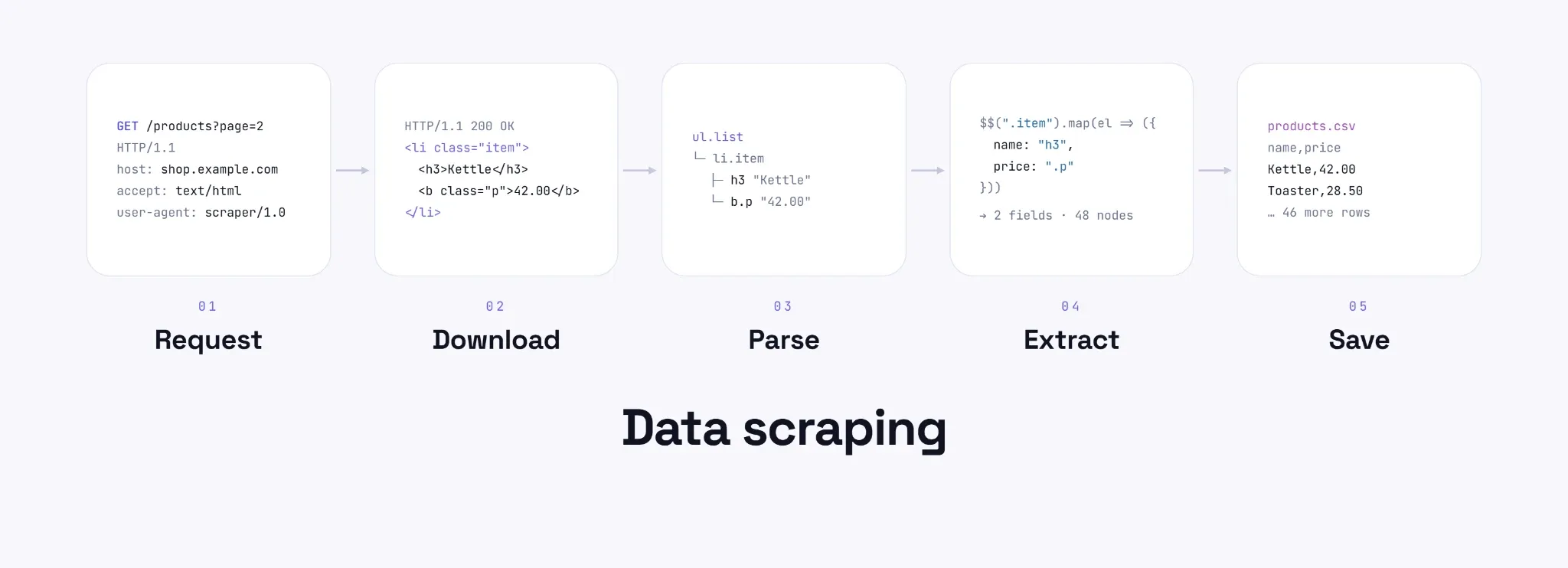
- Request: The scraper sends an HTTP request to the target website's URL. Based on the target's defenses, this may also involve routing the request through proxies or mimicking real-user behavior, such as location and click/scroll patterns.
- Download: If everything goes well, the server responds, and the scraper downloads the raw response, usually HTML but sometimes JSON.
- Parse: The scraper now takes the raw code and turns it into a structured representation, such as a document object model (DOM), which can be navigated programmatically.
- Extract: Predefined selectors or rules then pull the desired fields from the parsed structure. This can be anything from prices and product names to contact details and links.
- Save: The final step is saving the extracted data in popular formats, such as JSON and CSV, on your local machine or the cloud, as configured.
What is data mining?
Once we get the scraped data, the process of making sense of it is known as data mining. One may not appreciate its importance for extremely small datasets. But at scale, techniques such as statistical analysis and machine learning help data scientists uncover hidden insights and patterns.
The ultimate objective is to support business-critical domains, which might affect overall security, product launches, demand prediction, and profit/loss estimation.
Common data mining techniques
- Association and pattern mining identify how often variables occur together, their relation, and the probability of correlated occurrences. This helps companies, especially in e-commerce, understand which products are bought together and how their buyers shop.
- Classification sorts new objects into business-specific pre-defined classes based on their common characteristics and the models built from labeled records.
- Clustering works on unlabelled data. It groups entities based on their similarities and how they differ from objects in other groups.
- Outlier detection checks which individual records deviate from the entire data set and within their groups, and which groups diverge as a whole.
- Regression analysis helps predict future outcomes and relationships among variables. For instance, it can help a food business operator estimate demand based on the time of the year.
How does data mining work?
The best way to learn how data mining works is through the Cross-Industry Standard Process for Data Mining (CRISP-DM), a widely used framework that includes six phases. However, the first few steps may not closely resemble the modern “drawing patterns” definition.
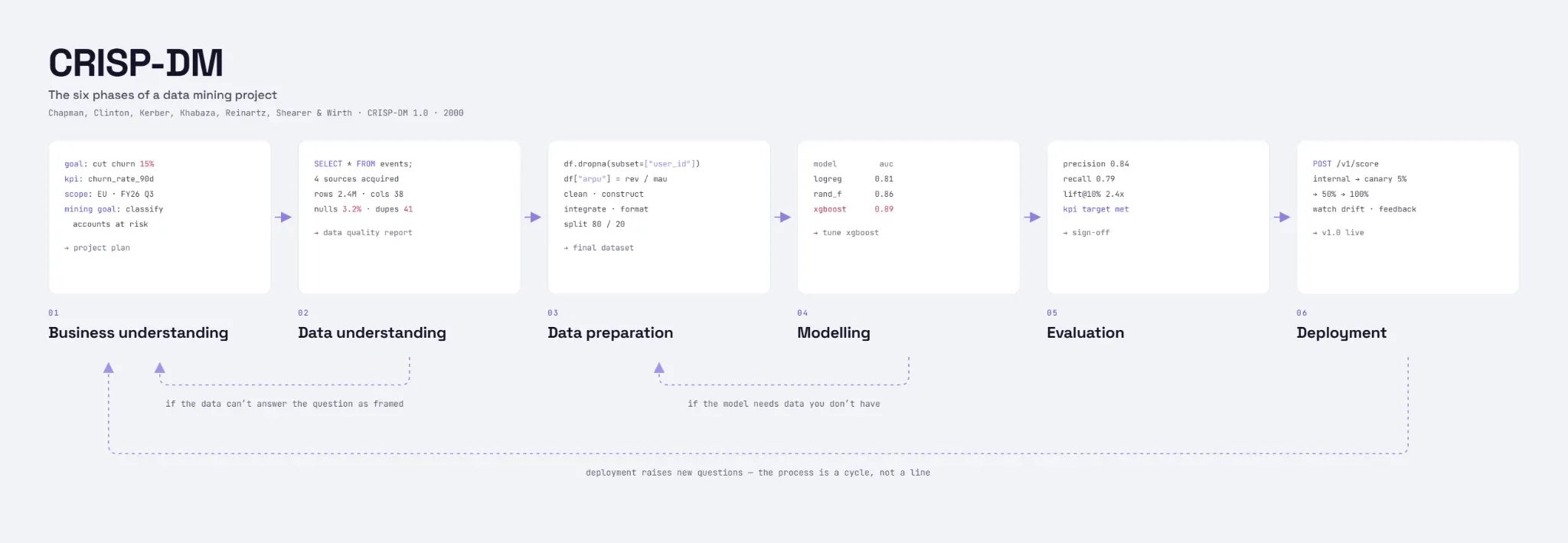
- Business understanding defines the project scope, develops the problem statement, and prepares a plan to execute the next steps.
- Data understanding is where you identify data sources, collect sample data, and run optional preliminary analysis. This may end with an understanding of data quality and a glimpse of patterns yet to be fully uncovered.
- Data preparation is the heavy lifting of cleaning and transforming data (if needed) to simplify the upcoming analysis. The objective is to prepare the final dataset for modeling.
- Data modeling comes next, where you experiment with multiple models based on various modeling techniques and build your own if needed. If the selected model needs data you don’t already have prepared, you move back to the data selection/preparation stages.
- Evaluation is the pre-deployment testing process where you ensure the model fulfills the pre-set business objectives and that no concerns remain unaddressed.
- Deployment is the final stage, which can further be done in phases until real-world reliability is completely proven. This can include intra-organization deployment, followed by opening it to the end user or customer. Documenting user feedback, problems encountered, and overall results analysis can be the final tasks of the process.
Data scraping vs Data mining
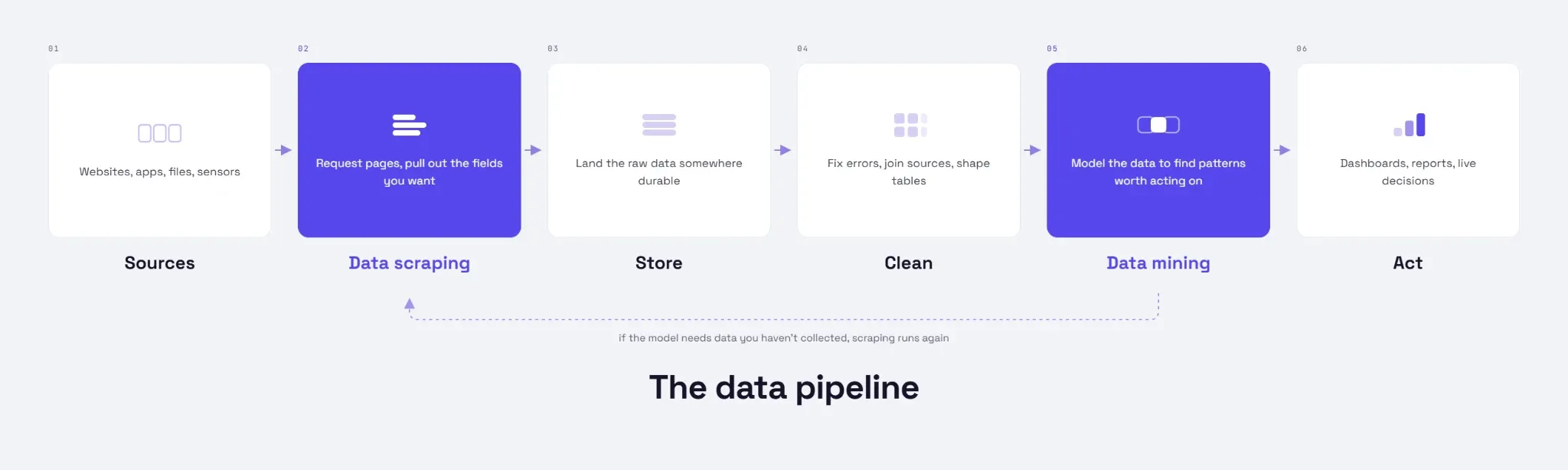
Data scraping and data mining are two distinct stages in the data processing chain. Naturally, scraping predates mining to collect data, which is then analyzed later. The following table explains more differences between them.
| Data scraping | Data mining | |
|---|---|---|
| The question | How to get the data? | What's the data about? |
| What it produces | Raw and/or structured data: text, images, records, JSON, CSV, etc. | Patterns, models, predictions, segments, and other insights |
| Who runs it | Engineers, developers, and ops teams | Analysts, data scientists, and BI teams |
| Can fail because of | Blocks, CAPTCHAs, layout changes, broken selectors, fingerprinting, and partial page loads | Overfitting, dirty inputs, biased data, and outdated patterns |
| Success indicators | Extraction rate, field coverage, and data quality | Model accuracy, pattern validity, predictive performance, and positive business impact |
| What drives the cost | Bandwidth, proxies, retries, CAPTCHA solvers, and scraper maintenance | Compute and data infrastructure |
| Why it stops working | The target source changes HTML structure, access rules, or behavior | The underlying data changes, invalid assumptions, or the model drifts |
| Legal risk | Terms of service, copyright, and data privacy | Data protection, privacy, and IP rights |
When do you need scraping, mining, or both?
You need only scraping if starting fresh with data gathering is the first priority, and there are little to no analytical requirements. This might mean fetching prices, contacts, links, or more. The ultimate goal can be as simple as keeping tabs on the competitor product line and learning about new launches as soon as possible, before they disrupt the market.
On the other hand, mining only works if the data already exists, such as in an internal knowledge base, support logs, performance reports, sales records, customer feedback, or similar sources. However, you should check external data for freshness before use, and if it's outdated, scraping may still be necessary.
Lastly, if your analysis can't be done with existing internal data, the model must work exclusively with up-to-date external records. This is a situation where the data pipeline starts from scratch, with data scraping and data mining taking place in order.
You can avoid scraping entirely if the source sells data via an API or otherwise. It also reduces legal exposure and turnaround time.
Legal and ethical differences
Since data scraping and data mining sit at different points in a data pipeline, their legal exposure and ethical responsibilities also vary considerably.
For instance, data scraping is mostly about data acquisition. Local laws govern it, but the target’s terms of service also matter. This was clearly demonstrated in the hiQ vs LinkedIn legal skirmish, which lasted almost six years. Initially, hiQ appeared to win against LinkedIn's appeals citing the Computer Fraud and Abuse Act (CFAA), with the US district judge even granting hiQ a preliminary injunction to continue scraping public profiles.
But the battle with a Microsoft-owned giant proved catastrophic for hiQ’s business. To make matters worse, legal inquiry revealed that hiQ used fake accounts (and indirectly agreed to the platform’s user terms) to bypass LinkedIn’s public-facing protections, taking the case out of hiQ’s grasp. In short, hiQ’s business collapsed; it surrendered to the legal accusations, had to destroy all data and code, and agreed to pay LinkedIn a $500,000 penalty as the final settlement.
On the bright side, this case drew a line in the sand about public scraping for all to learn from. So, while public data may be open to scraping, how you do it matters most. Furthermore, a website’s terms of service have a legal basis and should be accounted for before starting any scraping workflow.
Data mining, in contrast, starts after you acquire the data, but it still comes with obligations around how you process and use it. A famous case that highlights data mining risks is when the Dutch Data Protection Authority (DPA) imposed a €2.75 million fine on the Dutch Tax Administration. The problem was that the accused used dual nationality as a factor in processing childcare benefits applicants, something the DPA cited as unlawful and biased.
Not only this, but the Dutch Tax Administration also used the same variable to fight fraud within their childcare benefit scheme and deem certain applicants as risky. What put the tax administration under the scanner, beyond the scandalous data processing, is that they were supposed to delete the dual nationality data in January 2014, but instead kept using it improperly until May 2018. The lesson is that data mining can be risky and penalizing if you don't use it correctly and with good intentions.