


A P2P proxy is a residential or mobile proxy that routes your traffic through an ordinary person’s device, such as a home computer or phone. But the term “P2P proxy” can mean different things to different people.
For a proxy vendor, it means residential proxies that run on real people’s devices. When a torrent user says “P2P proxy,” they usually mean a proxy for P2P traffic. Others use it to mean a P2P network where peers pass traffic for each other with no central server.
In this article, we’ll explain what a P2P proxy is, where its IPs come from, whether it’s legal and safe, and how to spot an ethical network.
P2P network vs P2P proxy
A P2P network connects devices without the need for any centralized server carrying the data. BitTorrent, for example, lets you download pieces of a large file from other users while you’re uploading pieces to them as well.
Another example of a P2P network is Tailscale. This secure networking solution lets you connect your laptop to your home computer. As a result, you can open your home computer’s files from your laptop.
Your devices usually send data straight to each other. Tailscale’s servers help them connect, and relay traffic only when a direct link fails.
A P2P proxy borrows one part of this idea: ordinary people’s devices. But it puts a company in the middle. When you use a P2P proxy, you first connect to the provider’s gateway. Then, the provider’s gateway routes your request through a peer, such as a laptop in an Ohio home. The website you’re trying to connect to sees the household’s residential IP.
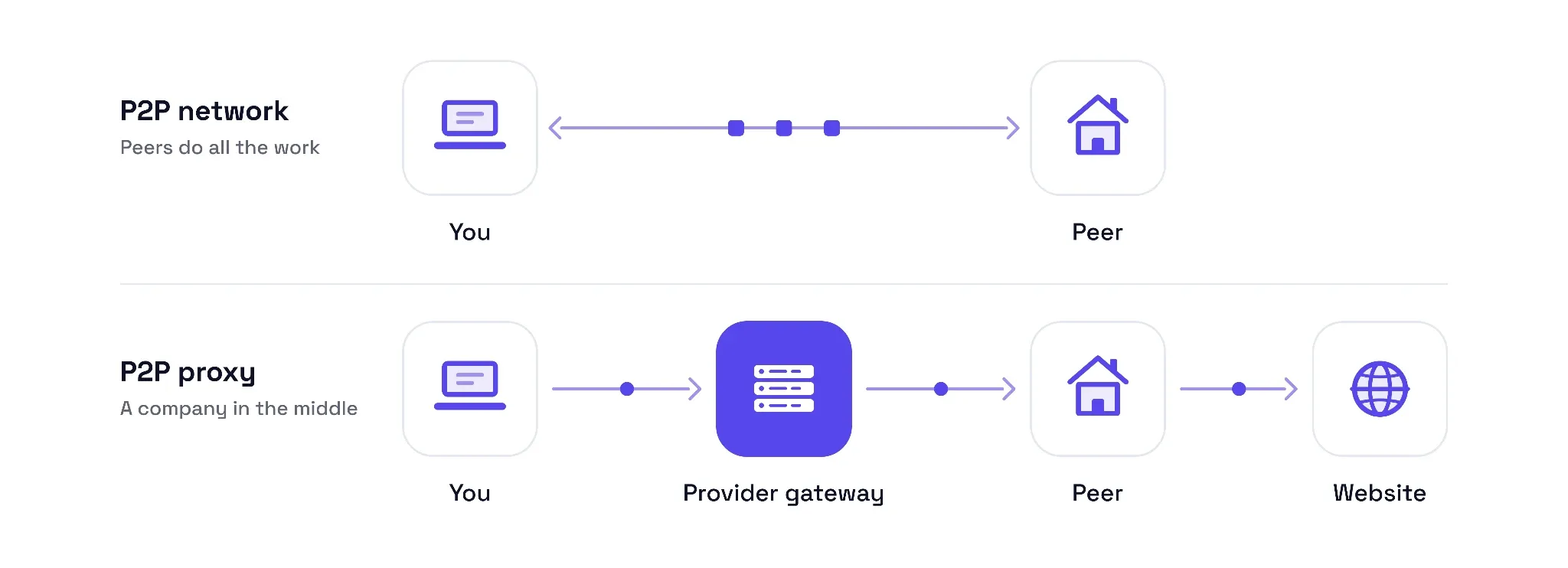
Because the peers are ordinary households, their IPs are residential IPs, which is why vendors often sell P2P proxies as residential proxies.
As you can see, a peer is added only in the last step of a P2P proxy connection. And your request must pass through the provider's gateway to reach a peer.
But in a P2P network, peers do all the work, and no central server carries the traffic.
Some users search for a P2P proxy when they want to hide their IP from a torrent swarm. For example, a qBittorrent user may not want other downloaders to see their home IP. What they actually need is a datacenter proxy that supports SOCKS5 and allows P2P traffic, not a residential proxy.
ISP peering can sound like a P2P network too, because two networks connect directly as equals. But the peers are whole networks, such as Netflix and an internet provider, not individual devices. And they swap traffic to make streaming faster. So, it’s not a P2P network.
Now that you know what a P2P proxy is and how it’s different from a P2P network, let’s find out how vendors source P2P proxies in the next section.
Where do P2P proxy IPs come from?
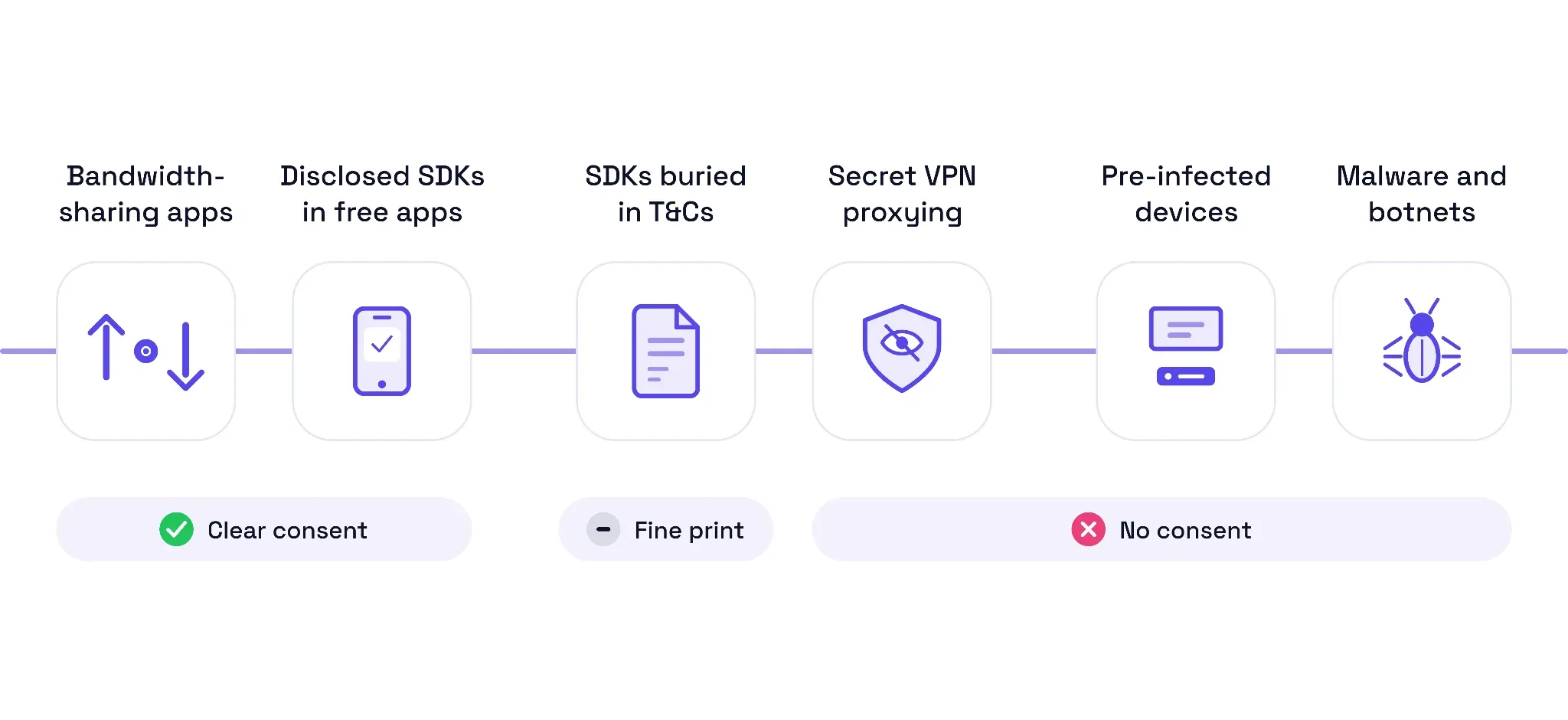
P2P proxies are most often residential proxies. Sometimes they are mobile proxies, where the peer device is a phone on cellular data.
Here are key ways proxy vendors source IPs.
- Bandwidth-sharing apps: It’s perhaps the most transparent method for sourcing IPs. Users install bandwidth-sharing apps, such as Honeygain, EarnApp, and PacketStream, on their devices. They get paid for bandwidth they share.
- SDKs clearly disclosed in free apps: Developers embed a proxy SDK in free game or utility apps. Users choose to share their bandwidth to avoid ads. There is a clear consent screen, explaining the deal.
- SDKs disclosed only in terms and conditions: Disclosure is there, but it is buried in terms and conditions that users rarely read. So, in practice, they have no idea that their devices are being used for proxy traffic.
- Free VPNs and tools that secretly proxy traffic: Some unethical vendors use free VPNs and tools to secretly turn users’ devices into proxy nodes. While using these apps, users get no disclosure and give no consent. For example, in 2015, Hola VPN was caught selling free users’ bandwidth through Luminati, its paid proxy service. Hola added a note to its FAQ only after the story broke.
- Pre-infected hardware: In this setup, devices ship with proxy malware, or pick it up when buyers first set them up. Either way, buyers unknowingly join a proxy network. In June 2025, the FBI warned about BADBOX 2.0 malware, which had infected millions of cheap, off-brand devices, such as TV streaming boxes, and turned them into residential proxies.
- Malware and botnets: Attackers hack devices and create a botnet, which they later rent out as residential proxies. In May 2025, law enforcement dismantled a botnet of hacked routers that had powered the Anyproxy and 5socks proxy services since 2004. The operators made more than $46 million selling access to the infected routers.
All the above methods have one thing in common: the IP lives on someone else’s device. That’s a defining attribute of a P2P proxy. Next, let’s see how a P2P proxy differs from other types of proxies.
Peer-sourced vs server-hosted proxies
You can split proxies into two groups:
- Peer-sourced proxies, which run on real users’ devices
- Server-hosted proxies, which run on servers
Static residential proxies, also called ISP proxies, run on servers the provider controls. So they’re not P2P proxies, even though they use residential IPs.
Here’s a quick comparison between various proxy types.
| P2P Residential | Static residential (ISP) | Datacenter proxies | |
|---|---|---|---|
| Type | Peer-sourced | Server-hosted | Server-hosted |
| Source | Real users’ devices (peers) | Residential IPs hosted on servers, no peers | Hosting providers and cloud servers |
| Stability | Low. Peers go offline at any time | High. IP stays the same for weeks or months | High |
| Speed | Variable. Depends on the peer’s connection | Fast | Fastest |
| Trust | Highest. Real ISP IPs on real devices | High. ISP-registered IPs | Low. Hosting ASNs are easy to flag |
| Pricing model | Per GB | Per IP (sometimes plus bandwidth) | Per IP or cheap per GB |
| Best for | Large-scale scraping, geo-targeting, ad verification | Account management, long sessions, checkouts | High-volume tasks on lenient sites |
| Behavior | IPs rotate. Sessions drop when a peer disconnects | Same IP, stable sessions | Stable, but blocked in whole ranges |
P2P proxies command the highest trust because they borrow IPs from real users. But these proxies have a caveat. Users can turn off their devices. Once they do that, your session on that IP ends.
So if your sessions keep dropping, consider static residential (ISP) proxies.
Is a P2P proxy legal and safe?
Yes, using a proxy is legal in most countries. But what you do using a P2P proxy determines whether the proxy usage stays legal or not. For example, using a proxy to verify ads or test geo-targeted content is generally fine in most jurisdictions.
However, running fraud campaigns or credential stuffing is illegal with or without using a P2P proxy.
Where a P2P proxy comes from matters, too. If a proxy vendor has sourced IPs from malware or hidden SDKs, you're paying for stolen bandwidth. And that’s not a hypothetical situation.
In January 2026, Google disrupted IPIDEA, one of the largest residential proxy networks. The takedown cut millions of devices from its pool. Its operators paid developers to embed SDKs in mobile and desktop apps. And those SDKs turned users’ devices into exit nodes, often without their knowledge.
That’s why it’s crucial to choose a provider that offers ethically sourced proxies and does KYC on its customers to control abuse.
But what about the safety and legality of sharing your bandwidth for money? Let’s find out next.
Should you share your bandwidth for money?
Though it’s legal to share your bandwidth through apps like EarnApp in most countries, doing so comes with risks.
First of all, many ISP contracts forbid their users from reselling bandwidth. So if your ISP is against it, you risk losing your internet connection.
Another risk is legal exposure. Strangers' traffic reaches the internet through your IP. If any of it is investigated, you're the first person investigators come to.
Also, you shouldn’t ignore the security implications of using bandwidth sharing apps. If any app has vulnerabilities, it can expose your home network to threat actors.
If you still want to try it, follow these two rules:
- Don’t do it if your ISP forbids it.
- Only use an app that’s clear about the deal, lets you stop anytime, checks its buyers, and bans misuse.
You should also consider the economics of using a bandwidth-sharing app. The money is not great, and you often get paid cents per GB.
On a metered connection, you’re likely to spend more on data than you earn by selling your bandwidth.
How to spot an ethical P2P proxy network
If you search the web, you’ll find that almost every proxy vendor claims that its proxies are ethically sourced. So don’t take the claim at face value. Check for the following instead.
Signs of an ethical network
- Explicit opt-in for peers and an easy way to opt out.
- KYC checks on buyers.
- A published page explaining how peers join and how they’re paid.
- A named, registered company with a compliance contact.
- Transparency about where the pool comes from.
- An acceptable-use policy that’s actually enforced, with sensitive sites like banking blocked.
- Limits that protect peers, such as idle-only use or bandwidth caps.
You can’t verify all of this from the outside. That’s why third-party signals matter. Look for the EWDCI Trust Seal, which is awarded only after a formal review of a vendor's practices against the EWDCI Core Principles.
Red flags
- An anonymous operator.
- Prices far below the market rate.
- Cheap “unlimited” residential plans.
- No KYC.
- “Any site, any use” marketing.
Byteful, our own proxy brand, is one example of a consent-based network. We ethically source residential and mobile IPs only from verified SDK providers and well-known earn apps. Every SDK integration requires explicit opt-in, and users are told about data sharing and any reward.
You can read how we source every IP in our Ethical Sourcing Guidelines, or reach our compliance team at [email protected].
On the buyer side, we run KYC checks at onboarding and enforce our acceptable-use policy.
We're an IWF member and hold the EWDCI Trust Seal, awarded after a formal review of our practices against the EWDCI Core Principles