


Developers often choose mobile proxies for the lowest possible block rates and/or targeting specific carrier ASNs. They work for most use cases, but their higher cost means they make the most sense where cheaper proxy types keep getting blocked.
Technically, mobile proxies extend residential IPs, but they offer better anonymity because CGNAT lets hundreds or even thousands of mobile users share a single mobile IP. On the downside, since they depend on real-time cellular networks, small performance fluctuations are inevitable.
This makes choosing the best mobile proxies a high-stakes job, since you’ll likely pay more and should make the most of every GB you buy.
Mobile proxy providers compared
Before checking individual sections, review the table below comparing the best mobile proxies in 2026 on key factors, including pool size, location coverage, geo-targeting, IP rotation, protocol support, and more.
| Byteful | IPRoyal | Decodo | ProxyEmpire | Oxylabs | |
|---|---|---|---|---|---|
| Best for | Mobile performance | Longest sticky sessions | AI-ready workflows | Shared and dedicated IPs | Enterprise |
| Mobile IP pool | 6M+ | Undisclosed | 10M+ | 4M+ (rotating) | 20M+ |
| Locations | 195+ | Undisclosed | 160+ | 170+ | 140+ |
| Carriers | 1,000+ | Undisclosed | 700+ | Undisclosed | Undisclosed |
| Targeting | Country, city, ZIP, ISP/ASN, OS | Country, state, city, carrier | Country, state, city, ZIP, carrier/ASN | Country, region, city, ZIP, ISP/carrier, ASN, OS fingerprint | Continent, country, state, city, coordinates, ASN |
| Rotation | Per-request | Per-request | Per-request | Per-request, custom TTL | Per-request |
| Max sticky session | 24h | 7 days | 24h | No fixed limit; custom TTL up to 2h | 24h |
| Protocols | HTTP, HTTPS, SOCKS5 (TCP) | HTTP/HTTPS, SOCKS5 | HTTP(S), SOCKS5 | HTTP, HTTP/2, SOCKS5 | HTTP(S), HTTP3, SOCKS5 |
| Dedicated mobile IPs | No | Yes | No | Yes (US + select countries) | No |
| Non-expiring bandwidth | Yes | No | No | Yes | No |
| Management | REST API (40+ endpoints), live activity, team management | API, granular permissions, 2FA | API, role-based usage control | API, Chrome extension | API, sub-users, traffic limits |
| Proxyway 2026 | Fastest response time (0.48s); fastest single pool (UK, 0.40s) | Participant, but mobile not tested | Best avg response time; 4th-highest success rate | Mobile pool tested; 97.79% of IPs classed as mobile | Best infrastructure success rate; 5th-largest avg response time |
| Starting price | $4.25/GB (1GB) | $6.80/GB (2GB); $10.11/day dedicated | $7.50 for 2GB ($3.75/GB) | $4.50/GB (1GB, promo); $125/month dedicated | $30/month ($7.50/GB) |
Best Mobile Proxies in 2026
The mobile proxy providers listed below stand out for their own strengths. For instance, Byteful is best for outright performance, never-expiring data, and its bandwidth-saving SmartPath AI.
Likewise, IPRoyal gets you the longest sticky sessions, Decodo supports AI workflows out-of-the-box, ProxyEmpire has dedicated and shared mobile IPs, and Oxylabs suits enterprise use cases. You can check each of them, with features, limitations, and pricing, subsequently.
Byteful: Industry-leading mobile performance
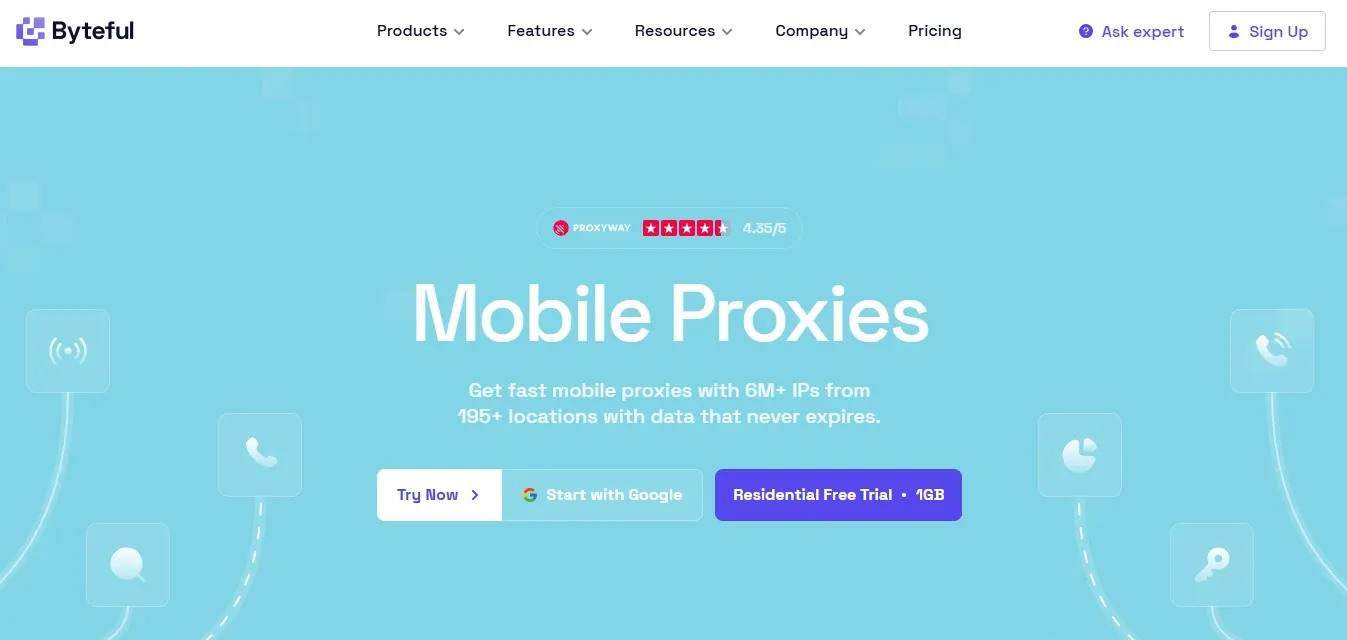
Byteful (ex. Ping Proxies) offers one of the best overall mobile proxy performance, as revealed by Proxyway’s 2026 market research. The mobile pools recorded the fastest response time (0.48s) and the single fastest mobile pool (0.40s, the UK) among the 13 providers tested.
Byteful’s mobile proxies also benefit from its homegrown AI routing, SmartPath AI. You can enable this with just a single parameter (or use it with our API) to automatically route low-risk requests via datacenter proxies to save mobile proxy data.
Features
- Over 6 million mobile IPs across 195+ locations and 1,000+ mobile carriers
- Country, city, ZIP, ISP/ASN, OS-level targeting, TCP/IP emulation
- Per-request IP rotation and up to 24-hour sticky sessions
- Unlimited proxy IP generation and concurrent sessions
- Username-password authentication
- Up to 40% mobile proxy data saving with SmartPath AI
- HTTP, HTTPS, SOCKS5 TCP support
- Live network activity and team management
- Byteful REST API with 40+ operational endpoints
- Non-expiring bandwidth
Limitations
- SOCKS5 UDP isn’t live yet
- Can feel expensive comparatively
Base plan: $4.25/GB (1GB), rollover bandwidth
G2/Trustpilot sentiment: Good performance and helpful customer support. Slightly expensive for smaller projects.
IPRoyal: Longest sticky sessions
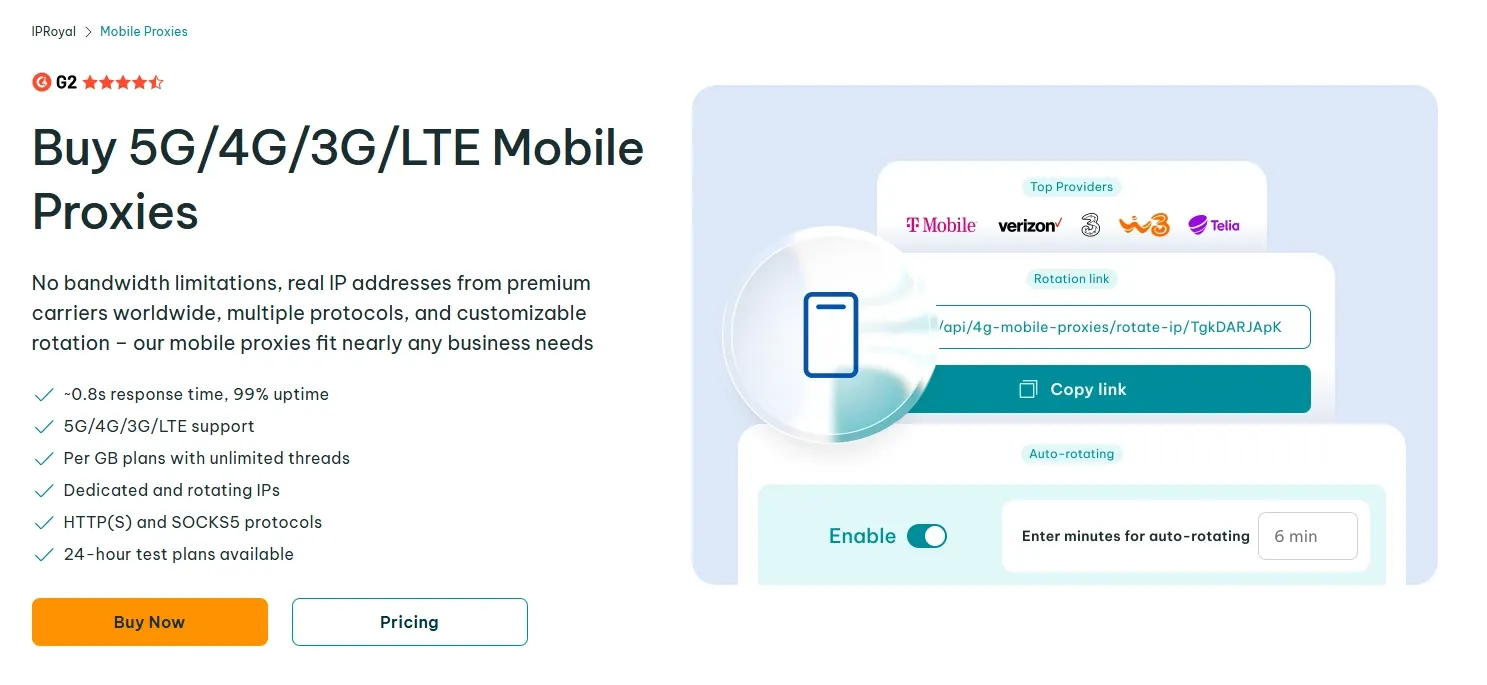
IPRoyal is a mid-weight proxy provider you can choose for rotating and dedicated mobile IPs. The latter offers time-based plans, with the entry-level tier for 24 hours. IPRoyal allows integration with 650+ tools, making it great for cross-platform workflows. Another differentiator is sticky session length, claimed to be up to 7 days (the longest in the industry).
Features
- Country, state, city, and carrier-level geo-targeting
- Per-request rotation and sticky sessions (1 second to 7 days)
- Unlimited traffic and sessions
- HTTP/HTTPS and SOCKS5 support
- Real-time and duration-based usage analysis
- Shared and dedicated mobile proxies
- Granular access permissions and 2FA
- API access
Limitations
- IP rotation requests can take up to 30 minutes to process
- No UDP support
Base plan: $6.80/GB (2 GB) and $10.11/day (dedicated)
G2/Trustpilot sentiment: Ease of use and good customer support. Inconsistent pricing.
Decodo: AI-ready workflows
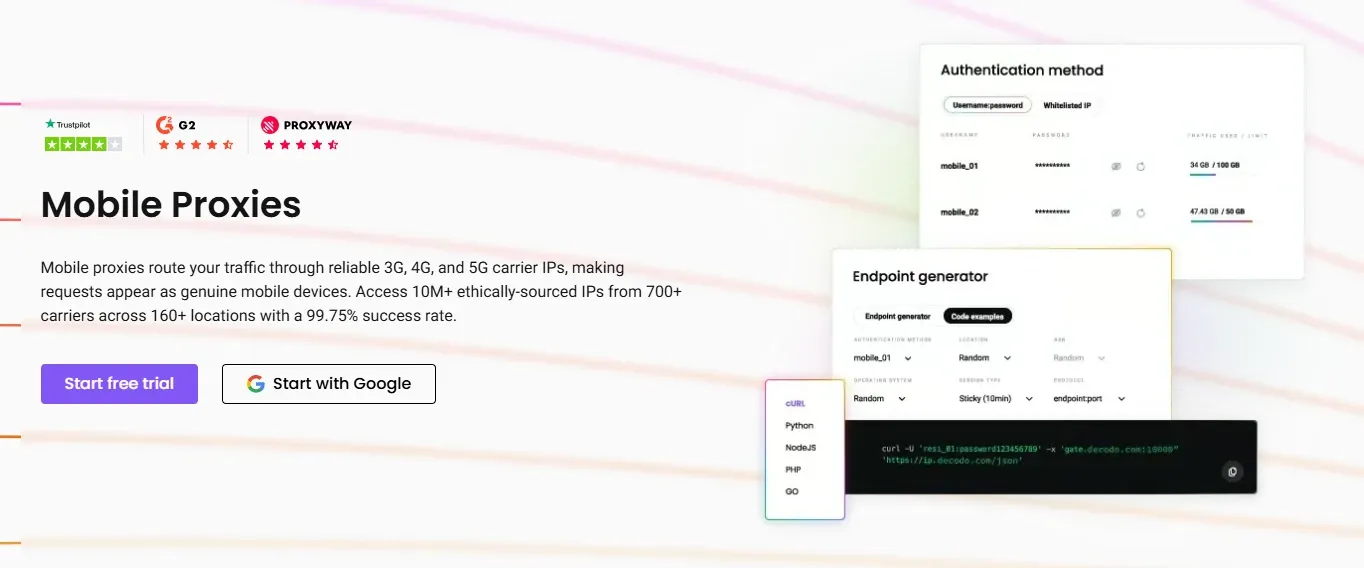
Decodo better suits enterprise use cases and comes with an “AI-ready” set of features, including an AI parser, MCP server, Markdown outputs, and an official n8n node. It has 10 million+ mobile IPs across 160+ locations and 700+ carriers. Decodo was also one of the 13 participants in Proxyway's 2026 market research discussed earlier. It scored the best average response time (2.71s) and fourth-highest average success rate (76.72) against popular targets.
Features
- Country, city, carrier/ASN-level targeting
- Username/password and IP-allowlisting
- Automatic IP rotation and sticky sessions (up to 24h)
- HTTP(S) and SOCKS5 protocols
- Usage analytics by traffic or requests
- Role-based usage control
- API-based proxy management
Limitations
- Comparatively smaller geographic footprint
- No SOCKS5 UDP support
Base plan: $7.5/month (2GB plan)
G2/Trustpilot sentiment: Intuitive interface and good performance. Issues faced with connection timeouts.
ProxyEmpire: Shared and dedicated IPs
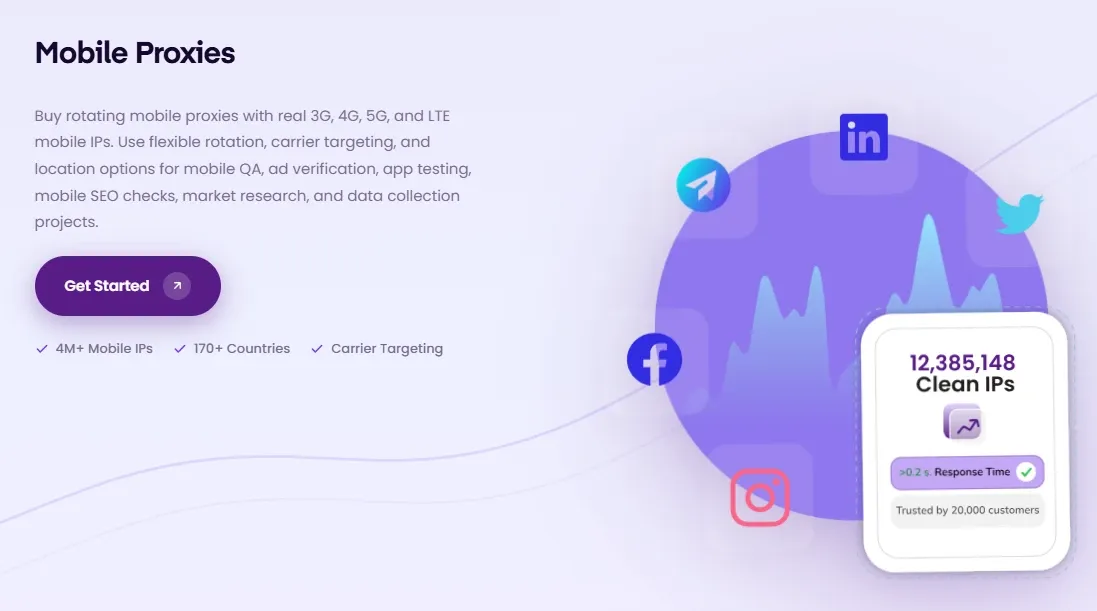
ProxyEmpire has 4 million+ rotating mobile IPs in 170+ locations and dedicated mobile IPs in the US and a select few countries, including the UK, Austria, and Israel. It has a handy tool on its homepage where you can check active mobile proxies per country and a global proxy coverage map to check multiple proxy types across major locations.
Features
- Country, region, city, ISP/ASN, and OS fingerprint targeting
- Per-request and custom TTL-based IP rotation
- HTTP, HTTP/2, and SOCKS5 support
- Unlimited concurrent sessions
- API and Chrome extension-based proxy management
- Flat rate dedicated proxies (single and multi-country package)
- Data rollover to next billing cycle
- $1.97 trial for rotating mobile proxies
Limitations
- No UDP support
- Dedicated mobile coverage is extremely narrow
Base plan: $4.50/GB (1GB, rotating residential) and $125/month (dedicated, multi-country plan)
G2/Trustpilot sentiment: Great customer support and user-friendly interface. DNS and IP geolocation mismatch in some cases.
Oxylabs: Fit for enterprise
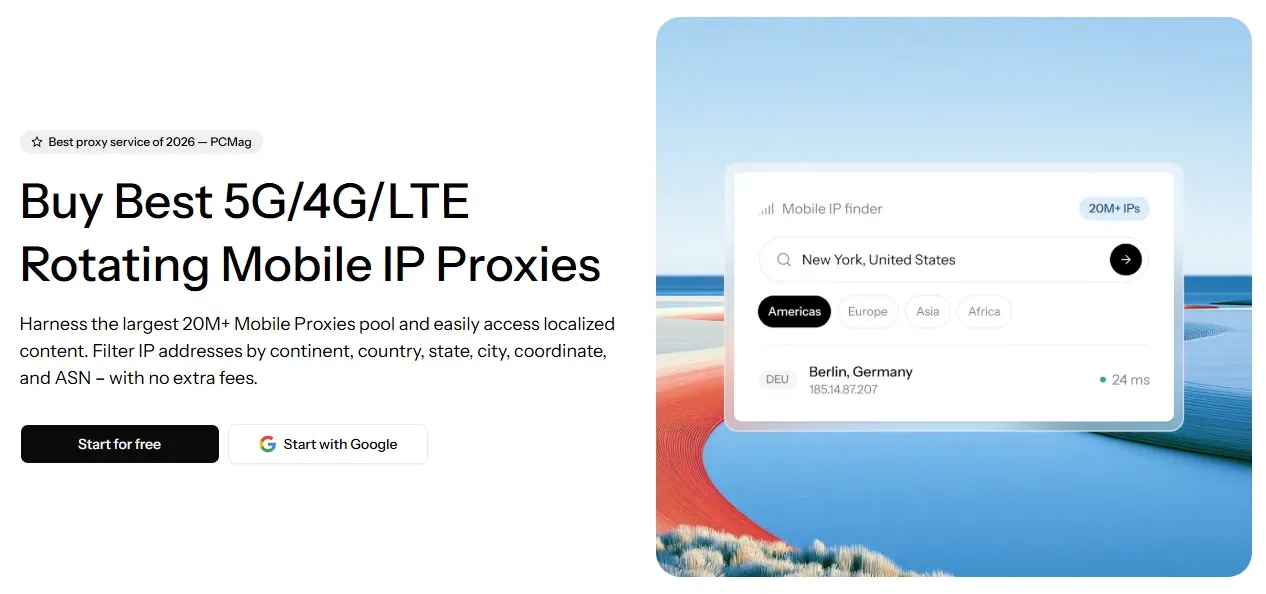
Oxylabs has the biggest mobile proxy pool of over 20 million in 140+ countries across this list. It’s another good-for-enterprise proxy provider, which is tailored for LLM and RAG applications. Oxylabs also participated in Proxyway’s 2026 study and performed decently, with the best infrastructure success rate and fifth-largest average response time against real-world targets.
Features
- Continent, country, state, city, coordinates, and ASN targeting
- HTTP(S), HTTP3, SOCKS5 (TCP & UDP) protocol support
- Unlimited concurrent sessions
- Per-request IP rotation and up to 24h sticky sessions
- Username-password and IP allowlisting
- API-led management (sub-users, traffic limits, usage tracking, etc.)
- Integration with over 30 tools
Limitations
- Very high per-GB rates
- Comparatively fewer mobile IP locations
Base plan: $30/month ($7.50/GB)
G2/Trustpilot sentiment: High performance and good customer service. Overall high complexity for simple use cases.
How to test a mobile proxy before you commit
After you review this list, the next step is to test a few providers before zeroing in on the best candidate for long-term use. The methodology is quite straightforward: subscribe to the trials/entry-plans and run the following checks.
Stage 1: Check whether a mobile IP is really mobile
Browser-based tools such as IPinfo and ip-api help you verify details like location, ASN/ISP, proxy type, and DNS. We found the latter, ip-api, to be particularly informative, since you get IP, ISP, and DNS checks all at once.
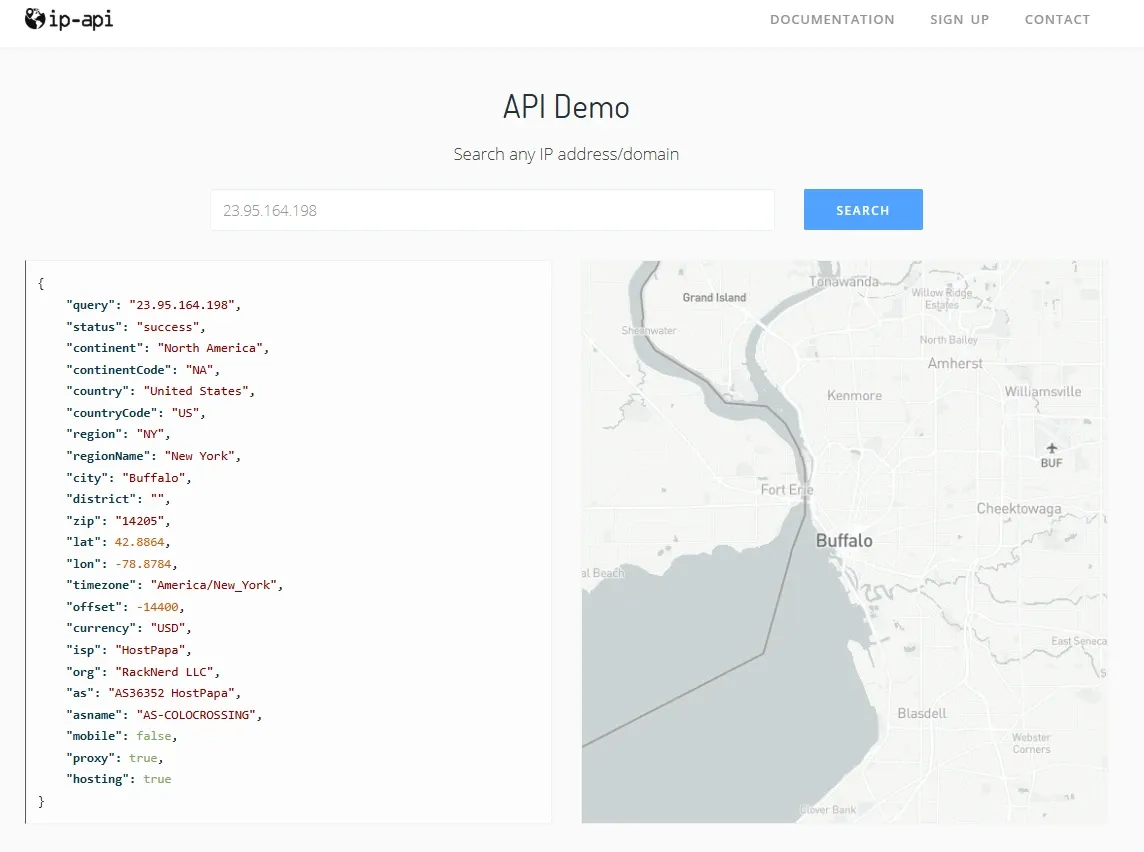
However, you can specifically test the DNS server(s) handling the queries with DNSLeakTest after configuring the proxy on a supporting browser (such as Firefox) or the entire operating system.
The key objective of these tests is to ascertain that the proxy IP indeed belongs to a cellular company and resolves to the advertised locations. Don’t conclude the entire pool is mobile from testing a single IP. Check at least a fraction (10-20 randomly picked IPs) after applying all required filters for location, carrier, and OS.
Stage 2: Check proxies against your target
Next, it’s time to see how the purchased IPs perform against your specific target website. We suggest grabbing at least 50-100 IPs and using our free proxy tester.
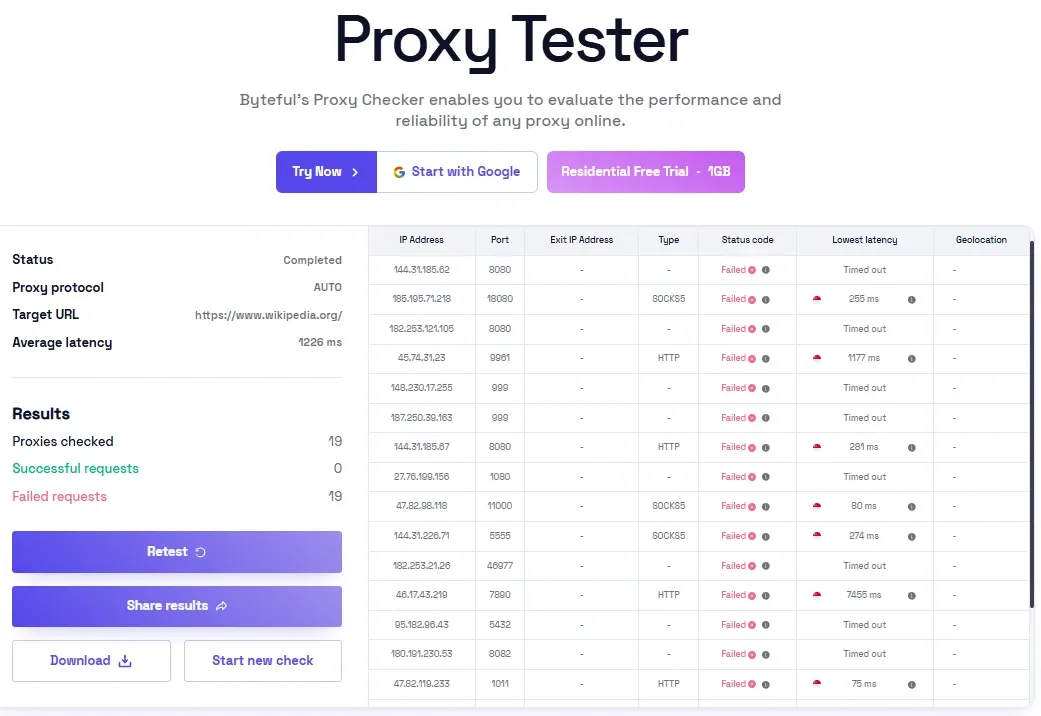
This is completely free and allows you to test 100s of IPs in one go for their protocol, latency values, geolocation, and more. In particular, the image above illustrates the plight of free proxy servers and gently reminds you to avoid using them against medium- to high-risk targets. The blank fields indicate the proxy IPs didn’t connect to the target at all or even reach the testing server, which is needed to report their protocol and geolocation.
However, since getting free mobile IPs is pretty difficult (because they are a premium commodity), you should expect better success rates and more information with proxy tests like these.
Stage 3: Pilot-level production run
We have invested a ton of resources into developing our proxy tester that you’ve seen in the previous section. Still, there is one important caveat: it tests from our servers and not the ones that will actually underpin your workflows. Also, no proxy tester can replicate a few production-specific factors, including request volume, concurrent sessions, and device fingerprints.
Therefore, we recommend doing a pilot run to mimic your production environment and workflow. You should test all the providers that made it to this stage. For every provider, run the exact same workload and track multiple parameters, such as success rates, number of blocks/CAPTCHAs, latency, timeouts, errors, geo-accuracy, and data consumption.
Finally, analyze all that data across all proxy providers. Or feed that information to an AI assistant like Claude or ChatGPT and draw insights from its output.