


Instagram's complex design and advanced anti-bot measures pose technical difficulties for scraping, such as login walls and complex anti-bot technology, as well as constantly shifting API endpoints, which can lead to scraper failures. The choice of the right tool depends on a combination of data needs, desired metrics, and budget.
In this guide, we compare the APIs, no-code tools, and open-source options, with pricing, limits, and the trade-offs of each.
Why scrape Instagram
It may be a snapshot or an ongoing feed. Discovery of influencers and market research are just snapshots. Brands rely on followers, engagement, and verification to create creator lists, and researchers read hashtag feeds for seasonal demand. Brand monitoring and competitor analysis are continuous and not one-shot.
AI teams gather images and captions in bulk, and lead generation extracts contact details from publicly available bios, involving a greater privacy risk.
What makes Instagram so hard to scrape?
Meta says it usesseveral methods to distinguish unauthorized automation from normal use, including rate limits, data limits, and behavioral patterns, but it doesn't publish a checklist for detecting it. What is documented is where scrapers fail.
- Fingerprinting: TLS fingerprints are able to differentiate between raw HTTP clients and browser-like traffic, such as JA3-style signals. Instagram public web endpoints can be sensitive to TLS fingerprints as of now, although Meta doesn't disclose what they use to detect this.
- IP reputation: The reputation of the network and requests you use matters. DIY scrapers can use consumer network IPs through residential and mobile proxies, but neither type guarantees access or prevents account-level restrictions.
- Authentication: Some public data is available without authentication; other unofficial workflows may require authentication and retain the session using a sessionid cookie.
- Account state: Responses from unofficial clients can indicate account-state or verification issues rather than network issues: challenge_required and checkpoint_required are identity challenges; feedback_required can signal an action block. These are separate but related anti-abuse states as found in the current clients.
- Rate limits: Throttling (429) is the response received from Meta when the number of requests is too high. Although Meta does not publish a stable scraping rate per IP, these limits are subject to change. A 401 instead signals an authorization problem.
- Changing sources: Unofficial tools use Instagram's public GraphQL endpoint and private mobile API endpoint. Public web routes can change and be blocked independently, and web routes using newer GraphQL helpers will use doc_id instead of the no-longer-effective query_hash. For large result sets, use cursor-based pagination. Recent client issues show that GraphQL requests can return HTTP 200 without the expected data, meaning the request may succeed but return no valuable information to the client.
Meta's official APIs are narrower but more stable. They focus on Business and Creator accounts and require Advanced Access, App Review, and Business Verification to serve pro accounts that aren't owned or managed.
Types of Instagram scrapers: What’s the best pick?
We grouped these tools by use case because a pipeline developer and a marketer need completely different solutions. Find the exact tool for your specific goal below.
Best Instagram scraping APIs
Performance figures below are based on Proxyway's Instagram Scraper Test, one of the tougher independent tests in this area, running 14,000 requests at two requests per second, and our analysis of each tool.
Bright Data
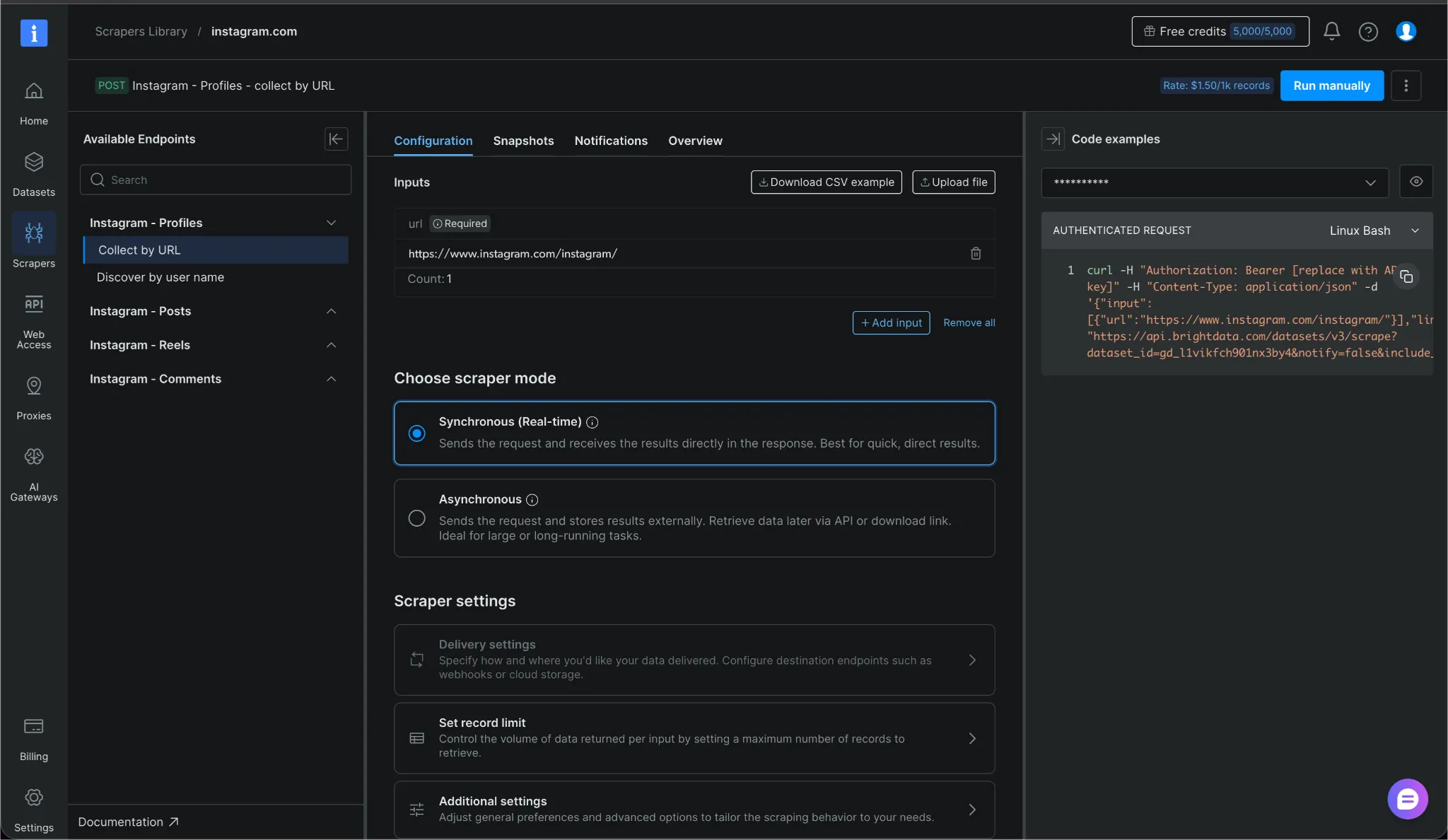
Bright Data is built specifically for Instagram rather than adapted to it, the only tool here designed that way. It has dedicated endpoints for profiles, posts, Reels, and comments, and includes a choice of JSON, NDJSON, or CSV to ensure you get parsed records with no selectors to maintain. Collection is live or batch and is pay-per-success.
Prices are per record, not per request. There is a free tier for 5,000 records per month, and a $1.50 per 1,000 records pay-as-you-go tier, while a monthly Scale plan costs $499 and offers 384,000 records per month.
Pros
- No parsing on Instagram records
- Real-time and batch modes
- Blocked requests aren’t charged
Cons
- Proxyway excluded it from its recent Instagram benchmark, so there’s no comparable figure
Choose it if you’d rather not maintain a parser at all.
ScrapingBee
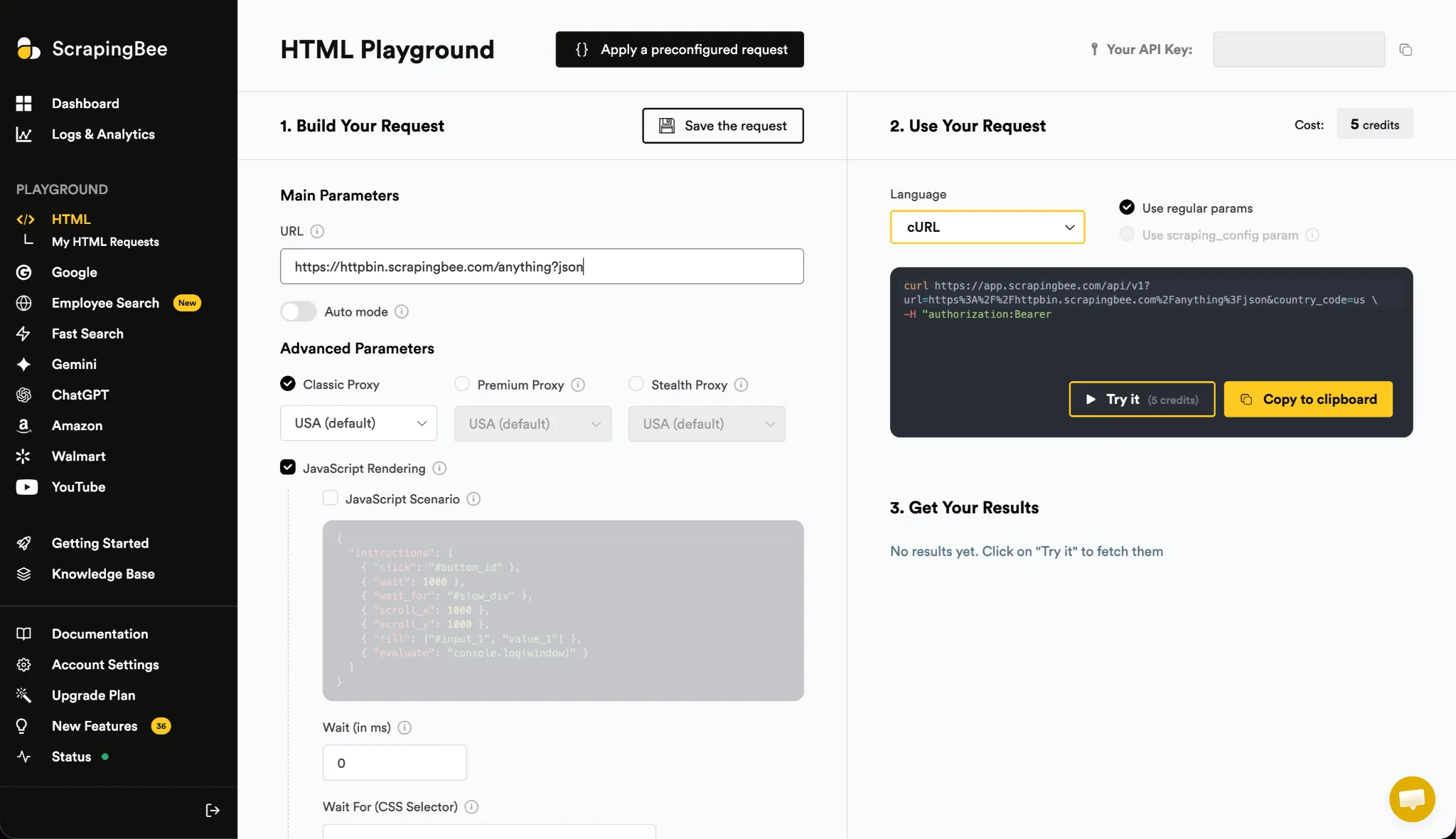
ScrapingBee is a general-purpose API, not an Instagram specialist. You post a URL and get HTML back; rendering, high-quality proxies, headers, and extraction rules are all per request. It was the best of the group, with a 99.65% success rate and an average of 4.54 seconds.
Know the credit model prior to budgeting; plans sell credits, not requests. A Classic request is 1 credit with no JavaScript or 5 credits with JavaScript; a Premium request is 10 credits with no JavaScript or 25 credits with JavaScript; and a Stealth request is 75 credits. That means that the 250,000 credits of the $49 plan are 50,000 rendered requests, or 3,300 Stealth ones.
Pros
- Excellent success rate and response time
- 1,000 free credits
- SDKs for Python, Node.js, PHP, and Ruby
Cons
- No dedicated Instagram schema; need to create extraction rules or parse returned HTML
- Unused credits will expire each month
If you are looking for a dependable choice and you can truthfully model credit burn, then choose it.
Zyte
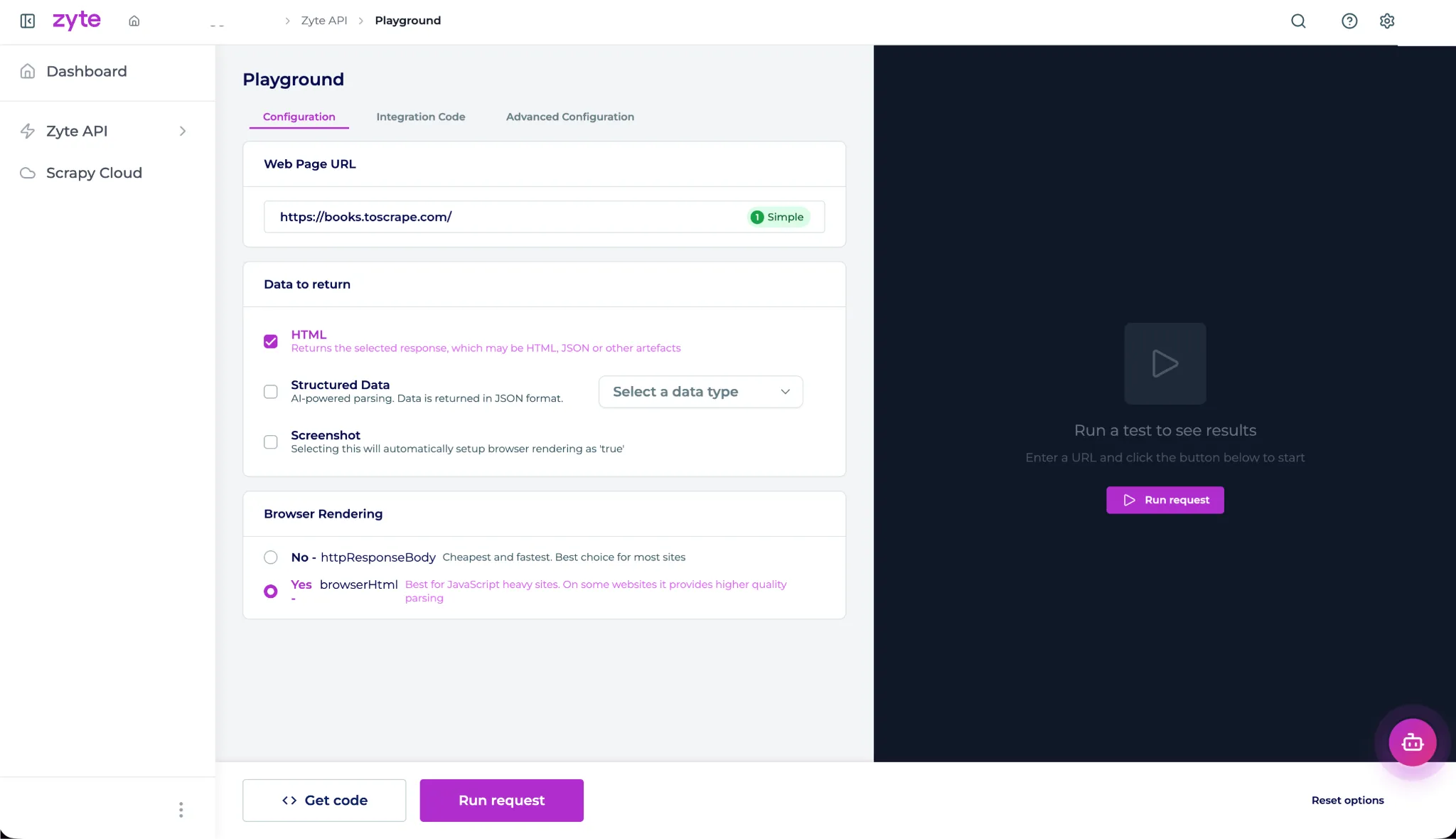
Zyte is also used for general-purpose, all-browser rendering, IP rotation, persistent sessions, and scriptable browser actions at one endpoint. It measured 98.63%, averaging 11.64 seconds.
It's priced in contrast to ScrapingBee. Zyte has 5 difficulty levels for HTTP and 5 levels of browser requests, assigns the tier automatically, and charges a price for it: $1.01 per 1,000 responses for browser-rendered requests, $0.13 per 1,000 responses for HTTP requests. Failures cost nothing. The trade-off is predictability, and you don't know a target's tier before you scrape.
Pros
- Failures aren’t billed
- $5 trial credit for 30 days
- Browser actions handle multi-step navigation
Cons
- No Instagram schema
- Due to the wide spread between browser tiers, budgeting is not precise
- Slower than ScrapingBee
Use it when you have to have scripted navigation for your jobs, or if you don't want to pay for blocked requests.
Best no-code and visual tools
They package these into an interface, and you can choose what to collect without having to create the scraper. We've continued to focus on tools that integrate Instagram workflows and noted those that require an Instagram account.
Apify
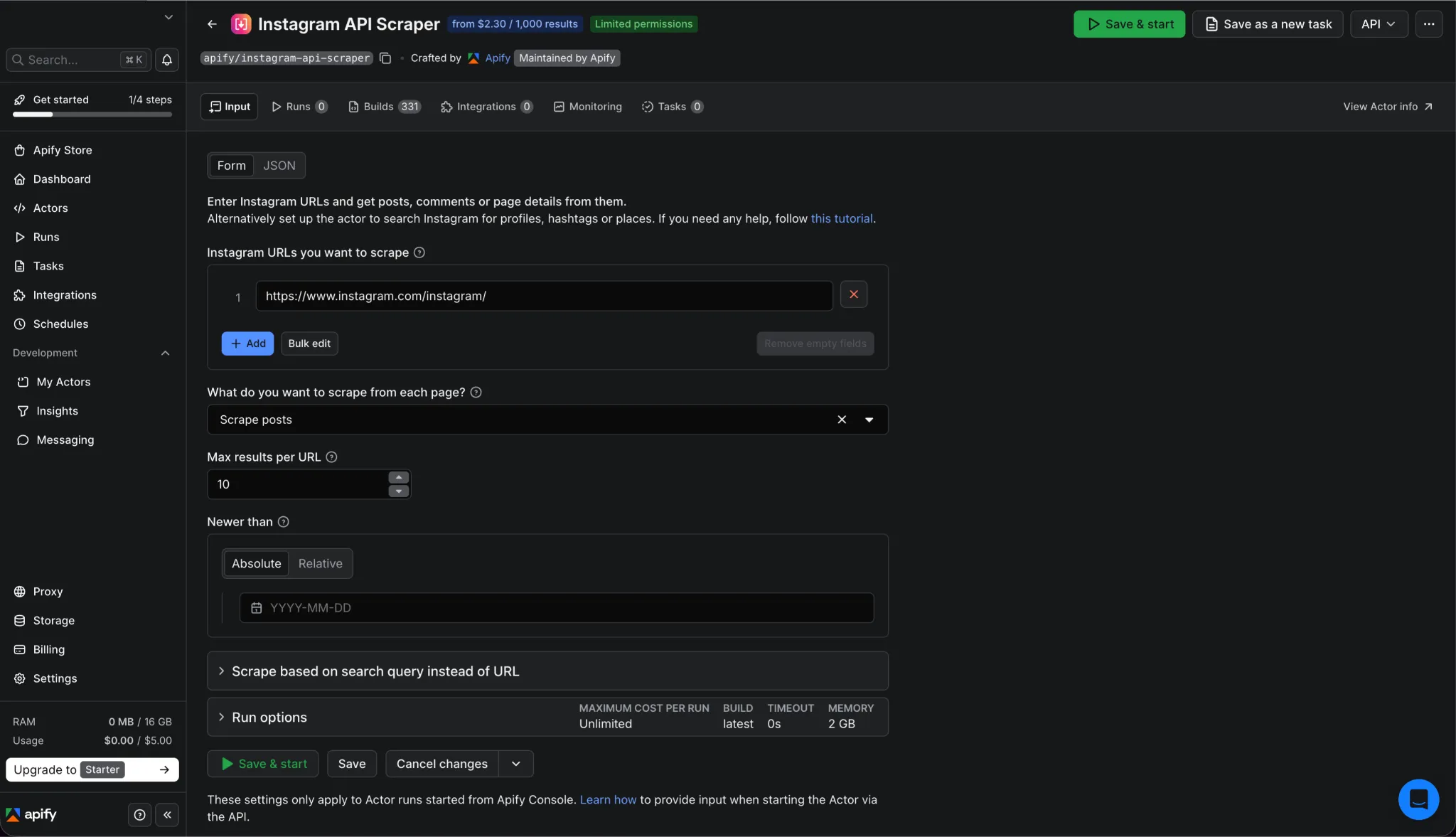
Apify's maintained Instagram Scraper is a prebuilt, cloud-based scraper. In the console, you choose a content type (Posts, Reels, Comments, Mentions, or Details for profiles, hashtags, places), and then copy and paste matching URLs. The output is in JSON, CSV, or Excel format. It was measured using the batch job: 5,956 results in 22m 42s.
Billing is based on plan size, ranging from $2.70 per 1,000 at the free tier to $2.30 per 1,000 at the Starter tier and $1.50 per 1,000 at the top tier.
Pros
- A wide range of content types are covered here
- Accompanied by their schedule, webhooks, and integrations
- API access on every plan
Cons
- Less control over request limits and proxy behavior than a DIY scraper would offer
Use it when you need frequent collection across multiple content types but aren't going to write code.
PhantomBuster
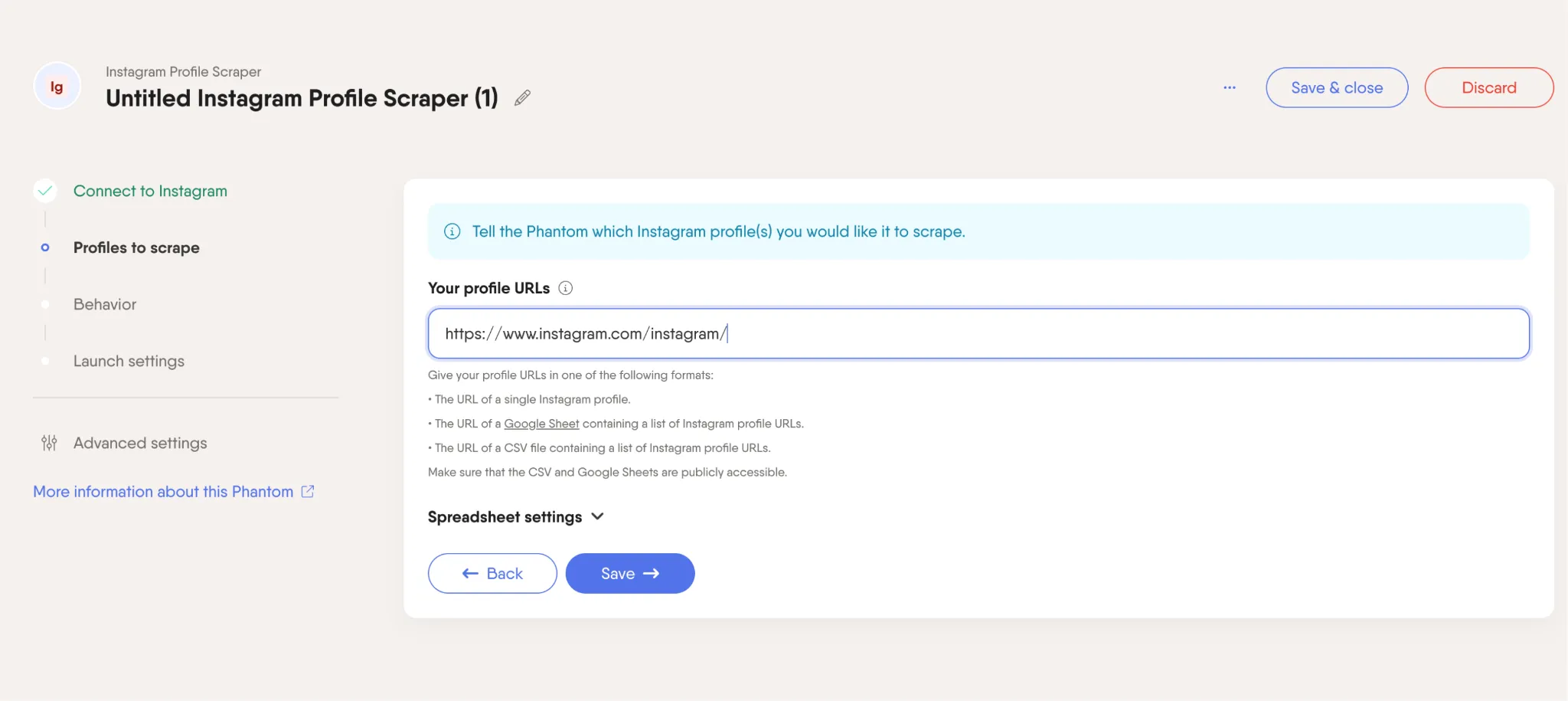
Designed to collect for specific research, using automations known as Phantoms that can be linked into workflows. Instagram Profile Scraper gets you the username, profile full name, description, category, website, follower count, following count, post count, public contact info (if provided), and private and verified account flag.
Two things separate it from everything above. It doesn't charge by result but by execution time: 20 hours of execution per month in the Start plan, depending on the automation used and the size of the job. And there must be a linked Instagram account for each and every run.
Pros
- Provides public contact information and detailed profile information
- Results are chained into other Phantoms and pushed to the CRMs
Cons
- Requires an account and session ID, so account risk is yours
- Execution hours don’t roll over
- Trial exports cap at 10 rows
Choose it if you are adding to a defined list of profiles and don't mind the exposure of the account.
Note: Octoparse currently lists Instagram.com as a restricted target and says direct Instagram extraction isn't supported, so we haven't included it as a recommended Instagram scraper.
If you only want the data and not a scraper to run, some providers sell it pre-collected. Bright Data offers Instagram datasets from $250 per 100,000 records, and Apify's Instagram Scraper generates downloadable datasets as it runs, from $2.70 per 1,000 results on its Free plan.
At the other end of the spectrum are the tools you run and maintain yourself.
Best open-source (DIY)
Open-source scrapers offer more control but require you to manage sessions, rate limits, proxies, and repairs when Instagram changes. All three are free, and you need to choose which one you want more control over. Two of them are Python, and most of this is just good old-fashioned Python web scraping against an unwelcoming target.
Instaloader
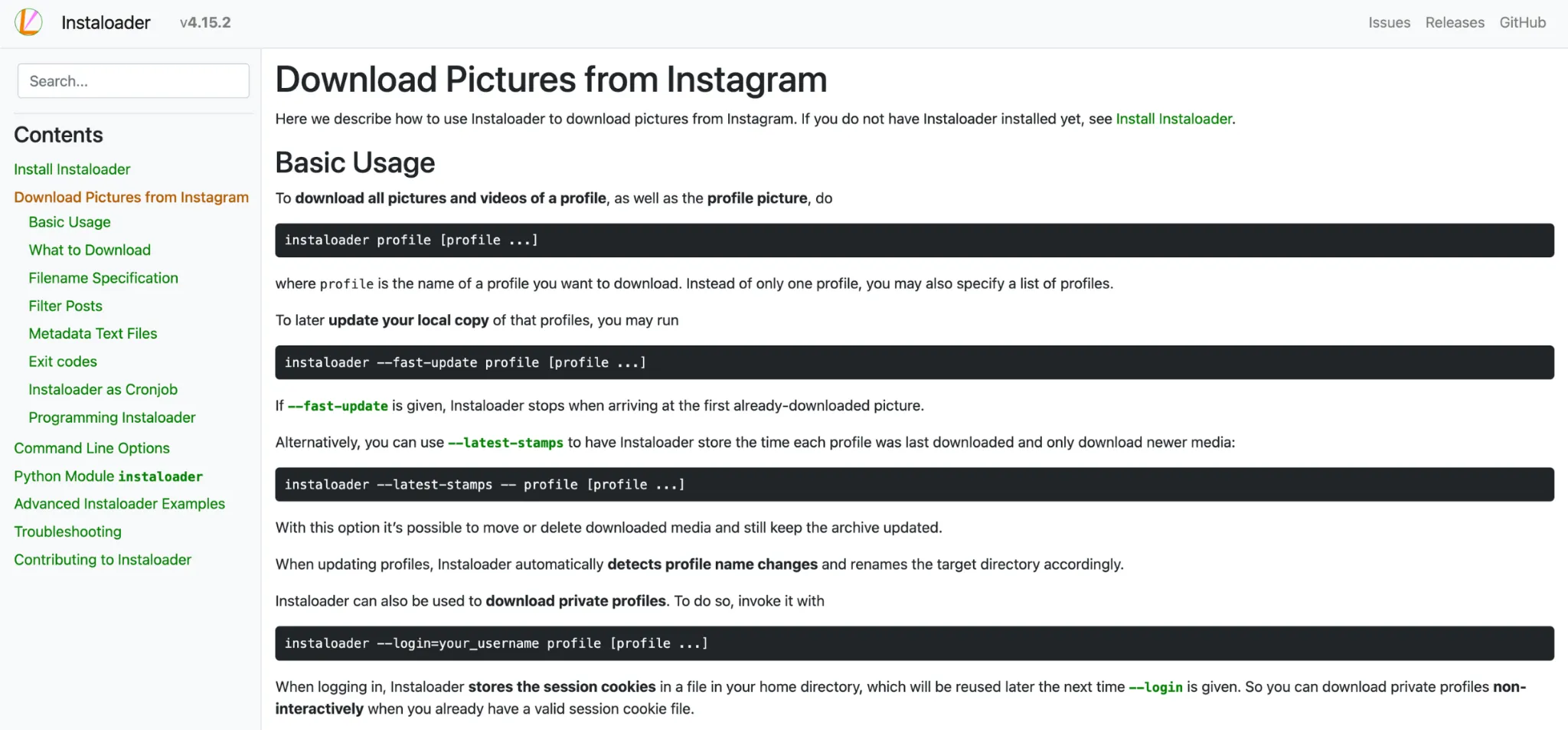
Instaloader is a Python program that supports downloading profiles, posts, Reels, Stories, hashtags, comments, and captions. Recurring logged-in jobs are easier to manage thanks to saved session files.
The difference lies in proxies: Instaloader doesn't mention a native proxy option in its CLI, and you configure a proxy separately from the normal command-line process.
Before troubleshooting an Instaloader failure, a Proxy Tester will test connectivity, exit IP, and location. If you are primarily looking to archive content, then go with it.
InstaTouch
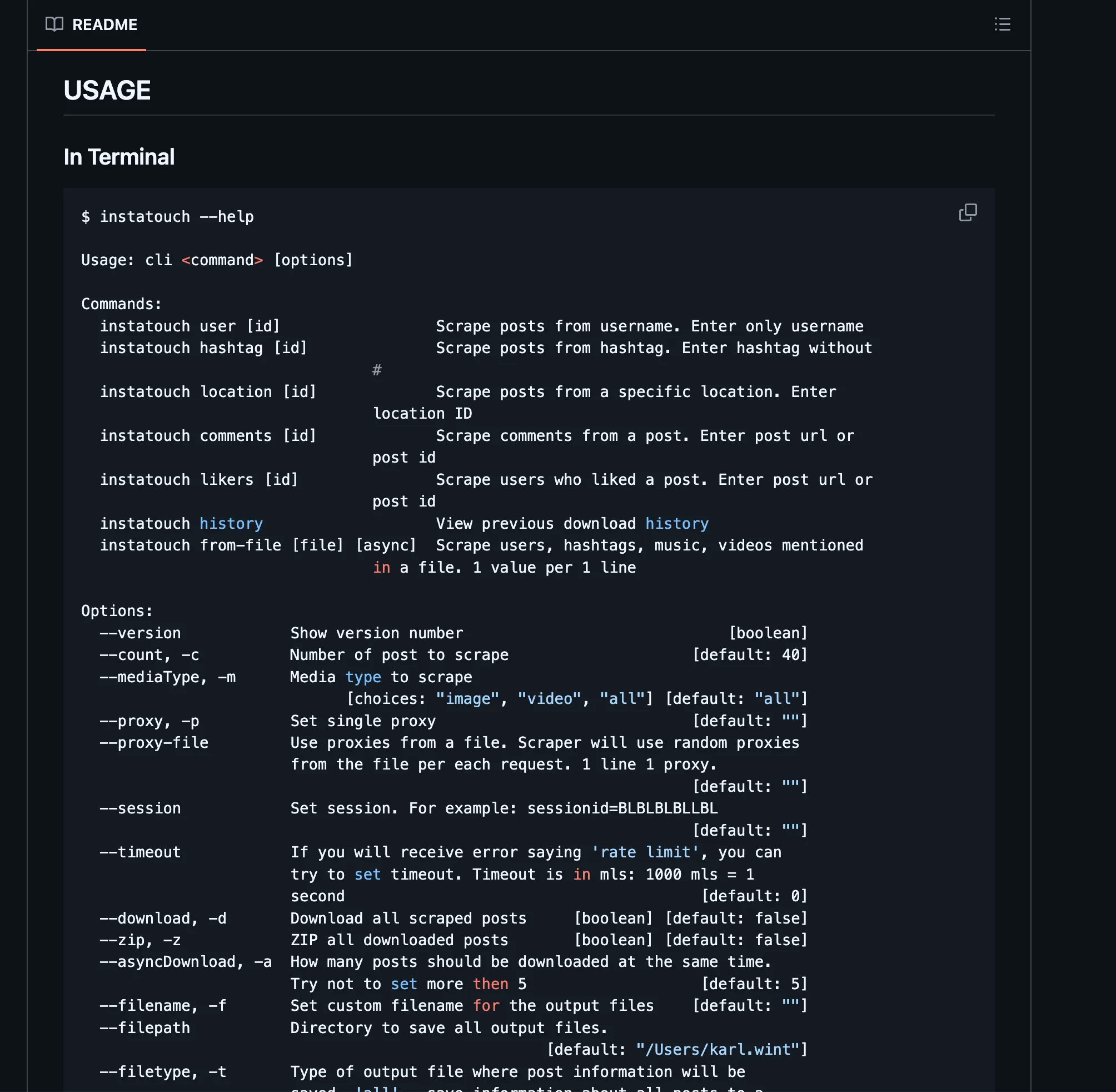
InstaTouch is a Node Scraper for Users, Hashtags, Location, Comments, followers, and Likers. It has more setup options than the others: --proxy and --proxy-file, which can rotate from a list, and --session, --timeout, and endCursor pagination.
The headline states that you don't need to log in, but in the list of features, for users, hashtags, likers, and followers, you do need an active session. It is for Node v8.6 and is based on an older behavior. Select it if you are looking for a base to modify.
instagrapi
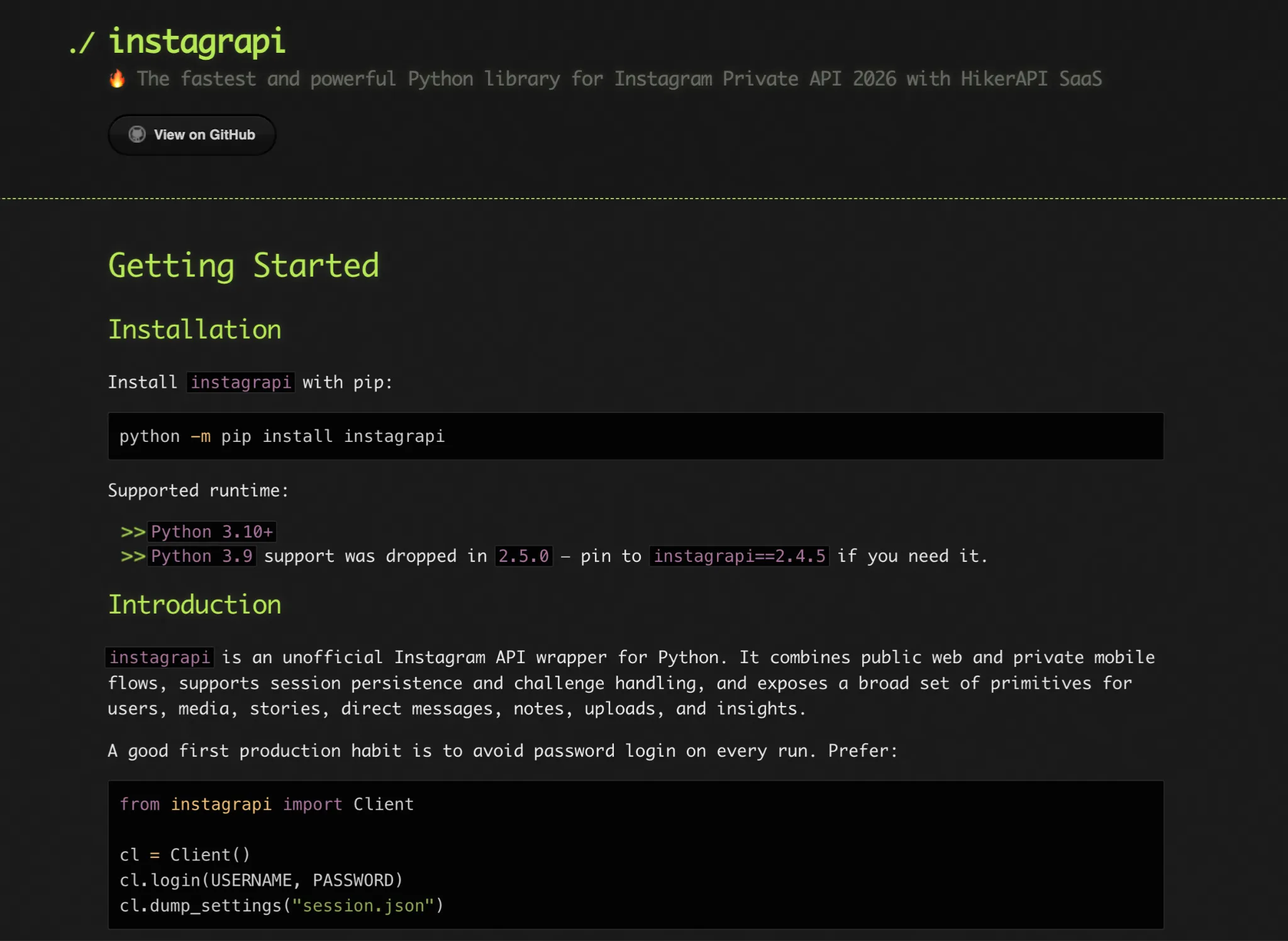
instagrapi includes public web data, in addition to the unofficial private mobile API for profiles, media, reels, stories, comments, sessions, proxies, and challenges. It has challenge-resolver hooks for authenticated workflows too, and can resolve challenges by email or SMS.
Use it if you need advanced or authenticated Python workflows. It's a little more flexible, but there are a few more facets like sessions, account state, and rate limits.
Why use proxies with DIY Instagram scrapers?
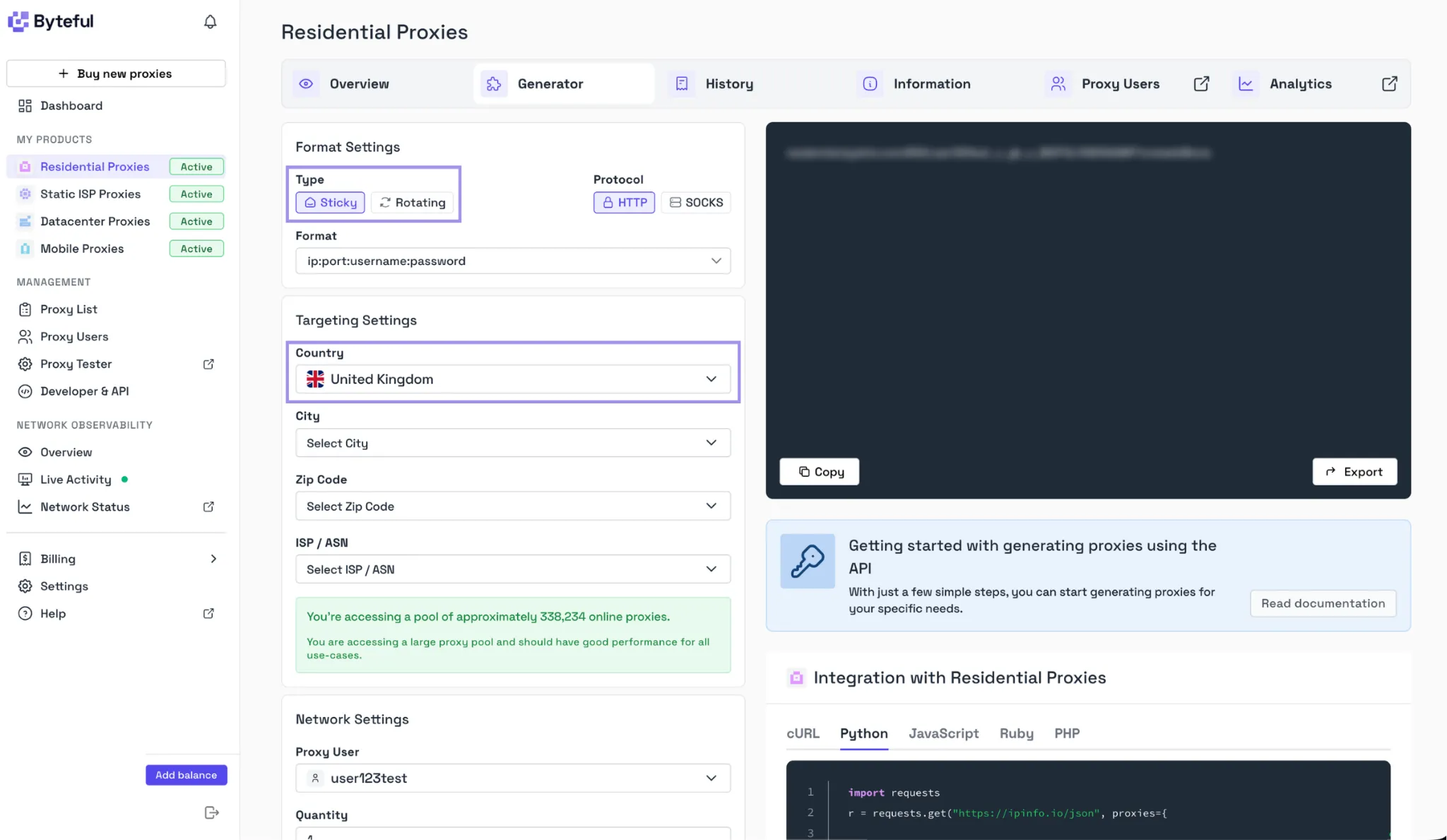
Managed APIs handle proxy infrastructure for you. With DIY tools, the Instagram proxy setup is yours: proxies let you route requests through different IPs, or keep an authenticated session on a consistent IP when continuity matters.
In Proxyway's 2026 Proxy Market Research, Byteful's residential pool led the aggregate Amazon, Google, and Instagram target benchmark at 81.23%. It also posted the fastest global mobile response time at 0.48 seconds, and 0.40 seconds in the UK mobile pool.
For authenticated social media proxy workflows, session and IP consistency can matter. A sticky session is better than rotating if you want continuity in a workflow. Where a session must persist for days, static residential IPs hold one address.
Routing is the other half, and hand-tuning per request doesn't scale. SmartPath may route the request through datacenter IPs instead of residential IPs to decrease the amount of bandwidth used from residential IPs, but we recommend caution on targets that have sensitive fingerprinting, and the requests do not maintain sticky-IP parameters.
We provide the network layer, not the scraper, so authentication, pacing, and Instagram's errors are yours to handle.
Test the routing before committing. New accounts receive 1GB of free residential data for 24 hours, which is enough to test the exit IPs of your account to ensure that they work correctly with a live target.
How to choose an Instagram scraper
Work through these before you shortlist. Most of them narrow the field faster than price does.
- Account access: This is the first to divide the field. Some of the managed APIs that gather public information do not require your Instagram login credentials, and PhantomBuster and a few DIY workflows require a session.
- Collection frequency: Short lists are appropriate for APIs and data sets. API based workflows can be scheduled in your stack, and recurring monitoring needs scheduling, which Apify does.
- Field coverage: A tool that works really well on profiles can't necessarily provide follower lists or comments in the same fashion. Look out for this before you pay.
- Parser upkeep: With endpoint-based solutions, you will get structured records and are less exposed to Instagram's front-end updates. General-purpose APIs give you HTML, which is less expensive per request, but a maintenance ticket each time the layout changes.
- Billing unit: Credits, results, execution time, and successful responses are four different meters, and the cheapest headline rarely wins. Price your hardest target, not the base rate.
- Failure billing: Zyte only charges for successful responses; Bright Data advertises pay-per-success records, and ScrapingBee uses up credits based on the request configuration.
- True cost: Check the benchmark before accepting its results to ensure it was run in a similar way. From 99% to 89% represents 10 more failures per 100 attempts, which equates to retries, IP rotation pressure, and cost per usable record under similar conditions.
Is scraping Instagram legal?
In the USA, the scraping of public data is not necessarily prohibited, but not all projects are legal.
The rules of the platform are otherwise. Meta states that automated collection without permission violates its terms even when the data is visible to users, and it litigates.
The best, recent example is Voyager Labs. Meta sued the surveillance firm in January 2023 for allegedly using fake accounts to scrape data accessible to logged-in users, such as their profile details, posts, friends lists, photos, and comments.
Meta's complaint centered on the fake accounts and the fact that Voyager accessed data while logged in rather than as an anonymous visitor.
In December of 2024, the case was resolved with Voyager agreeing to a permanent injunction barring it from Facebook and Instagram, as well as a monetary payment to Meta.
There are obligations that come with personal data. The GDPR expressly contemplates information collected from publicly available sources; that data must still comply with the obligations. Photos and captions pose separate considerations since the content itself is protected work.
The question of whether the reuse is fair use is decided on a case-by-case basis. This information is general and not legal counsel; seek counsel before anything commercial or large-scale.
