

Finding the best ISP proxy provider isn’t straightforward, as it’s not simply about the biggest IP pools, raw speed numbers, or unlimited bandwidth claims. There are ISP-related aspects, such as ASN diversity, uptime, and network monitoring, which matter more when putting a good ISP IP to work. Besides, user feedback across platforms, such as G2 and Trustpilot, also indicates a proxy provider’s market reputation.
Covering all of these details, we have rounded up top-shelf ISP providers and included the strategy to test an ISP proxy before purchase to help you make the right choice.
What is an ISP proxy, also known as a Static Residential Proxy?
A static residential or ISP proxy is an IP address linked to internet service providers but hosted in a data center. They are called “static” because their IPs don't rotate or change like regular residential proxies, making them great for session continuity.
Because of their ISP origin, security systems don’t classify them as datacenter IPs, which helps them evade swift blocks. Besides, you can expect near datacenter-level performance since they aren’t tied to real-world bottlenecks.
Best ISP proxies at a glance
| Provider | Best For | Shared/Dedicated | Highlight feature | Per-IP Cost (100 dedicated IPs Plan) |
|---|---|---|---|---|
| Byteful | Ethically-sourced, KYC-clean ISP IPs | Dedicated | Dedicated IPs from top-shelf ASNs (AT&T, Comcast, Glide Spectrum, RCN, Virgin Media) | $2.75/IP |
| Oxylabs | Premium ASNs / enterprise reliability | Both | Dynamic IP rotation with unlimited session duration | $2.70/IP |
| Bright Data | Global coverage / largest pool | Both | 100 GB fair usage allowance per IP per month | $2.75/IP |
| IPRoyal | Affordable dedicated ISP | Dedicated | No bandwidth and session length limits | $2.85/IP |
| Webshare | Budget/self-service | Both | Stated no logs/tracking for dedicated proxies | $1.785/IP |
| Decodo | Beginners | Both | IPs sourced from premium ASNs (AT&T, Verizon, Orange) | $2.6/IP |
| ProxyEmpire | Customer support | Dedicated | Hybrid billing model | $2/IP (flat rate) (+separate data costs) |
| Geonode | Low cost | Both | US ISP proxies | $1.4/IP |
Best ISP Proxy providers in 2026
Byteful: Best for Ethically-Sourced, KYC-Clean ISP IPs
Byteful (formerly Ping Proxies) is one of the most performant proxy providers, which recently also won Proxyway's Newcomer of the Year 2026 award. This was an independent study conducted by Proxyway, where we competed against twelve well-known names, including veterans such as Oxylabs and Decodo.
We scored brilliantly across many metrics with great numbers, including the fastest residential proxies (0.41s), the best residential success rate (81.23%) against real-world targets, and many more.
Needless to say, that goodness also translates to our ISP offering.
Features
- Dedicated IPs from top-shelf ASNs (ATT, Comcast, Glide, Spectrum, RCN, Virgin Media)
- Advanced country and city-level geo-targeting
- HTTP & SOCKS5 compatible
- Username/password and IP whitelisting support
- Ethical IP sourcing policy and KYC'd users
- Smartpath AI routing (for residential and mobile proxies)
- Granular level control with access control (ACL) rules
- Live network activity view from an intuitive dashboard
- Free Proxy tester and proxy formatter
- No-credit-card 1GB free residential data
- REST API access
ISP Base Pricing: $30/month for 10 IPs (dedicated).
User feedback (G2/Trustpilot): Upvoted for genuine residential ASNs, fast speeds, friendly customer service, and great uptime. Downvoted for the comparatively higher price.
Oxylabs: Best for Premium ASNs / Enterprise Reliability
Oxylabs sources its static residential proxies from premium ASNs (including Lumen and Comcast) to offer decent success rates against sophisticated targets. Currently, they offer 20+ locations for their ISP proxies, covering major American, European, and Asian markets.
You can also integrate Oxylab ISP proxies with 3rd-party tools, such as Puppeteer, Selenium, AdsPower, and more.
Features
- Dynamic IP rotation and unlimited session duration
- HTTP(S)/SOCKS5 support
- Usage and spend tracker
- Free on-request (via email) trial
- Shared and dedicated IPs
- In-house scraping tools (scraping and search APIs)
- AI-powered scraping workflows
ISP Base Pricing: $16/month for 10 IPs (shared) and $16/month for 5 IPs (dedicated).
User feedback (G2/Trustpilot): Upvoted for stable connections, good support, and reliable service. Downvoted for high price (for small users) and complicated refund process.
Bright Data: Best for Global Coverage/Largest Pool
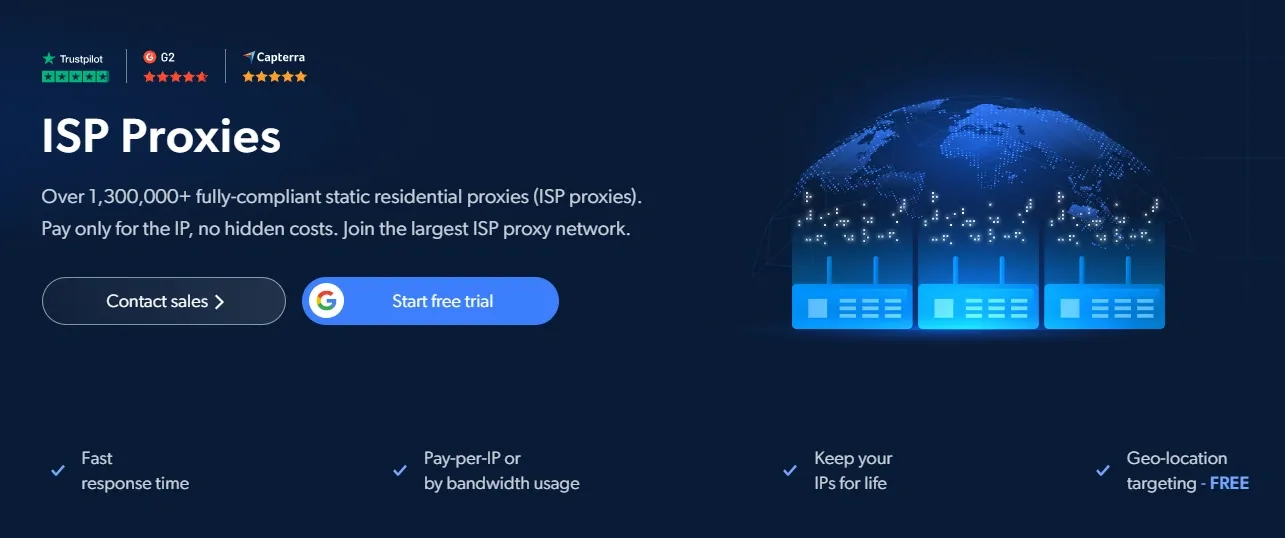
Bright Data boasts over 1.3 million ISP proxy IPs, one of the largest pools in the entire proxy industry. Every subscription comes with quick response times, free geo-targeting, and the stated ability to keep IPs forever.
It also features one of the longest lists of integrations, which include leading headless browsers, anti-detect tools, CAPTCHA solvers, and API platforms.
Features
- Flexible subscriptions (shared, dedicated, and bandwidth-based)
- Control panel and API-led IP management
- HTTP(S)/SOCKS5 support
- Free trials across all tiers
- Real-time network monitoring
- 100 GB fair usage per IP per month
- Native scraper APIs
- Pre-collected databases
ISP Base Pricing: $18/month for 10 IPs (shared), $35/month for 10 IPs (dedicated), and $8/GB (PAYG).
User feedback (G2/Trustpilot): Upvoted for ease of use and outstanding support. Downvoted for a higher price for smaller teams.
IPRoyal: Best for Affordable Dedicated ISP
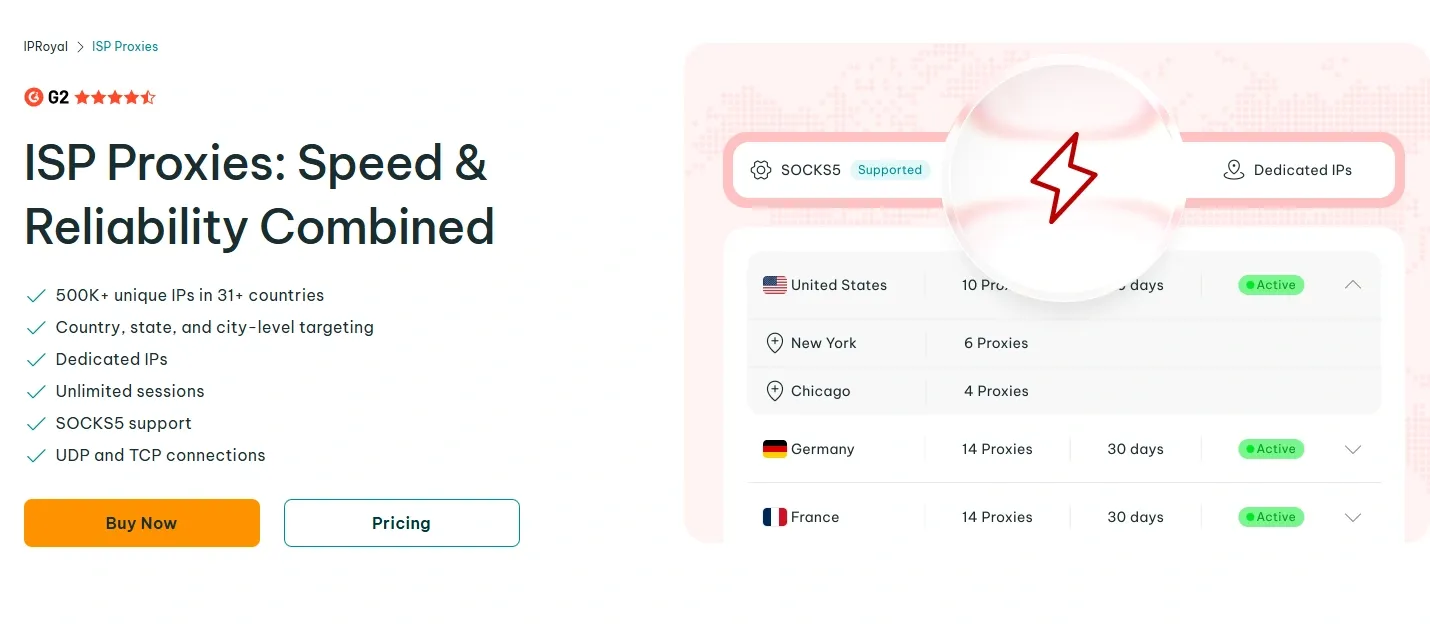
IPRoyal shines as a budget-friendly proxy provider with no bandwidth and session length limits for its ISP proxies. It covers ISPs from 30+ countries and offers 99.9% uptime to support your scraping operations round-the-clock.
Features
- HTTPS and SOCKS5 support
- IP whitelisting, 2FA, and role-based access control
- Flexible subscription lengths (24 hours to 90days)
- Intuitive user onboarding
- Integration with 650+ tools
- City/state-level geo-targeting
ISP Base Pricing: $2 for 1 proxy (24 hours)
User feedback (G2/Trustpilot): Upvoted for ease of use, customer support, and stable connections. Downvoted for slow speeds.
Webshare: Best Budget / Self-Service
Webshare is known for its free-forever tier (datacenter IPs, however) and beginner-friendly ecosystem. It features a self-service platform, which means you can sign up, use, scale, and cancel without needing to contact their 24/7 support.
It was acquired by Oxylabs in 2022, which suggests there might be some sort of behind-the-scenes infrastructure sharing.
Features
- Shared, private (semi-dedicated), and dedicated ISP proxies
- HTTP/SOCKS5 support
- 50+ Countries with 99.97% uptime
- Stated no logs/tracking for dedicated proxies
- Forever-free10 datacenter IPs (no-credit-card needed)
- Browser extension and API access
ISP base pricing: $6/month for 20 IPs (shared), $23.16/month for 25 proxies (private), and $25.20/month for 10 IPs (dedicated).
User feedback (G2/Trustpilot): Upvoted for responsive support, good speeds, and stability. Downvoted for frequent blocks and self-service.
Decodo (formerly Smartproxy): Best for Beginners
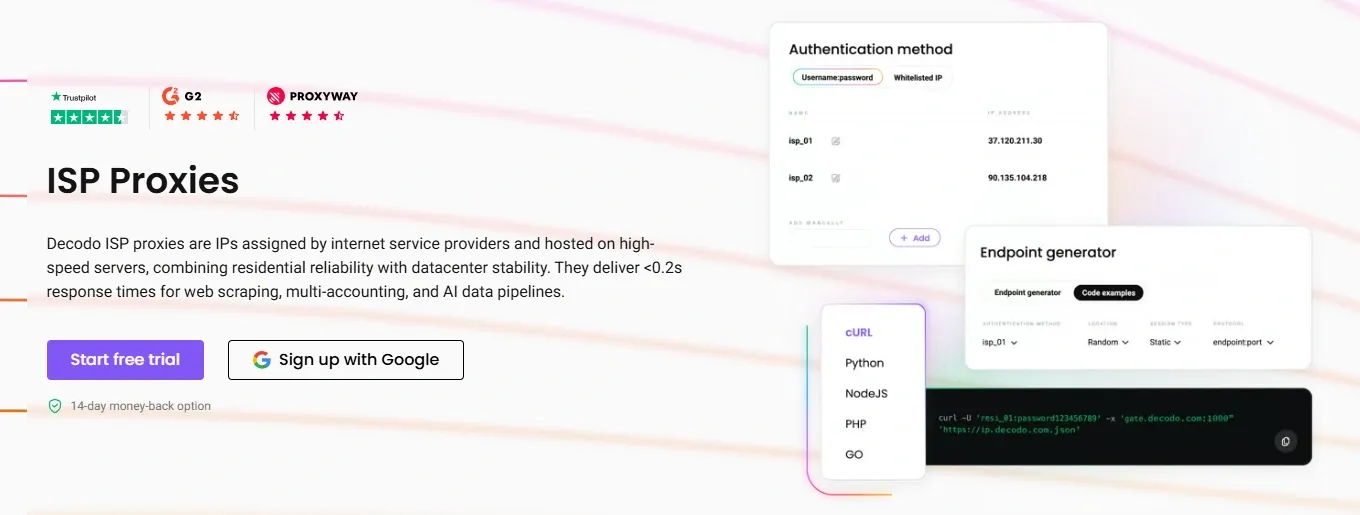
Decodo is a beginner-friendly provider that offers quick response times and IPs sourced from premium ASNs (such as AT&T, Verizon, and Orange). It also has multiple pricing models and a good enough geographic coverage that varies based on the plan.
Decodo also ships AI-ready tools, which can come in handy for plugging in LLM agents with real-time data. Finally, you have their browser extensions (Chrome and Firefox) to set up and manage proxies with ease.
Features
- Dedicated (per IP) and shared (per GB and per IP) ISP proxies
- City, state, and ASN-level geotargeting
- Live usage statistics
- HTTP(S) and SOCKS5
- 99.99% Uptime
- 3-Day 100MB trial
ISP base pricing: $9.99/month for 3 IPs (dedicated), $3/GB for 1GB (pay per GB), and $4.7 for 10 IPs (pay per IP).
User feedback (G2/Trustpilot): Upvoted for good performance, user-friendly interface, and great customer support. Downvoted for slow IPs and constant timeouts.
ProxyEmpire: Best for good customer support
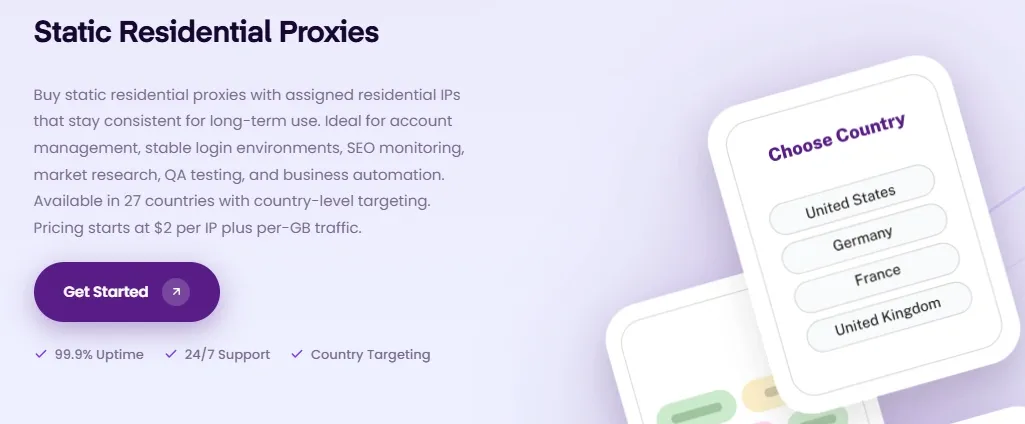
ProxyEmpire is an entry-level proxy provider that currently offers static residential proxies across 25+ countries. Other than ISP, it has some really interesting products in its portfolio, including unlimited bandwidth residential proxies with speed-based subscriptions, contrary to the per-GB plans this industry offers generally.
You will also love the global proxy coverage map, which straightaway shows the number of IPs from the selected location pin. However, this only mentions residential, mobile, and datacenter IP numbers, giving ISPs a miss.
Features
- Country-level targeting
- Fixed IPs with no rotation
- API-led proxy management (optional)
- HTTP, HTTPS, and SOCKS5
- Hybrid billing structure (per-IP and per-GB)
- Username-password authentication
ISP base pricing: $2/month/IP plus $20 for 7GB data.
User feedback (G2/Trustpilot): Upvoted for clean IPs, customer support, and uptime. Downvoted for high cost.
Geonode: Best for cost-effective ISP
We have featured Geonode multiple times for its free proxy servers, free SOCKS5 proxies, and more, but it also offers many other worthy products, such as its multi-tiered ISP proxies.
Besides, Geonode has a flat-rate, unlimited-requests scraping API and SDKs to support AI-heavy workloads. Overall, Geonode looks like it's trying to undercut other market players on price, and its user feedback suggests that approach has been paying off.
Features
- Unlimited bandwidth (fair usage caps still apply) per IP
- Shared (up to three users) and dedicated ISP
- HTTP(S) and SOCKS5 support
- Username/password and IP-allowlisting
- ISP proxies only in the US (*currently)
- API access
ISP base pricing: $5.25/month for 3 IPs (shared) and $10.50/month for 3 IPs (dedicated).
User feedback (G2/Trustpilot): Upvoted for low cost, customer support, and overall simplicity. Downvoted for low speeds.
How to pick the best ISP proxies
- ASN legitimacy: Check WHOIS/ASN records to verify if the IP really belongs to the advertised ASN and is not a datacenter IP reclassified as an ISP proxy since datacenter IPs don’t carry the level of trust owned by their ISP counterparts.
- Subnet diversity: IPs from the same subnet share the reputation baggage of other IPs from the same group. Therefore, action against a single IP can adversely affect others in that subnet.
- IP cleanliness/fraud scores: Take a handful of IPs and quality-check by running them through tools offered by services such as IPQualityScore and APIvoid. Try to avoid IPs with multiple blacklist mentions and higher fraud scores.
- Ethical sourcing & KYC: Make sure the provider has published a record of their ethical IP sourcing policy (not just claims) and whether they KYC their users to avoid malicious use. Without such a clear framework, IP stability and unnecessary legal exposure can be troublesome for a sustainable, high-stakes workflow.
- Dedicated vs. shared/semi-dedicated: Dedicated is best for solo IP use for high-risk tasks, whereas shared is preferred for a lower cost. Semi-dedicated provides a middle ground (a small number of users per IP).
- Pool size and location: Larger pools with more unique IPs mean less reuse frequency, which generally translates to greater access. Also, check if the provider offers geo-targeting locations/parameters for the specific use case.
- Success rate/speed: Since it’s generally not possible to get real, unbiased success/speed benchmarks, look for a trial and test it out yourself against your specific targets.
- Pricing model (per-IP vs per-GB): Running a small-scale production workload will tell you how much bandwidth it takes. In addition, you will know which pricing model works best for your use case.
- Session & rotation control: This is also based on your workflow, but it’s generally recommended to have both sticky sessions (logins, carts, multi-step flows) and on-demand rotation (if one IP gets banned or to evenly spread detection risks) control.
- Support: Look at whether a provider provides good support by analyzing user feedback on platforms, such as G2, Trustpilot, and even Reddit. We highly recommend a pre-sales chat to verify the support’s technical depth and availability.
How to test an ISP proxy before you buy?
Directly buying a subscription for your production workload without running a few checks (discussed below) on a small sample is never a good idea. Agree, there are 3rd-party tests that might provide performance metrics. However, what matters more to any user is how a proxy provider performs against their own targets, not against some random server.
Therefore, we recommend looking for a trial or subscribing to the lowest tier and performing these tests before committing to anything big. (If you’re still starting out, going through this proxy explainer will help, where you’ll learn about proxy routing, proxy types, protocol, and common myths to avoid).
Once subscribed, rotate through the pool to collect a decent sample size of 50-100 IPs and run the following tests.
Check Response Time and Success Rate
To help users steer clear of generic speed tests, we developed our own free Proxy Tester, where you can test multiple IPs against any specific target in one go.
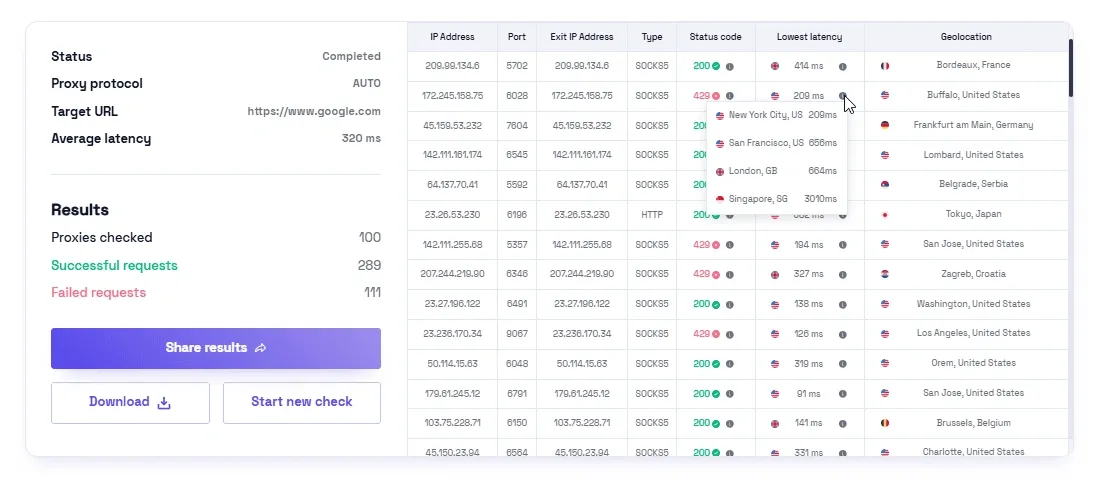
This gives you all the important parameters, including status code, latency, and geo-location, against your target website. Finally, you can easily download the results or share (with optional password protection) with others.
Ideally, one should run multiple tests (to verify consistency) with proxy servers that are closest to the target websites. This will make sure the latency figures are the best you can possibly get, since it’s generally better to choose a proxy server closer to your target.
Verify IP Reputation and ASN/Subnet Diversity
There are various tools from services such as APIvoid, Scamalytics, and Cisco Talos, which allow you to check proxy IP reputation.
For instance, APIvoid runs your IP against 70+ blacklists at once. In addition, you can check the ASN, geolocation, and anonymity level for each IP. Likewise, EasyDMARC is great for a simple view, indicating blacklist mentions and the IP location, and finally, Cisco Talos’s reputation checker outputs location, blocklisting, reputation, and email volume data.
But if you want to bulk check for free, this bulk IP reputation check from WhoisFreaks is a good bet. It allows analyzing 100 IPs at once, and you get detailed data for each IP, covering aspects such as security, location, connection type, and networking. You can also download the results in JSON.
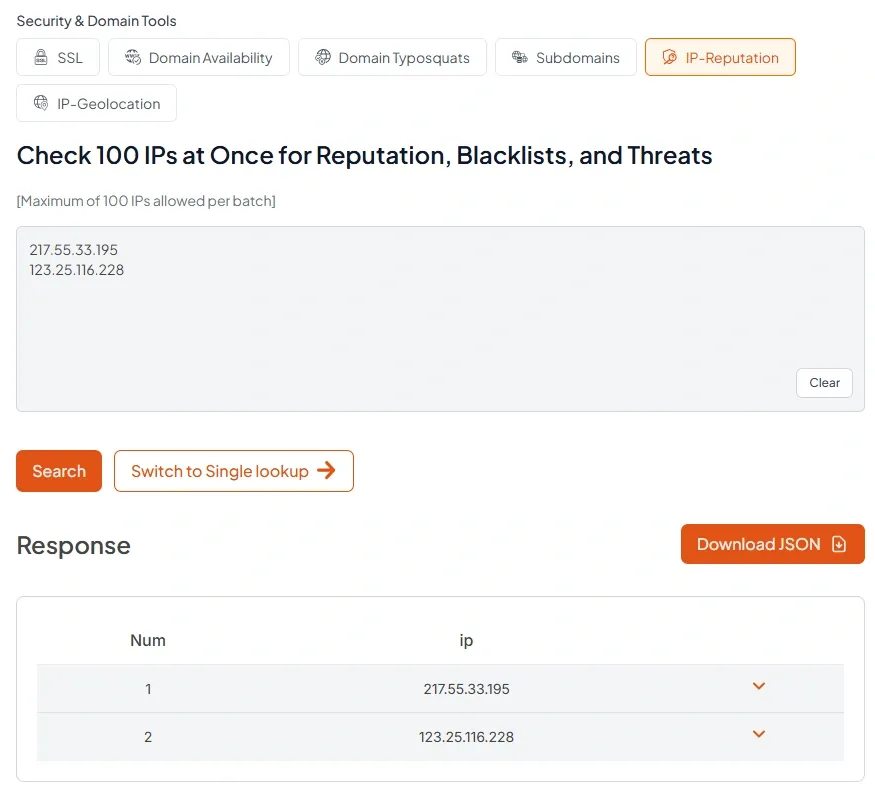
Importantly, don’t forget to confirm ASN diversity by running the sample from a similar bulk testing tool. Try to find a provider that can supply IPs from most ASNs for your subject location. And that must include the premium ISPs in that geography, because they carry minimal detection risk.
How do static residential proxies compare to residential proxies?
Here’s a detailed breakdown of how static residential and residential proxies stack against each other.
| Criteria | Residential proxies (rotating) | Static residential proxies (ISP) |
|---|---|---|
| IP source | Real end-user devices via peer/consent networks | Leased directly from ISPs, hosted on servers. |
| IP stability | Rotates per request or on a pre-configured interval | Fixed for the specified plan. Rotation is mostly possible only on request. |
| Speed | Depends on the end-user's actual connection quality | Consistently fast due to datacenter origin |
| Uptime reliability | Less, because of real-world bottlenecks | Generally high because of server hosting |
| Session persistence | IP can change mid-session unless sticky sessions are preconfigured | The same IP persists for the entirety of the subscription |
| Detection risk | Least, but IP rotation during active sessions can raise alarms. | Low for session-based workflows. |
| Pool size | The larger, the better for evenly spreading detection risk across IPs | Not applicable. Single IP for dedicated and a handful of IPs for shared plans are enough. |
| IP Anonymity | Very high, different identity every rotation | Negligible, because of the static IP format |
| Pricing model | Per-GB (bandwidth-based) | Typically per-IP (flat monthly rate) |
| Ethical sourcing concerns | Vary from provider to provider | Generally cleaner sourcing since IPs are contractually leased from ISPs |
| Ideal request pattern | Bursty, high-volume, many short-lived requests | Steady, ongoing, session-based access |
| Best use cases | High-risk scraping, ad verification, market research | Account management, social media management, anything needing a consistent identity |