

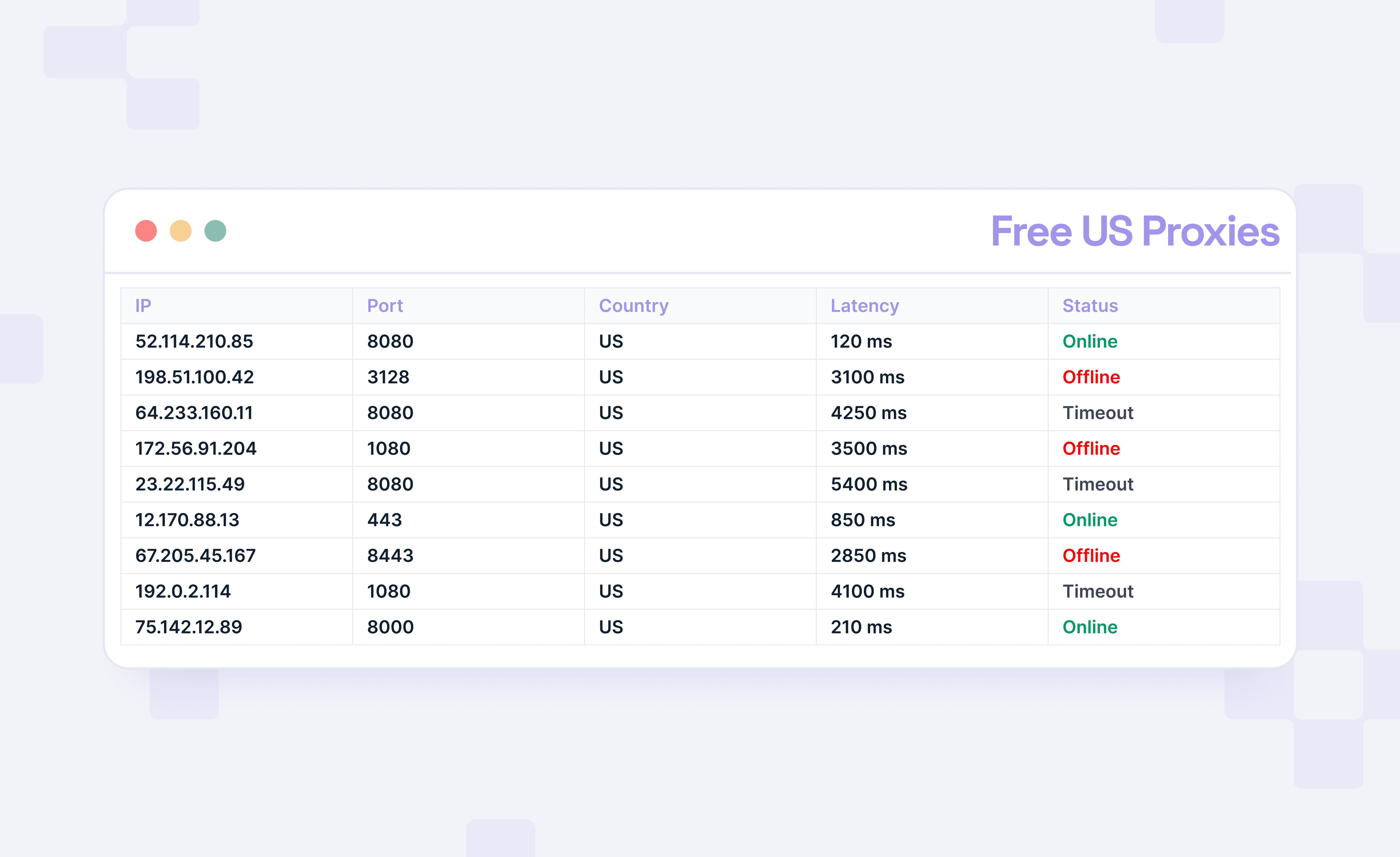
Most public free US proxy lists are seemingly useful. However, their proxies are often expired, overloaded, mislabeled, or gone after a few requests. Still, they can provide value when the proxies are used as temporary resources that don't need to be sustained.
This guide shows you how to find free US proxies, demonstrates how to remove IPs from proxy lists that are non-US, how to identify the right format and protocol, explains ways to check if a proxy is online and is from the US, and if it is functional, and at what point free proxies are not worth the upkeep.
Why use a US proxy IP?
If you're trying to check content that is only available to US users, or you need to see what a US user sees, you should use a US proxy IP. Common use cases:
- Search results and local SERPs in the US
- US pricing, retail drops, and shipping
- US ad verification
- CDN, redirect, app behavior, etc.
- Single-geo QA, then wider regional tests
Free US proxies can help you check whether a page, catalog, redirect, or result set changes for a US IP. Don't consider them a safe way to access streaming services, bypass platform policies, or perform sensitive actions on an account.
Where can you get free US proxies?
The best resource highly depends on how often the same proxy will be used. For a single use case to check a region, a public list can be used. For a frequent need, more reliable lists must be used.
Free proxy lists you can filter to the US
Free proxy lists are either already filtered to the United States or can be narrowed to US proxies with country filters.
No matter which source you use, check the port, protocol, anonymity level, last checked time, speed or timeout, uptime, and export options before copying anything into a tool.
SPYS.ONE
SPYS.ONE's US proxy list is already filtered to United States proxy servers. It shows proxy type, anonymity level, country or city, hostname or organization, latency, speed, uptime, and the latest check date.
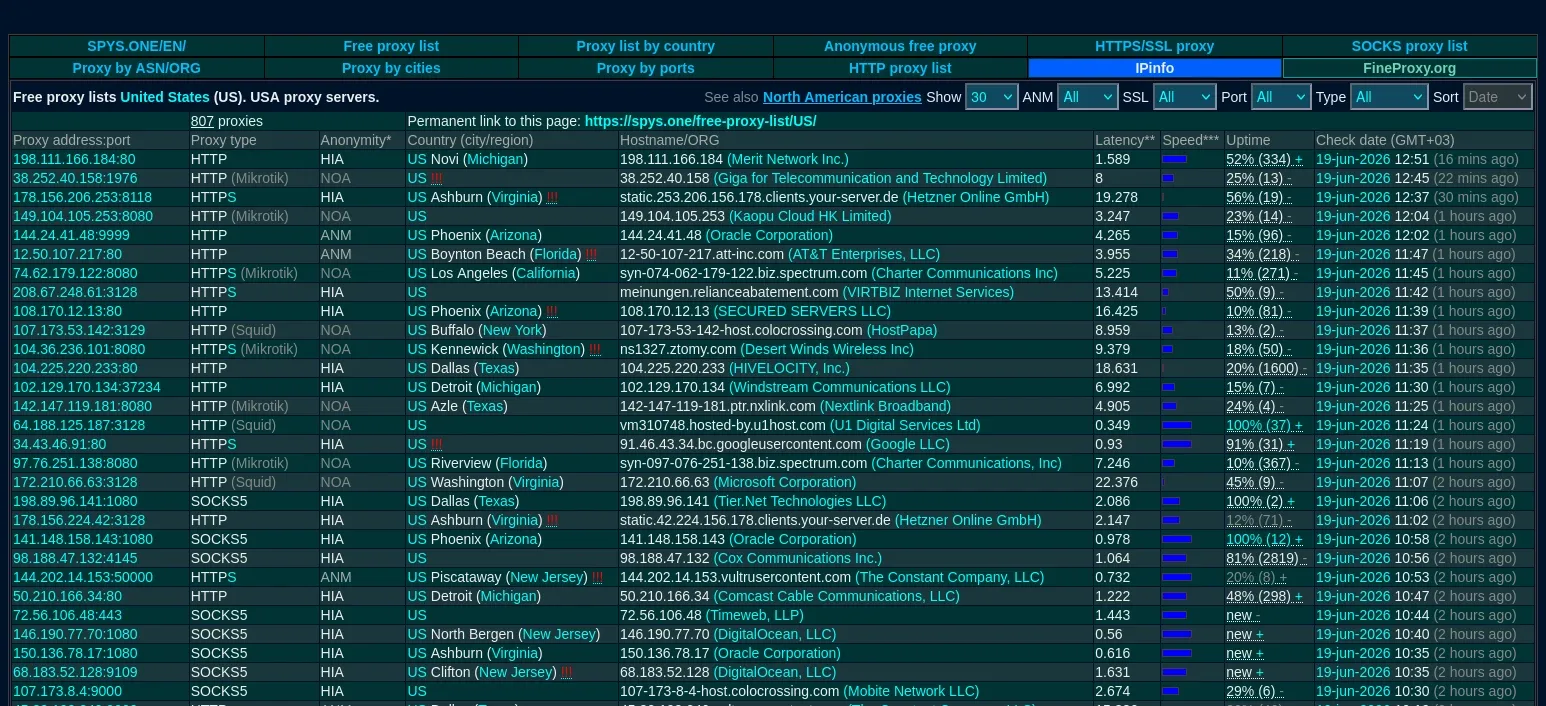
This is a useful quick-check source when you want a US-only table without starting from a global list. Still, treat the results as volatile because public proxies can disappear, slow down, or lose anonymity quickly.
ProxyScrape
ProxyScrape's United States free proxy list is a dedicated US page with support for HTTP, SOCKS4, and SOCKS5 proxies. You can filter by protocol, anonymity, and timeout, then export the list as TXT, JSON, or CSV.
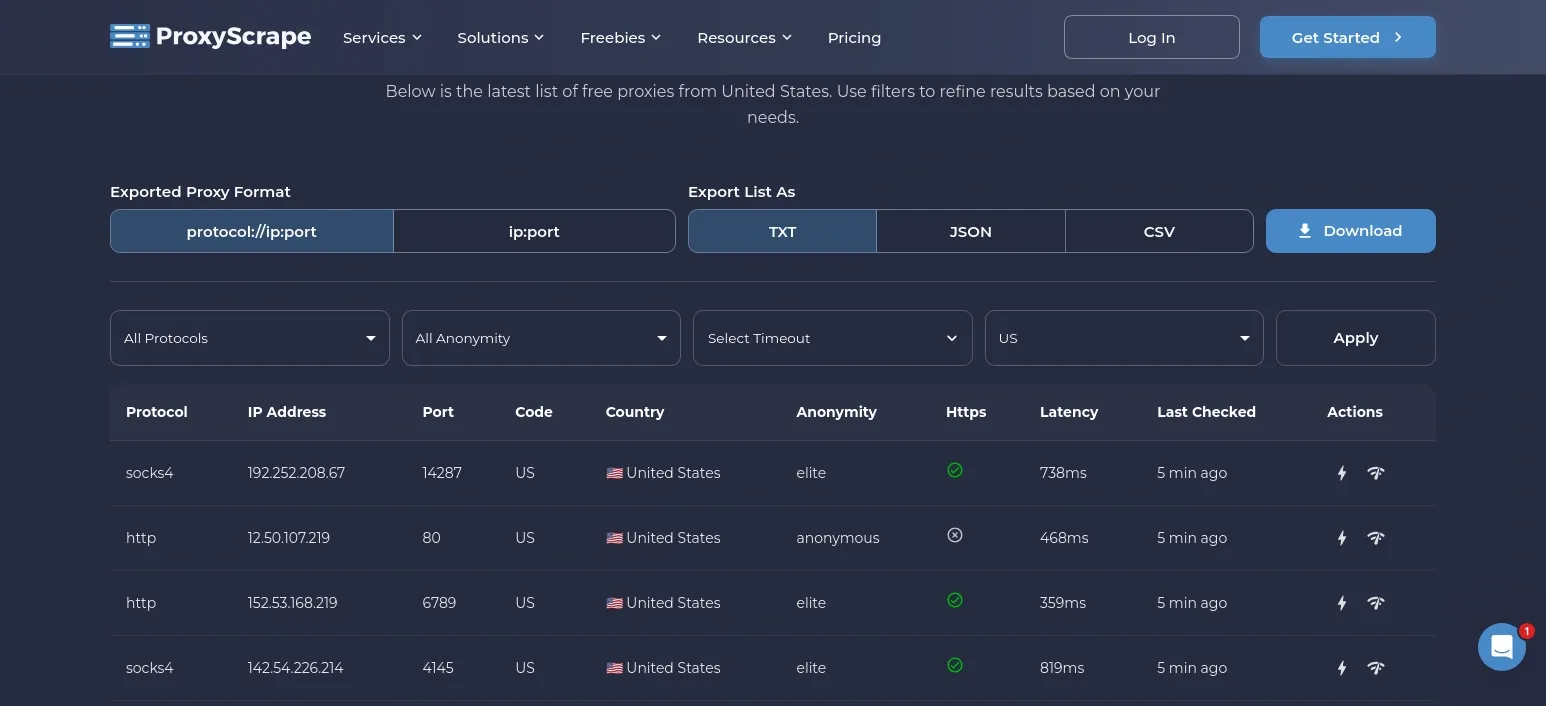
ProxyScrape is also useful if you want to automate pulls because the page exposes an API URL for US proxies. If the page says there are no active US proxies at the moment, check again later or use another source in this section.
On Trustpilot, we see many users reporting good support and quick proxies. However, poor proxies, or poorly filtered, slow, or unreliable proxies, are common topics for users rating ProxyScrape less than 5 stars. These reviews cover ProxyScrape's full service range and are not limited to the free US Proxy list.
Geonode
With Geonode's free proxy list, you can build a custom proxy list using various filters, such as country, type, protocol, anonymous level, speed, uptime, and the time it was checked.
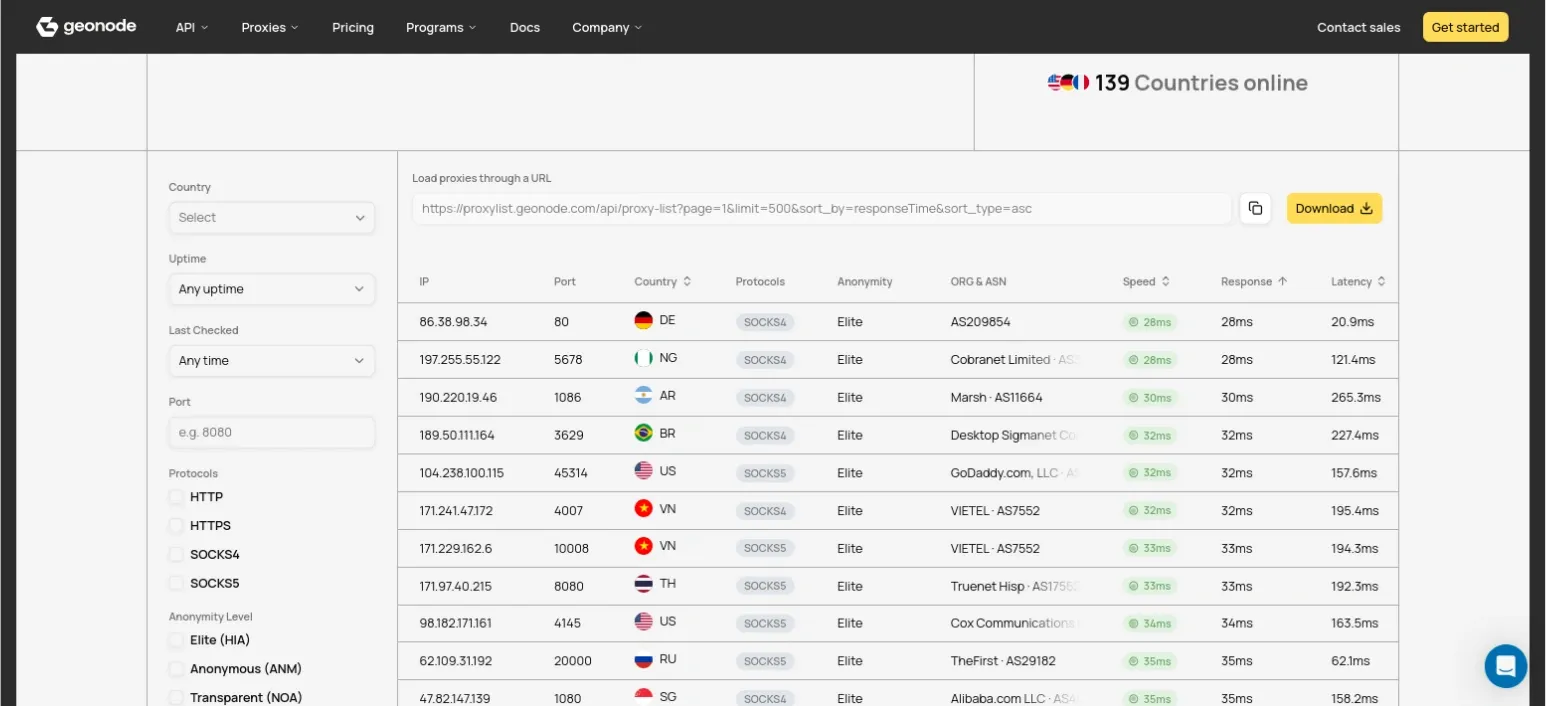
Start by filtering by Country = United States. Next, choose the protocol your tool supports (HTTP, HTTPS, SOCKS4, SOCKS5) and, if possible, filter by elite or high-anonymous proxies.
Next, pick the proxies with the least latency and the highest uptime that were checked most recently. Many users on Trustpilot report reliability, good pricing, support, and a good range of pool IPs as positives. There are a few mentions of bugs in reporting or the dashboard as a watch-out.
NodeMaven
NodeMaven's free proxy list includes filters for country, protocol, type, and max latency. Its table includes fields such as IP, port, country, protocol, type, latency, Google status, and last checked time, with a CSV export option.
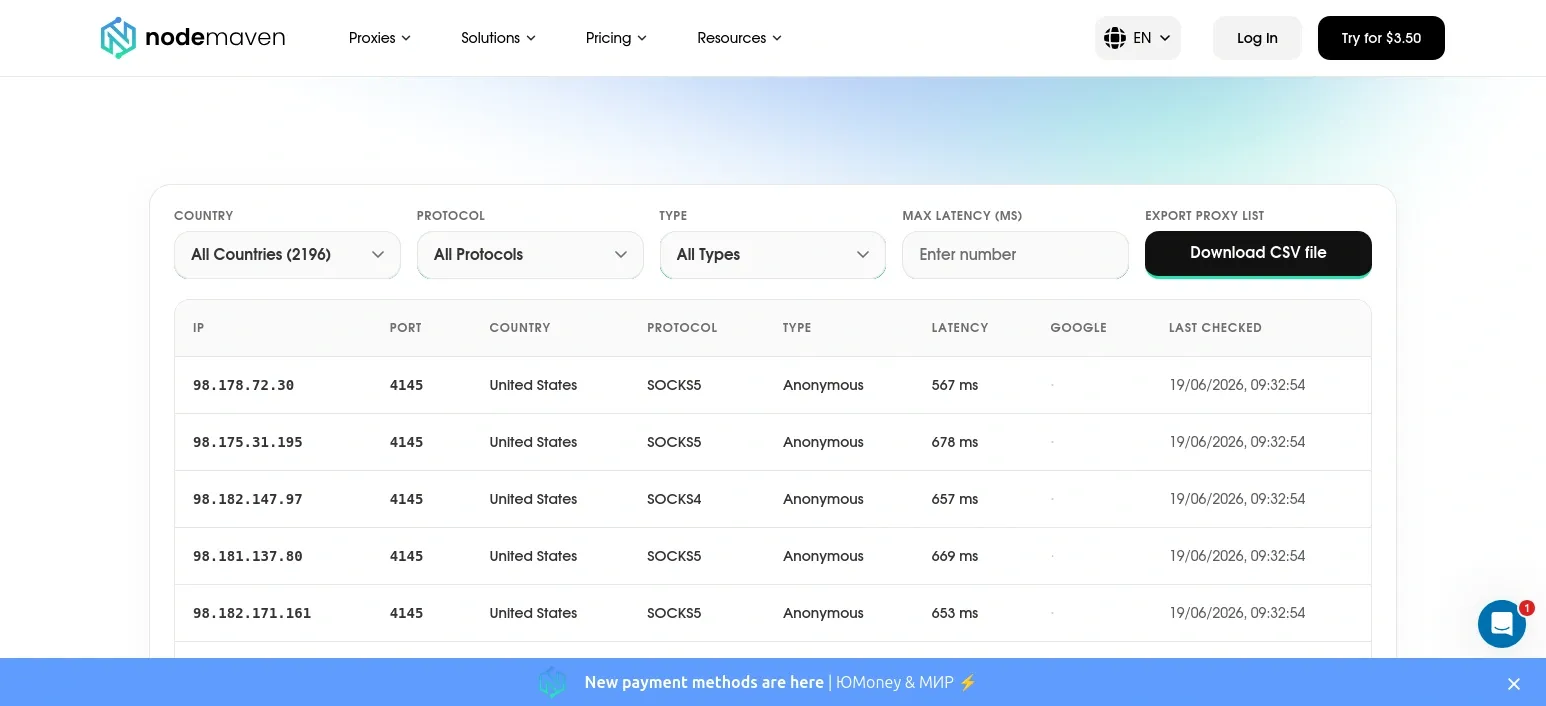
This is useful if you want a cleaner interface for narrowing a public list to US proxies. NodeMaven gathers the public proxies from public sources, so reliability, speed, and anonymity are not guaranteed.
On Trustpilot and G2, the review focus is more on the paid product than the free proxy list. Good and fast proxies, as well as good support and pricing, are common mentions. A common issue is support friction.
ProxyRack
ProxyRack's free proxy list provides free HTTP, HTTPS, and SOCKS proxies, and says its lists are updated every 10 minutes. The free list can include residential and datacenter proxies.
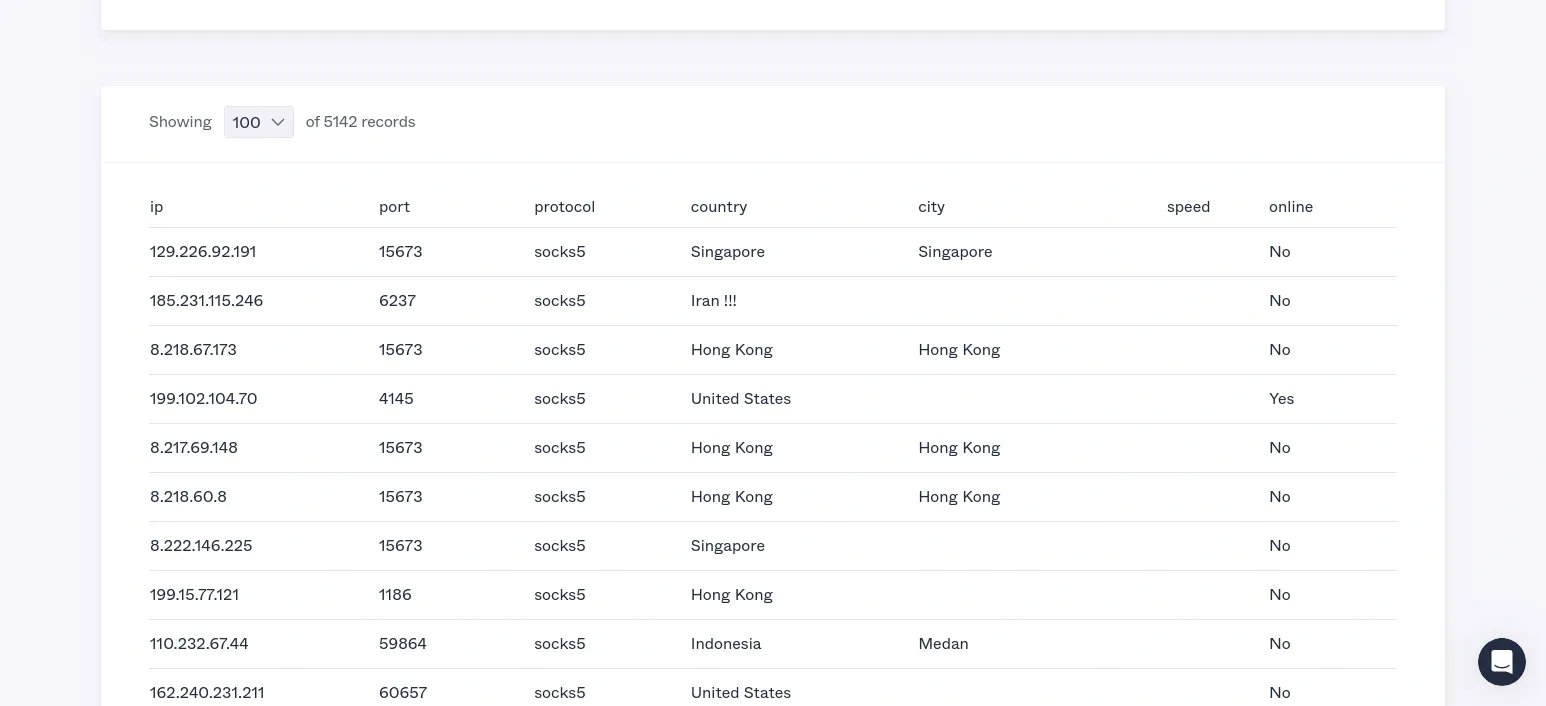
Use ProxyRack as another source to check when you need US proxies across common protocols. If the table is empty or does not show a US result during your session, move to another list and check back later.
On Trustpilot, reliability, stability, and prices for unmetered traffic with good support are big draws. Hard configurations, a slow support response, a bad dashboard, and some stability issues are common watch-outs. These reviews cover ProxyRack as a whole product, not just the free proxy list.
Sockslist.us
Sockslist.us focuses on SOCKS5 proxies and includes a country selector with the United States as an option. Its table shows IP, port, proxy type, anonymity level, country, state, city, ZIP, timezone, and latest update time.
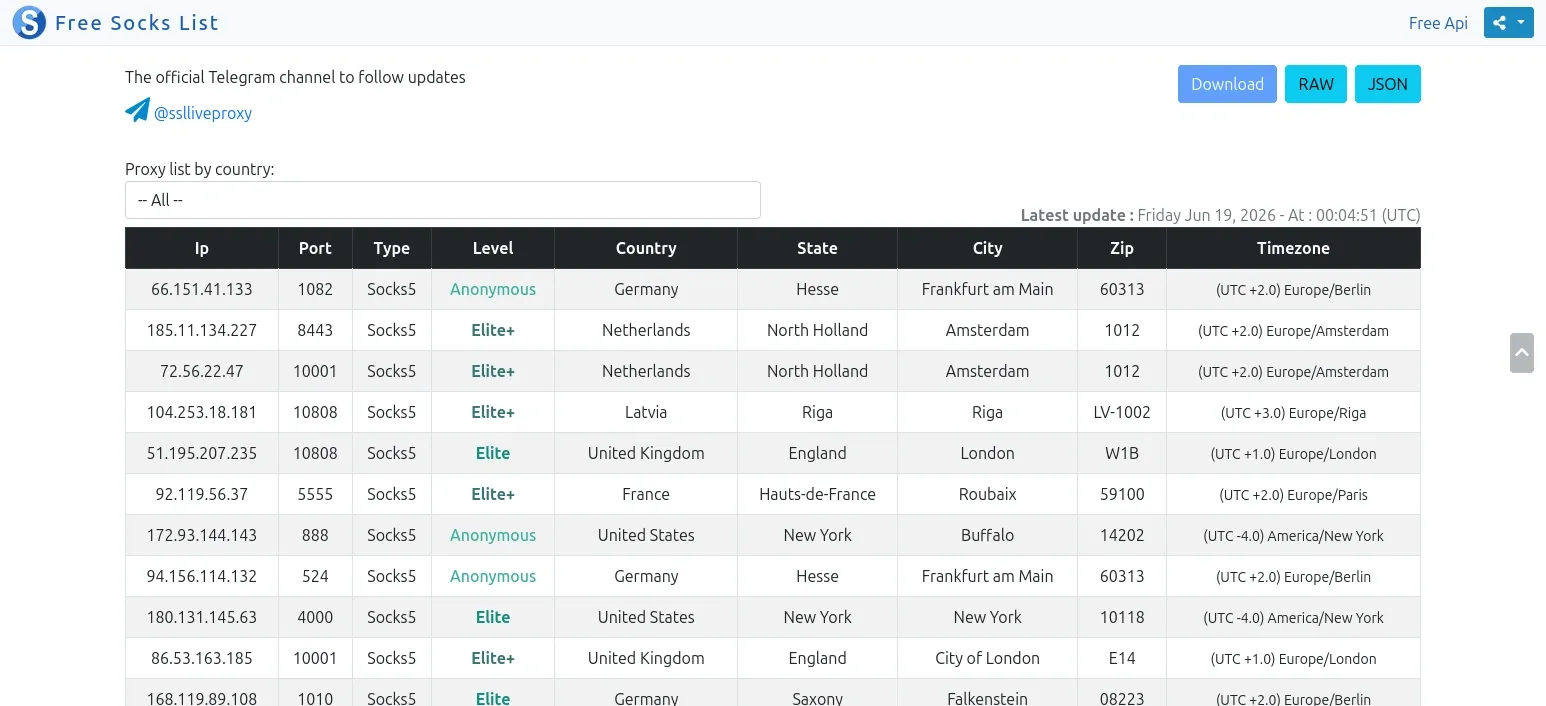
Use this list when your tool specifically needs SOCKS5 rather than HTTP or HTTPS. It also offers RAW and JSON downloads, which can help if you want to test the list in a script.
Public proxy lists are volatile. They get blocked quickly, recycled often, and mislabeled more often than you want. A proxy that worked an hour ago may be dead now.
Developer sources: GitHub lists and APIs
GitHub and API-based lists are handy when you want proxies that you can refresh on a frequent basis. They are easier to get with curl, schedule, and integrate with scripts or proxy rotators. They are also prone to provide TXT, JSON, and CSV exports.
An example is Proxifly's free proxy list on GitHub . This list publishes HTTP(S), SOCKS4, and SOCKS5 proxies, and it sorts the proxies by country and protocol, which means you won't have to do web scraping to get a text file with US proxies.
On its US proxy list, ProxyScrape offers a direct API. This means you can get a US proxy list in the format you want.
The advantage is that this is a repeatable process. The disadvantage is that automation doesn't make public proxies clean. You still need to do a quality check on the proxies before you decide to use them.
Provider free tiers and signup-gated free plans
Provider free tiers are the best starting point. You will end up with a reliable proxy system because providers are making sure their proxies are stable. But they require you to sign up, and there is usually a limit to their use. So, use these plans for validation, not production traffic.
There are differences in provider structures. You can get account-based bandwidth from some providers. Others give you a small pool of datacenters. Some have provider-hosted public lists. For US-related work, always check which exit country you are dealing with before building a workflow based on the plan.
Byteful
For US-focused proxies, the main question is whether the IP looks like real US residential traffic once it reaches the target.
Proxyway's 2026 Proxy Market Research reported that 98.68% of Byteful's tested residential pool was identified as residential on average, with 99.14% in the US pool. That makes Byteful residential proxies a strong fit when your workflow depends on realistic US ISP traffic rather than random public proxy IPs.
You can use Byteful's dashboard to validate connectivity, authentication, targeting, and target response behavior without paying by using the free 1 GB residential trial.
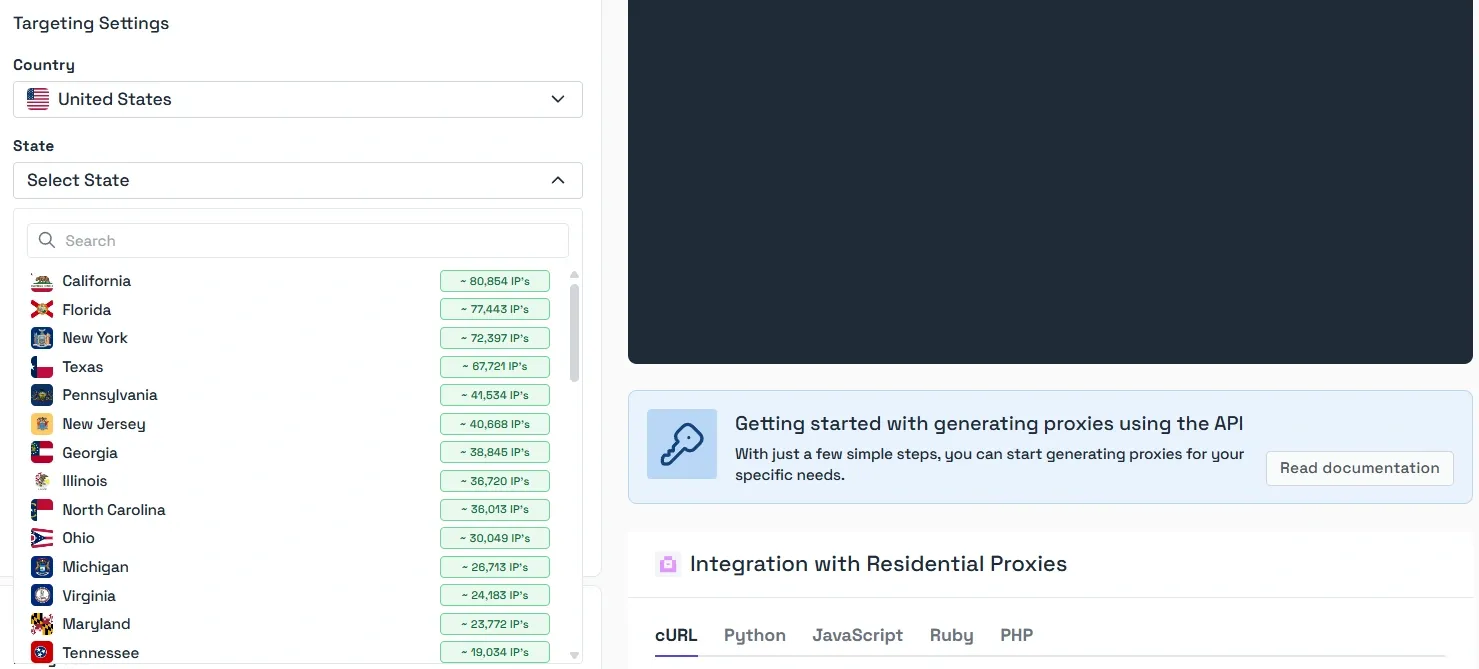
With Byteful, you get 35M+ residential IPs, 195+ locations, use of both HTTP and SOCKS5, automatic IP rotation, sticky sessions, and targeting by country, region, city, or ISP.
Byteful residential proxies help US searches, eCommerce, and ad validation. Use them to help learn if the target response behavior is different from US residential traffic before you pay for traffic.
We also offer the ability to target requests by city, state, zip code, or even ISP, and support rotation. Because of this, Byteful residential proxies are optimal for US SERPs, US pricing, retail tests, and ad verifications where the requests need to appear as if they come from actual US residents.
If the target is stricter or account-heavy, then you can use Byteful mobile proxies, which are better for targeting. For a long-lasting US route identity, use Byteful static residential / ISP proxies. Use Byteful datacenter proxies for low-risk targeting.
Webshare
After signing up for Webshare's free proxy plan you get 10 free proxies with 1GB bandwidth monthly. It is a signup-gated plan that provides HTTP and SOCKS5, dashboard controls, and no credit card is required.
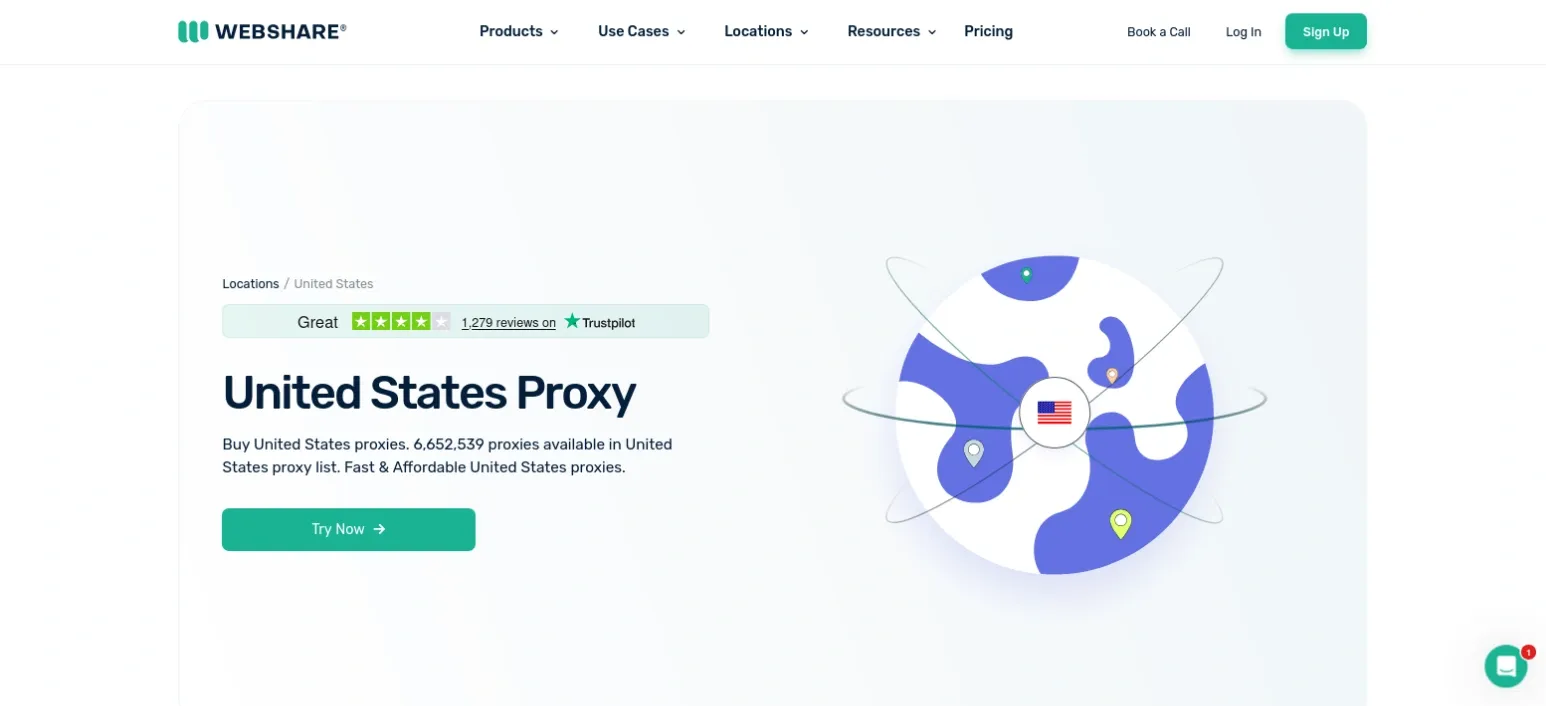
This is useful for simple proxy configurations, small scripts, and testing scenarios that require more consistency than what public proxy lists can offer. Before using this for US QA, verify that your assigned proxies have US exits.
Expect less control, limited bandwidth, and fewer proxies compared to what you may typically see for a paid service.
IPRoyal
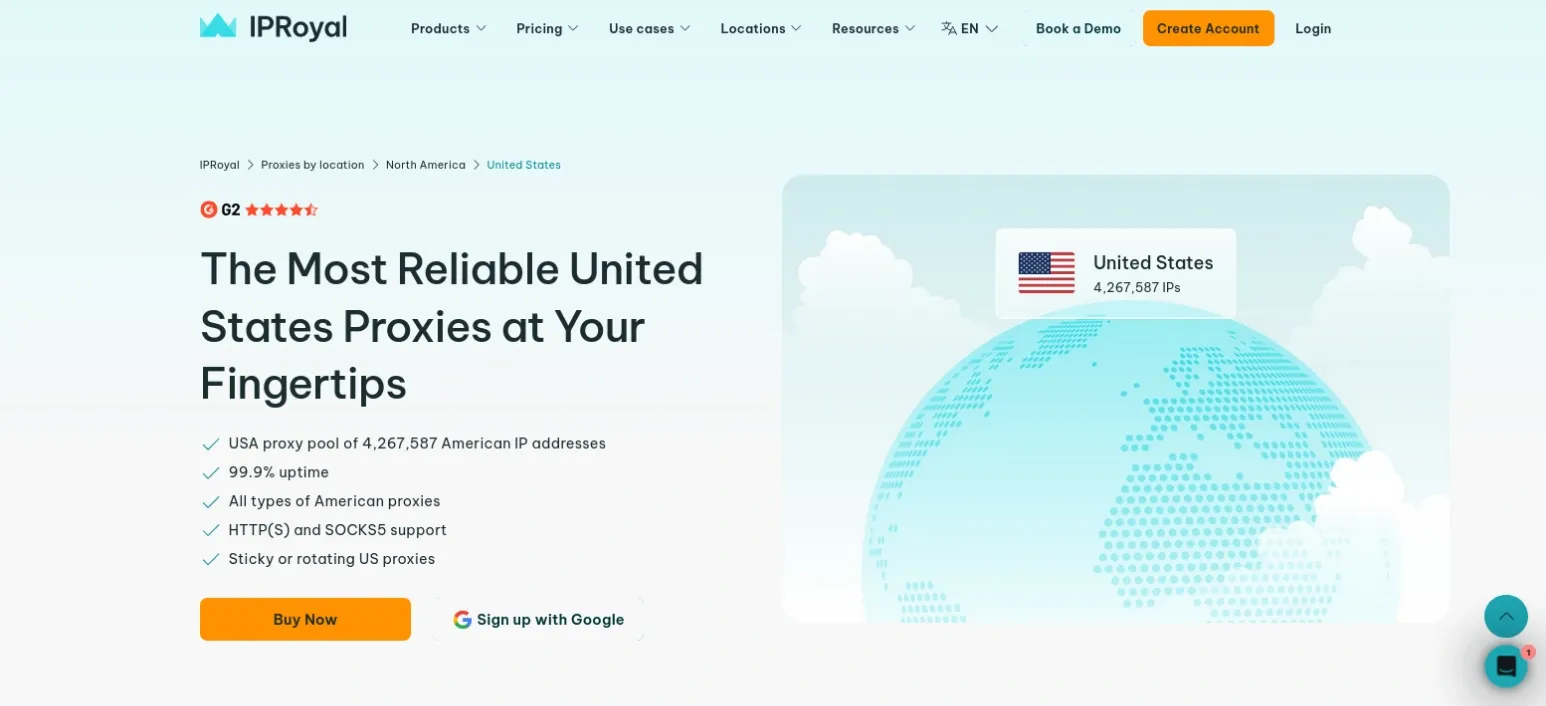
IPRoyal's free proxy list is a hosted public list of proxies rather than an account-based free plan. There are HTTP, HTTPS, and SOCKS proxies, and IPRoyal refreshes the list every 10 minutes. Use it like a public list, not a managed free tier. Trusting any IP in the list requires checking liveness, anonymity, geolocation in the US, and reputation.
How to pull US-only proxies
Before downloading anything, think about what your tool needs. Proxy lists can seem interchangeable, but if a format doesn't match, it can break your scraper, browser profile, proxy rotator, or command line test.
Formats: ip:port vs. protocol://ip:port
The least complex format for a proxy is ip:port:
203.0.113.10:8080A number of tools use ip:port when the protocol is configured elsewhere. Many browser extensions, proxy managers, and scrapers operate like this.
When the list has protocol mixes, use protocol://ip:port:
http://203.0.113.10:8080
socks5://198.51.100.25:1080
The protocol prefix eliminates guesswork and makes tool exports and imports easier.
Protocols and anonymity levels
For standard web requests, use an HTTP proxy. If web requests require encryption, an HTTPS proxy would be appropriate. Most browser clients and scraping tests will suffice with HTTPS and HTTP support.
SOCKS4 and SOCKS5 work at a lower network level, so they can route more types of app traffic. SOCKS5 is the more flexible option because it supports more authentication and traffic patterns than SOCKS4.
Unlike the previously mentioned protocols, the anonymity of a proxy is defined as follows:
- Transparent. Exposes your original IP or is clearly a proxy.
- Anonymous. Hides your original IP but may reveal it is a proxy.
- Elite or high anonymous. Conceals the original IP and doesn't contain proxy-identifying headers.
When it comes to public lists, elite or high-anonymous proxies are the better choice if available. This doesn't guarantee quality, but it's a better starting filter than accepting anything marked "US."
The level of anonymity is only one factor to consider while doing US geo work. The source of the proxy is also important.
For protected US targets or sensitive US account work, Byteful mobile proxies are more appropriate. For lengthy work sessions on ad verifications or US account management, Static residential / ISP proxies would be suitable. Datacenter proxies can serve as a good option for lower-priority US tests where anonymity is less of a concern, but when there is a need to look like an actual US user, they are the weakest option.
Filtering to the US and exporting
Use the following filters in the specified order:
- Country = US.
- Protocol = the protocol your tool supports.
- Anonymity = elite or high anonymous.
- Last checked = recent.
- Latency = low enough for the task.
- Uptime = acceptable for repeat tests.
curl -sL "https://cdn.jsdelivr.net/gh/proxifly/free-proxy-list@main/proxies/countries/US/data.txt" -o us-proxies.txtIf you use an API style source, you can get US filtered proxies using the following command:
curl -sL
"https://api.proxyscrape.com/v4/free-proxy-list/get?request=display_proxies&proxy_format=protocolipport&format=text&country=us" -o us-proxies.txt
Select your preferred format from the table below based on how you will utilize the proxy list:
| Format | Best for | Why it helps |
|---|---|---|
| TXT | Scripts and proxy rotators | The least amount of structure for a list; easiest to input. |
| CSV | Manual sorting and filtering | Works well in spreadsheets when you want to compare columns. |
| JSON | Metadata-heavy workflows | Great for filtered proxy lists, keeping fields like anonymity, latency, country, last checked time, and ASN. |
You should not rely on free proxy lists to still be valid once you have downloaded them. Test them frequently, and remove low-quality proxies.
How do you check if a proxy is really US-based and not dead?
Testing the following criteria will show if you can trust the free US proxy:
- Does it connect?
- Does the exit IP show a US location?
- Does the IP show a poor reputation?
Confirm it’s alive
The Byteful Proxy Tester can check connection status, response time, supported protocols, and timeout behavior. It requests a resource through a proxy and reports the status, latency, geolocation, exit IP, and hostname.
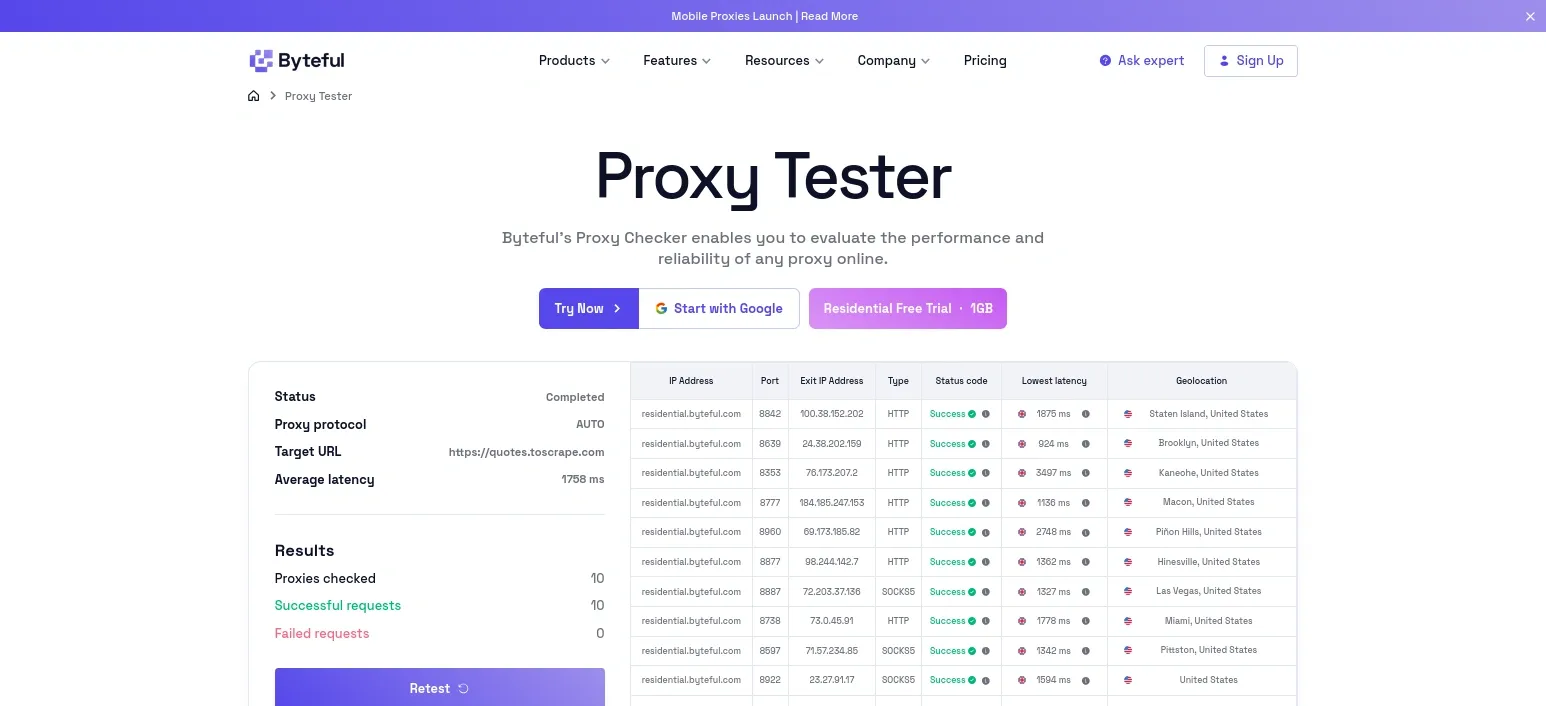
With free proxies, you should test on the resource type you care about. A proxy that can contact a generic IP echo service could easily fail to contact a resource on a retail site, a search result page, or a resource on a guard-app.
Also, pay attention to timeout behavior. A proxy that finally does connect after 30 seconds isn't going to help most automation. Slow is not "working" when your script repeats itself into a block.
Confirm the IP geolocates to the US
Check the country first, and then check the region, state, city, ASN/ISP, and hostname. The ASN will tell you the ISP or the network over which the IP is hosted. This could be a residential ISP, a cloud host, a university, a business line, or something else.
As a simple manual check, you can test a proxy to an IP lookup service by running the following in your terminal:
curl -x http://IP:PORT https://ipinfo.io/jsonReplace IP:PORT with the proxy you're testing. If the proxy is a SOCKS5, use socks5://IP:PORT.
If precise geolocation is important to you, you should also check multiple IP lookup services and check the target directly. The target site's geolocation decision will ultimately determine how your service will operate.
Check it isn’t already blacklisted
A proxy can be alive, US-located, and still have a bad IP reputation. Since public proxies are often reused, many of them have a history of abuse in particular IP, ASN, or subnet.
At a minimum, look at the abuse history, blacklisting, datacenter or residential classification, fraud or risk score, and ASN reputation.
Don't assume paid means clean, and don't assume residential means safe. The quality of the proxy depends on sourcing, controls, and usage history, as well as how the target IP evaluates the proxy. We address these assumptions in our guide to debunking proxy myths.
When should you switch to paid US proxies?
Free proxies are fine for light testing. But they're weak for serious workflows because the public proxy ecosystem is unstable by design.
A 2024 arXiv paper, "Free Proxies Unmasked", studied more than 640,000 free proxies over 30 months and found major issues around instability, vulnerable hosts, and content manipulation. Earlier open-proxy research reached similar conclusions around poor availability and proxy misbehavior.
Free proxies work fine for light testing. However, they're weak for serious workflows. In a 2024 arXiv paper, "Free Proxies Unmasked", more than 640,000 free proxies monitored for public use in the 30 months prior to the paper highlighted the major design weaknesses of free public proxies focused on insecure hosts, unstable proxies, and content manipulation.
Common misbehavior (that will most likely be encountered when using free public proxies):
- Inactive proxies
- High latency
- Unpredictable IP changes
- Misleading geolocation
- Shared abuse history
- CAPTCHAs and blocks
- Traffic inspection or manipulation
- No reliability or support
Paid US proxies are required for session stability, account management, targeting the US by city/state/ZIP, lower blockage, and for higher expected throughput with less variability.
In routing and reliability work, Byteful's Smartpath AI Proxy is applicable when you want to push easier requests away from residential traffic, while keeping the strongest routes available for sensitive targets.
