

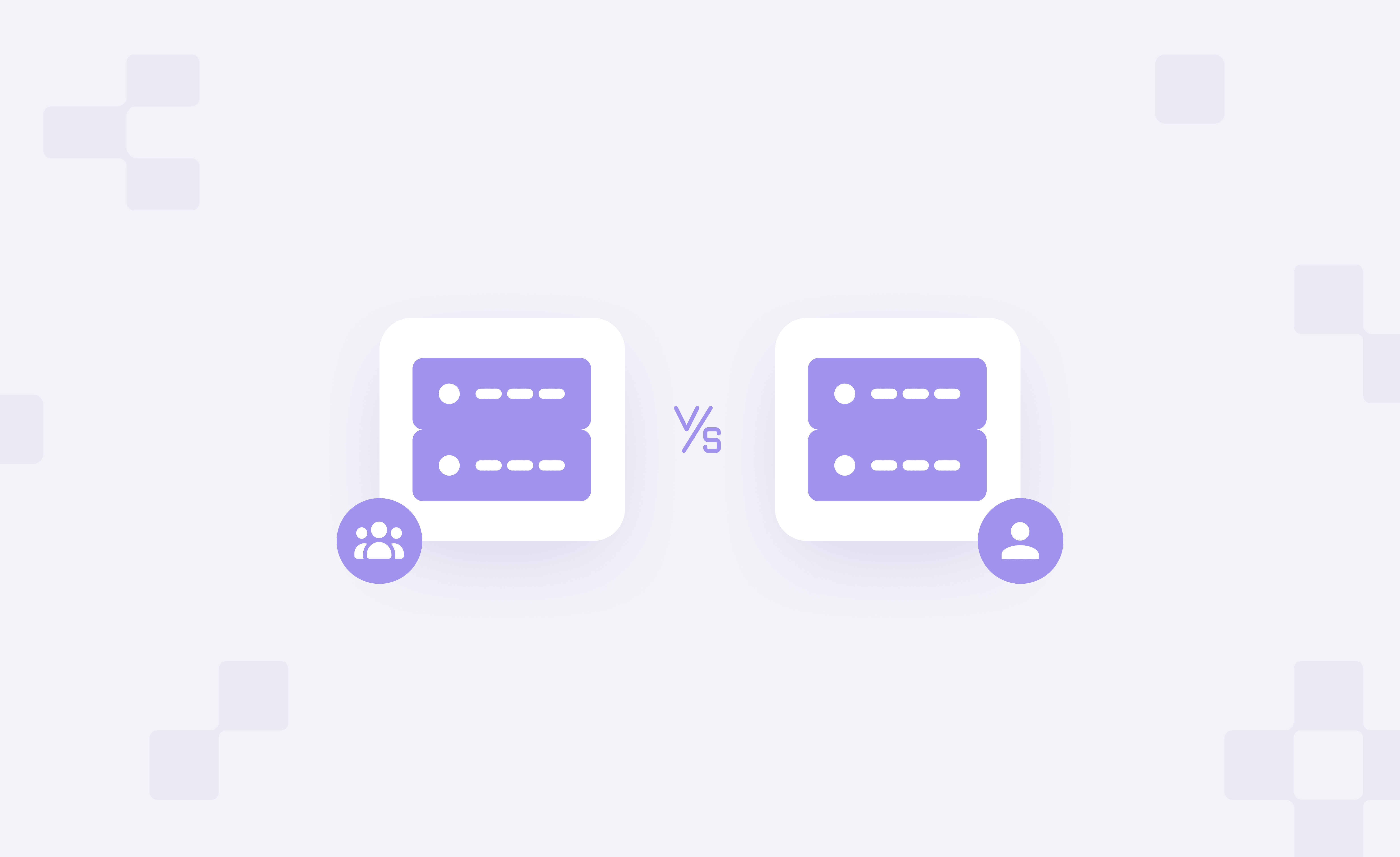
One provider calls an IP "private", while another may describe the same setup as "dedicated." A third provider may call access "semi-dedicated," meaning that just a small group of users shares the same IP. It can get overwhelming just thinking about the different types of IPs.
But what's the right balance between price and how much control you need over an IP, its reputation, and the session behind it?
In this article, we'll break down the differences between dedicated and shared proxies. We'll also discuss how you can use them interchangeably, and what you should avoid while using proxies for scraping, automation, SEO monitoring, research, and account-based workflows.
Shared and dedicated proxies: what's the difference?
A proxy server functions by sending your requests to a specific target by altering your IP address to one of the server's. The key difference between shared and dedicated proxies comes down to who else is sharing the use of the same IP as you.
Shared proxies
Shared proxies give you IPs that are intentionally shared with other users. You are still accessing the provider's network, but your exit IP can also serve requests for other users.
There are two common ways this sharing works: shared pool access and shared static IPs.
With shared pool access, the provider typically has a collection of IPs available, and every request you make is assigned to an IP that is unreserved from that pool. Depending on your chosen service level, the IP may be assigned per request (stickiness), or it may be set to alternate per session or at the time of a reconnect.
With shared static IPs, the IP itself stays fixed, but it is still assigned to more than one user. You may keep the same exit IP over time, while another customer can also use that same IP for their own traffic. So the IP is static from your point of view, but not exclusive.
The main thing contributing to the low cost of a shared proxy is the low cost of the infrastructure shared by many.
Shared proxies are also great because they give you a broad geo-location coverage, especially in rotating residential networks, as they can provide many different locations as opposed to a single static solution.
On the flip side, there is no way to know who used your IP earlier. The previous users of the address assigned to you could potentially cause many different types of problems that are difficult to identify. The target website might already have opinions about that address.
A good provider can manage abuse, pool health, and sourcing quality, but shared access still means that someone else using the same IP irresponsibly can degrade your reputation, too.
Dedicated proxies
On a dedicated proxy, you get exclusive access to a single IP address.
This results in less confusion when debugging. If your IP starts failing, you can investigate your own request instead of wondering whether another customer damaged the address first.
Dedicated IPs are particularly useful for workflows that need a dedicated and persistent IP, such as long-lived sessions, monitoring, and account management.
However, a target can still block you when you pile up too many requests without control - mismatched headers, wrong location tags, strange ASNs, accounts acting out, policy rule breaks.
Dedicated IPs also don't make you immune to subnet bans. If a target blocks a wider IP range, your dedicated IP can be affected even if your own traffic is clean. The same applies to the noisy neighbor problem at the subnet level: other customers may not share your exact IP, but their behavior on nearby IPs can still influence how a target treats your traffic.
Best-fit scenarios for shared proxies
Choose a shared proxy when you expect shorter jobs, minimize costs, or when jobs aren't highly sensitive to IP history. They work in research, checks, short jobs, or during early stages of jobs at scale, since losing a single IP won't break everything.
Budget-first workloads
Use shared proxies to minimize costs and get a better sense of workflow needs in validation jobs, low-intensity research, or when you're testing a scraper.
Picture this: you're setting up a tool to track prices online. First, start with a shared proxy to check how well your tool grabs pages, moves between them, handles errors, and shapes results. There's no need to use dedicated IPs until you know it is the right thing to spend money on.
Here's when the no-cost options start seeming like a good idea. Watch out, though. Unmanaged free proxies often come with unknown sourcing, unstable uptime, and weak abuse controls.
Disposable sessions
Shared pool proxies are a great choice for short-run data checks, one-off validation tasks, public page sampling, and broad discovery jobs that don't need an IP identity to last. The system only cares whether a task is completed.
Target-tolerant environments
Using shared proxies is easier to justify when the target environment doesn't demand a clear-cut single user IP history. You'll see that in internal systems, low-friction public pages, testing environments, or websites that don't treat proxy traffic as suspicious by default.
Most websites are sensitive to bad IP reputation, rapid bursts of activity, or other indicators related to data centers. Others are just concerned that your traffic is reasonable and within the confines of their policies.
Make sure to check the terms and legal requirements every time, because what is allowed will depend on how you are utilizing them. Using a proxy won't let you get around the regulations.
Validation before scaling
One of the most common use cases of shared proxies is proving a workflow is good before you invest in cleaner, more stable IPs. That includes testing whether the target returns the required data, testing to determine if your parser is resilient to structural changes, and whether your request volume is realistic.
Upgrades may not be required if shared proxies end up achieving the desired results. But if certain targets or workflows repeatedly fail, moving just those pieces to dedicated IP addresses often makes more sense than using dedicated proxies for the entire setup.
|
Factor | Shared proxies | Dedicated proxies |
|---|---|---|
| IP access | Multiple customers can use the same exit IP | One customer gets exclusive use of the exit IP |
| Cost |
Lower | Higher |
| Reputation control | Limited, other users can affect the IP history | Higher, your traffic shapes the IP history |
| Performance consistency | Can vary if the pool is busy or poorly managed | Usually more predictable |
| Session stability | Depends on rotation and stickiness settings | Stronger fit for stable sessions and repeat access |
| Troubleshooting | Harder, failures may come from pool behavior | Easier, the IP is tied to your own workload |
| Scaling | Easy to scale broad, low-risk traffic across a large pool | Better for controlled, high-value, or reputation-sensitive traffic |
| Provider dependency | Very high, because pool quality and abuse controls matter | Still high, but exclusivity reduces cross-user risk |
| Main trade-off | Less control | Higher cost |
Best-fit scenarios for shared proxies
Choose a shared proxy when you expect shorter jobs, minimize costs, or when jobs aren't highly sensitive to IP history. They work in research, checks, short jobs, or during early stages of jobs at scale, since losing a single IP won't break everything.
Budget-first workloads
Use shared proxies to minimize costs and get a better sense of workflow needs in validation jobs, low-intensity research, or when you're testing a scraper.
Picture this: you're setting up a tool to track prices online. First, start with a shared proxy to check how well your tool grabs pages, moves between them, handles errors, and shapes results. There's no need to use dedicated IPs until you know it is the right thing to spend money on.
Here's when the no-cost options start seeming like a good idea. Watch out, though. Unmanaged free proxies often come with unknown sourcing, unstable uptime, and weak abuse controls.
Disposable sessions
Shared pool proxies are a great choice for short-run data checks, one-off validation tasks, public page sampling, and broad discovery jobs that don't need an IP identity to last. The system only cares whether a task is completed.
Target-tolerant environments
Using shared proxies is easier to justify when the target environment doesn't demand a clear-cut single user IP history. You'll see that in internal systems, low-friction public pages, testing environments, or websites that don't treat proxy traffic as suspicious by default.
Most websites are sensitive to bad IP reputation, rapid bursts of activity, or other indicators related to data centers. Others are just concerned that your traffic is reasonable and within the confines of their policies.
Make sure to check the terms and legal requirements every time, because what is allowed will depend on how you are utilizing them. Using a proxy won't let you get around the regulations.
Validation before scaling
One of the most common use cases of shared proxies is proving a workflow is good before you invest in cleaner, more stable IPs. That includes testing whether the target returns the required data, testing to determine if your parser is resilient to structural changes, and whether your request volume is realistic.
Upgrades may not be required if shared proxies end up achieving the desired results. But if certain targets or workflows repeatedly fail, moving just those pieces to dedicated IP addresses often makes more sense than using dedicated proxies for the entire setup.
Best-fit scenarios for dedicated proxies
Dedicated proxies make sense when consistent IPs matter more than the size of the pool. You use them when one bad IP can disrupt the workflow, one session needs to stay stable, or you need to assume more responsibility for how your traffic behaves.
They are more expensive, but the extra buy is because the workflow can gain more from it.
Reputation-sensitive tasks
Certain target sites build a history around the IP if it appears multiple times. The issue with a shared proxy is that the history could potentially involve traffic that is not your own.
That's not the case with dedicated proxies. You're not inheriting another customer's scraping bursts, failed logins, or policy violations. That's useful for running accounts, tracking brand mentions, checking search rankings, and confirming ads are live.
Session-heavy workflows
Frequent changes in IP cause disruption in saved logins or dashboards. Multi-step forms fail if your proxy triggers an IP change. Items in a shopping cart are lost if the proxy changes. Time spent on a site is lost if, again, a proxy change.
If you manage multiple accounts across dashboards, marketplaces, research tools, or internal systems, a stable IP helps keep the session behavior consistent and easier to troubleshoot.
Dedicated proxies are a better option here, as it is easier to maintain the same IP on a particular workflow than with a shared one.
Proxy terminology can be a bit confusing, so let's clarify. Shared vs dedicated describes whether other users are on the same IP. Whereas static, sticky, and rotating describe how long your session keeps the same IP.
Predictability-critical operations
If you run the same check every hour, you want to make sure the changes are coming from the target, not your code, or the proxy layer.
A dedicated IP makes the separation clearer. This clarity helps spot delays, failed requests, mismatched replies, or regional mismatches faster.
Accountability and control
With dedicated proxies, if a proxy fails, gets rate-limited, or starts rolling over into CAPTCHAs, you can associate that behavior with your workload.
That makes debugging quicker. You may isolate proxies and assign each to a different task or even assign different proxies to different customers, jobs, or even different regions. You may even isolate your production and testing traffic such that one experiment may not disrupt a priority workflow.
Can shared and dedicated proxies be used together?
Not everything is so neatly categorized. Instead, the real demands can be met by the right combination of dedicated and shared proxies. And that is where efficiency hides.
Think of a public data scraping pipeline. You would be able to discover data relatively easily with shared residential IPs, but if you want more consistent access with fewer proxies to scrape or monitor a small number of pages, you would want dedicated proxies. The flexible and the sensitive layers serve very different and specific requirements.
Shared for scale, dedicated for sensitive tasks
Shared proxies are useful when you need to reach many pages from many different locations. Dedicated proxies are useful when the workflow has higher consequences: recurring access, accounts you own, stable monitoring, or targets where IP history matters.
Splitting the two keeps costs under control. You don't reserve premium IPs for low-value traffic, and you don't send sensitive sessions through a pool you cannot fully control.
Testing with shared, stabilizing with dedicated
Start with shared proxies. Test whether the workflow is worth running, what response patterns look like, and where the real constraints appear.
Once the workflow proves itself, move the delicate parts to dedicated proxies. That might be a specific geography, a specific target, or a specific login-based process. You avoid overspending early, then stabilize the sections that deserve it.
Splitting proxy types by workflow stage
Each workflow stage can dictate proxy choice.
Since there are low-cost shared proxies with rotating IPs, experimenting is relatively inexpensive. Based on the sensitivity of the target and the required rotation, there are dedicated proxies that can be used for data collection. Validation and access use cases are then time-sensitive activities that eventually require dedicated proxies.
Shared for discovery, dedicated for logged-in activity
Logged-in activity assumes you own or are authorized to use the account. Many platforms treat sudden IP changes, geography jumps, and inconsistent session behavior as risk signals.
Shared proxies can still help with non-authenticated discovery around the same workflow. But once cookies, account state, or long-lived sessions enter the picture, dedicated IPs reduce the chance of a failure.
Shared for broad coverage, dedicated for priority targets
A well-managed shared IP pool gives you the flexibility to sample many public pages or regions.
On the other hand, if 10 targets matter more than 10,000 low-value pages, those priority targets may deserve dedicated IP, tighter rate limits, and separate monitoring.
For wide regional distribution, residential proxies are optimal proxy solutions for target pages that are likely to filter datacenter traffic.
Matching proxy type to risk level
The rule is simple: match proxy cost and control to the risk of failure.
When a failed request is cheap, shared proxies can be enough. When a failed session causes lost data, account friction, broken reporting, or need a manual cleanup, dedicated proxies are easier to justify.
Choosing shared vs dedicated proxies: mistakes to avoid
Most mistakes happen when you focus only on one thing at a time. Sure, it all comes down to cost. But what really shapes results is who you buy from, how sessions act, whether tools show clear data, and if websites accept automated visits. The proxy reputation plays its part too.
Bad picks often come from these errors:
- Choosing based on price alone. Shared proxies can be cheaper, but failed jobs, retries, and manual cleanup also have a cost. Dedicated proxies can be expensive, but they may reduce the operational cost and improve stability.
- Ignoring IP reputation. An IP address carries a reputation from past activities. With shared proxies, you inherit the reputation of other users. With dedicated IPs, the reputation is easier to own.
- Using one type for every task. Different tasks don't all have the same proxy needs. Split the work by risk and stability requirements.
- Overlooking session needs. If your workflow depends on cookies, repeated access, or a stable account state, proxy rotation can cause more trouble than it solves. Dedicated or sticky setups are usually a better fit.
- Assuming dedicated is always better. Shared or rotating proxies work better for wide geographic coverage, frequent IP changes, or low-cost testing.
- Assuming shared means low quality. Shared access can work well when the provider manages sourcing, abuse prevention, capacity, and pool health properly.
- Comparing specs instead of outcomes. Things like coverage, IP count, and bandwidth help, but they aren't everything. Check your workflow for latency, error patterns, and stability and success rates of your sessions.
- Judging proxy type without judging provider quality. Provider quality determines whether shared access is well managed and whether dedicated IPs are clean, stable, and supported. Look for ethical sourcing, transparency, status visibility, and usable management tools. We maintain a public network status page and support ethically-sourced proxies. We also believe responsible sourcing is important.