

Public and private proxies can create expensive confusion for new buyers, because there's no single, standardized definition of what "public" and "private" actually mean. Pick the wrong one and the price is real: banned accounts, leaked data, or money spent on something you never needed.
The only difference that really matters is who controls access to the proxy. This guide will show you the true definition of public and private proxies, how they differ in cost, reliability, IP reputation, and security, and which will actually fit better when it comes to what you are trying to do.
Private vs public proxies: What's the real difference?
The true difference is narrowed down to one thing: access. There are no gatekeepers or costs; anyone can connect to it without a login. Private means access controlled by a provider, which allows only you or a small group of approved users to send traffic through it (that is what you actually pay for). That one fact drives speed, security, and ban risk.
| Public proxy | Private proxy | |
|---|---|---|
| Who can use it | Anyone with the IP and port | Only you or approved users |
| Cost | Free | Paid |
| Reliability/Uptime | Unpredictable and uncertain | Stable, monitored |
| IP reputation/Ban risk | High, abused by many | Low, controlled access |
| Security | None, traffic can be watched | Authenticated, provider-managed |
| Support | None | Provider support |
What is a public proxy?
A public proxy is a free, open proxy server that anyone can connect to. Those are the IPs from public proxy lists: scraped, posted in bulk, and used by many people at the same time. No sign-up, no payment, which is precisely the reason budget users reach for them.
That openness is also the issue. It is shared by everyone because that same IP was probably already flagged on all the sites you care about, and nobody really keeps it alive, so that connection fails in a few hours. Most free proxy lists are unmaintained and unencrypted, so the server operator can often see the traffic passing through. They suit trivial, throwaway tasks and little else.
What is a private proxy?
A private proxy is one where access is controlled by a provider. Access comes either as a dedicated IP only you use, or shared (also semi-dedicated), where a handful of vetted users share it. This reduces the bad-neighbor problem of someone else's abuse damaging the IP's reputation and you inheriting it, since you control who uses that IP.
Here's the bit that virtually every comparison article gets wrong: "private" is about access, not where the IP originates from. Those are two separate questions. This source can be any of these, and each becomes private when a provider controls who uses it:
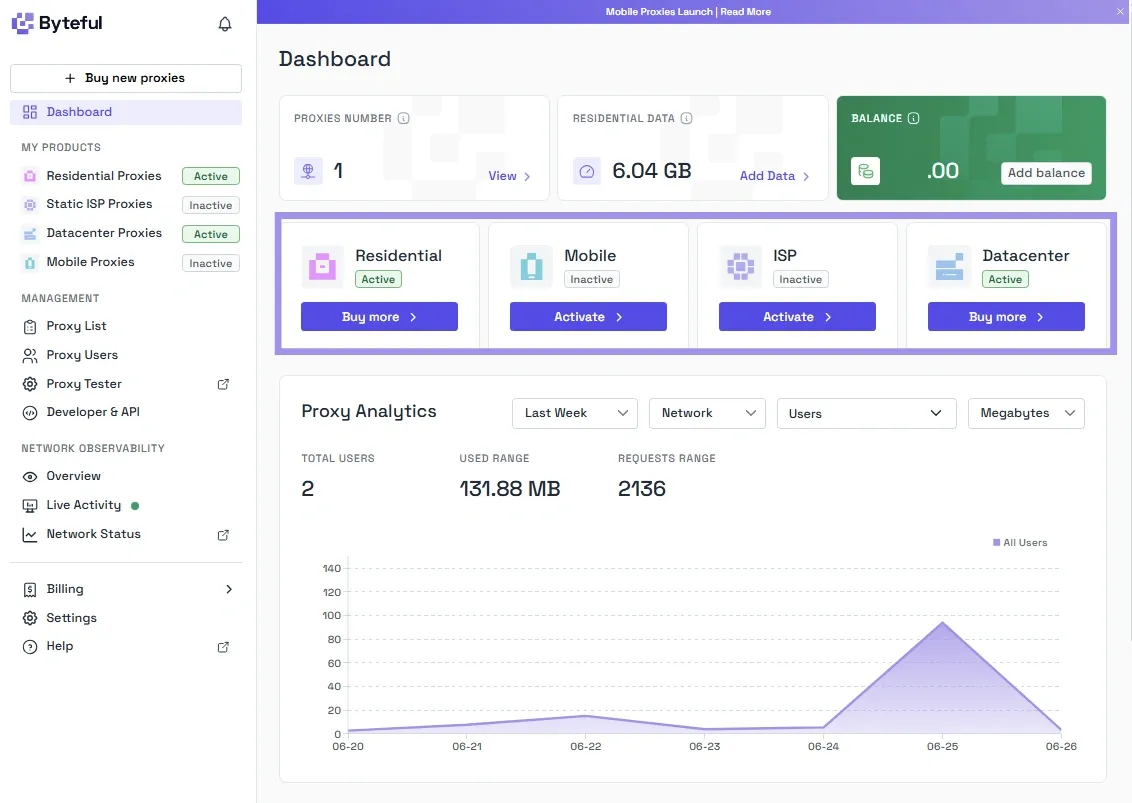
- Datacenter IPs are pooled between different server farms and assigned only to you or a few selected people. Quick and affordable; however, simpler for sites to track.
- ISP proxies are datacenter-hosted IPs, but registered to a real internet provider, so they appear residential, while staying stable and private to you.
- Residential IPs are actual home IP addresses obtained and distributed with the owner's agreement through a controlling provider, bringing in the ultimate trust and making ot best fit for a private proxy.
- Mobile IPs are from mobile carriers, rotated and managed by the provider. Due to CGNAT, they are often less likely to be flagged, making them fit as private proxies.
Confusing the two is how people buy the wrong thing, paying for a "private" datacenter IP when the task actually needed a residential one. Choosing between these sources and between dedicated and shared is a separate decision we cover in our guide to the best private proxy providers. If you want to try private proxies, Byteful’s free 1GB residential bandwidth can be a great way to start.
Which proxy should you use: Private or Public?
In real terms, most of the time, the answer is a private proxy. The reason is what changes, and the level of how much the choice matters is what a factor will tell you.
For account management, social profiles, or multi-accounting, the deciding factor is IP reputation: a clean IP that won't get your account flagged for a stranger's activity, which is why mobile and ISP addresses are common picks here. For scraping, its reliability, since a public IP that dies mid-job costs you the whole run.
It's worth understanding how providers measure and protect their reputation. If privacy is your goal, a private proxy hides your real IP from the destination website, but it doesn't encrypt your traffic. If you need encrypted traffic, well, that's a job for a VPN. For anything commercial, private is the default, since one banned account or data leak has greater costs than years' worth of free list "savings".
Is it ever okay to use a public proxy?
Yes, but the opportunities are limited. A public proxy is okay for something non-critical and totally throwaway, a fast geo-check, a one-shot test, or just dabbling in ways to use public proxies. Because the task isn't sensitive, the practical risk is much lower.
Never put one on a login, an account, a payment, a scrape job, or anything of significance. And the very same openness that allows you to use a public proxy for free is what enables its operator to spy on your traffic and gives access to other people's bans. The moment it matters, free is no longer free.
That's the gap a private provider fills, and why sourcing matters. There are lots of providers that advertise "ethical" IPs, but the market has a real problem with addresses taken from people's devices without consent, sometimes through malware. One 30-month academic study of free proxy services found thousands of exploited devices and proxies that actively tampered with user traffic.
Here at Byteful, we have built our proxy pools with KYC-verified, consented-to, and screened IPs to lower the impact of bad-neighbor issues. We are also a member of the Internet Watch Foundation (IWF).
That discipline shows up in independent testing. In Proxyway's 2026 Proxy Market Research, a benchmark of 13 providers, our residential network posted the fastest global response time at 0.41 seconds against a 0.93-second median, the highest target success rate at 81.23%, and a 99.69% infrastructure success rate.
On cleanliness, third-party tools flagged just 37.09% of our residential IPs at a 2.61 risk score, cleaner than most of the field. A 1 GB free trial lets you test how the network performs in your own workflow. Those proxies also support SmartPath AI routing, which sends non-essential requests through datacenter IPs to cut the residential traffic you spend, a cost optimizer rather than a success-rate booster.
